IAR-823
Romanian civil and military trainer aircraft, built from 1974 until 1983, used for primary flight training. Key figures: top speed 310 km/h, range 1,800 km, service ceiling 5,600 m, max takeoff weight 1,500 kg, built 80.
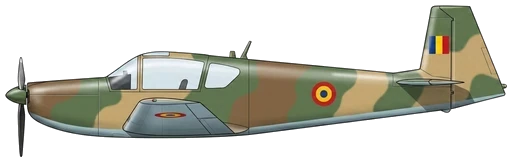
| Crew | 2 (pilot, instructor) |
| Length | 8.2 m (27.0 ft) |
| Wingspan | 10 m (32.8 ft) |
| Height | 2.5 m (8.3 ft) |
| Wing area | 15 m² (161.5 sqft) |
| Empty weight | 900 kg (1,984 lbs) |
| Max. takeoff weight | 1,500 kg (3,307 lbs) |
| Powerplant | 1 × Lycoming IO-540-G1D5 216 kW each |
| Maximum speed | 310 km/h (193 mph) |
| Operational range | 1,800 km (1,118 mi) |
| Endurance | 6 hours |
| Service ceiling | 5,600 m (18,373 ft) |
| Climb rate | 7.49 m/s (24.6 ft/s) |
Description
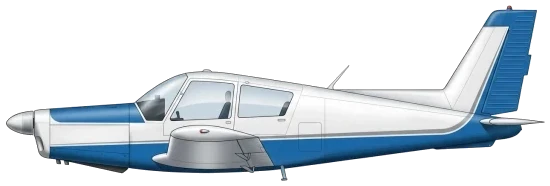
The IAR-823 is a Romanian civil and military primary trainer designed under the leadership of Radu Manicatide. The design was completed in 1970 at IMFCA Bucharest, and construction of the prototype began in autumn 1971 at ICA Brasov. The prototype first flew on June 10, 1973, and initial deliveries commenced in 1974. Production continued until 1983, with a total of 80 aircraft built to replace the IAR-813 in Romanian Air Force service.
Design
The aircraft is designed as a conventional low-wing monoplane featuring a retractable tricycle undercarriage. It is configured with side-by-side seating for a student and instructor, with space for three additional rear seats. Alternative cabin configurations support either one pilot, a stretcher, and a paramedic, or one pilot and 500 kg of cargo. Over its production run, design changes included a transition from a tubular canopy to an all-fiberglass canopy, and a transition from a three-piece instrument panel to a single-piece slide-out unit. While not designed for combat, the aircraft features two underwing hardpoints, each stressed for 100 kg, allowing a maximum external payload of 200 kg.
Operational History
The Romanian Air Force was the primary operator of the type, initially assigning the aircraft to the 20th Regiment at Boboc and subsequently transferring some to the 19th Regiment at Focsani. The type was grounded around 1995-1996 due to budget constraints, the domestic unavailability of its required fuel (which had to be imported from Greece), and the mid-1980s introduction of the cheaper-to-operate Yak-52. Surplus airframes were stored at Brasov before being sold; 10 were purchased by a private US customer in 1999, followed by 36 more in 2000, and six were sold to the Romanian Air Club in 2004.
In 1980, Angola ordered 12 IAR-823 aircraft, which were deployed to Negage in 1981 to support the 188th National Military Aviation School (ENAM). These aircraft were used exclusively for training and did not fly combat missions. Following the cancellation of the Romanian instructor contract in 1983, the remaining aircraft were transferred to the Angolan Air Force. Other operators of the type have included the Hungarian Aeronautical Association, which acquired four aircraft from the United States, and the International Test Pilots School in Canada, which operated a single aircraft. During its operational lifespan, the type suffered four fatal crashes, including one in Angola on July 6, 1981.
Frequently Asked Questions
What type of aircraft is the IAR-823?
What is the maximum speed of the IAR-823?
What is the range of the IAR-823?
When did the IAR-823 first fly?
How many IAR-823 have been built?
Which countries operate the IAR-823?
What is the service ceiling of the IAR-823?
- JUL 12026 Created Page created: IAR-823