Karayel
Turkish tactical reconnaissance and combat unmanned aerial vehicle, developed in the 2010s and deployed for surveillance and precision strike operations. Key figures: top speed 150 km/h, range 150 km, service ceiling 5,486 m, max takeoff weight 630 kg.
| Length | 6.5 m (21.3 ft) |
| Wingspan | 13 m (42.7 ft) |
| Height | 2.1 m (6.9 ft) |
| Max. takeoff weight | 630 kg (1,389 lbs) |
| Maximum speed | 150 km/h (93 mph) |
| Operational range | 150 km (93 mi) |
| Endurance | 20 hours |
| Service ceiling | 5,486 m (17,999 ft) |
| Climb rate | 13.3 m/s (43.6 ft/s) |
- Anti-Tank L-UMTAS
- Air-to-Surface Roketsan Cirit
- Air-to-Surface TUBITAK-SAGE Bozok
- Anti-Tank MAM-L
- Air-to-Surface MAM-C
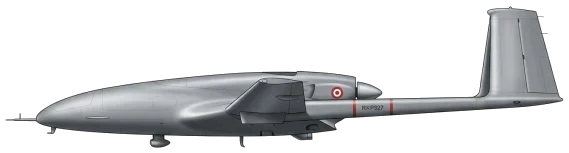
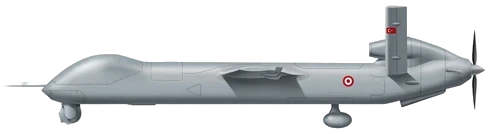
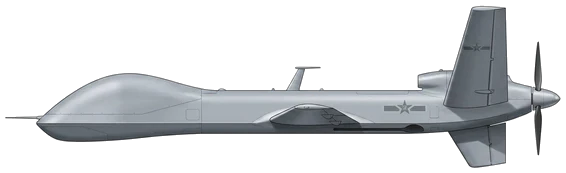
Description
The Vestel Karayel is an unmanned aerial vehicle (UAV) developed by Vestel Savunma (later renamed Lentatek). Designed in accordance with the NATO STANAG 4671 airworthiness standard, the aircraft features a composite airframe with an aluminum network grid for lightning protection and an automatic de-icing system. The system's architecture utilizes a triple-redundant distributed avionics design. The base platform measures 6.5 meters in length with a 10.5-meter wingspan, and is powered by a 72 kW (97 hp) engine driving a single-blade propeller. It has a maximum takeoff weight of 550 kg, an endurance of 20 hours, and a service ceiling of 6,900 meters. The sensor payload consists of a camera system for day and night target detection, alongside laser sensors for target marking, lighting, and ammunition direction.
Armament
The Karayel-SU is an armed, extended-wing variant with a 13-meter wingspan and a maximum takeoff weight of 630 kg. It features two hardpoints under each wing, with each hardpoint capable of carrying 30 kg, for a total wing payload capacity of 120 kg. It also retains a 50 kg fuselage payload bay for electro-optical/infrared (EO/IR) systems. Underwing hardpoints can carry munitions or non-lethal payloads. Compatible armaments include L-UMTAS anti-tank missiles, MAM-C and MAM-L precision-guided munitions, Roketsan Cirit 70 mm missiles, TUBITAK-SAGE Bozok laser-guided rockets, and TUBITAK-SAGE TOGAN 81 mm mortar munitions. The Karayel-SU has an operational altitude of 18,000 feet, a data link range exceeding 150 km, and an airborne endurance of 20 hours without ammunition, 12 hours with a 60 kg load, and 8 hours with a 120 kg load.
Operational History
The aircraft is operated by the Turkish Armed Forces, which holds 10 Karayel-SU-TUAV-SOTM units, and the Armed Forces of Saudi Arabia, which operates six units with plans to deploy an additional 40 over a five-year period starting in 2021. During the Saudi-led intervention in Yemen, Houthi forces shot down several Saudi Karayel UAVs: two on December 31, 2019 (in the Razih district and Hodeidah), one on January 6, 2021 (in Al-Jawf province), one on March 7, 2021 (in Al-Jawf province), and one on May 21, 2022 (in Hajjah governorate). Export prospects include Hungary, which conducted flight tests at Pápa Air Base in November 2021 with plans for joint German-Turkish-Hungarian production in Békéscsaba. Kosovo also planned a procurement of three Karayel-SU drones and associated munitions under a government-to-government agreement with Turkey.
Variants
- Karayel-SU: An armed variant featuring a 13-meter wingspan, four underwing hardpoints with a total capacity of 120 kg, and a 50 kg fuselage payload bay.
- DEV-KU-18 SATCOM Karayel: A variant integrated with a DEV-KU-18 SATCOM On-The-Move terminal.
- DEV-KA-12 SATCOM Karayel: A variant integrated with a DEV-KA-12 SATCOM On-The-Move terminal.
Frequently Asked Questions
What type of aircraft is the Karayel?
What is the maximum speed of the Karayel?
What is the range of the Karayel?
Which countries operate the Karayel?
What is the service ceiling of the Karayel?
- JUL 62026 Created Page created: Karayel