KC-46 Pegasus
Summary
| Category | Military Transport Aircraft |
| Origin country | 🇺🇸 United States |
| Manufacturer | Boeing |
| First flight | 28 December 2014 |
| Year introduced | 2019 |
| Number produced | 108 units |
| Average unit price | $287 million |
Technical specifications
| Version: KC-46A | |
|---|---|
| Crew | 3 (2 pilots, 1 boom operator) |
| Operational range | 11,830 km (7,351 mi) |
| Maximum speed | 914 km/h (568 mph) |
| Wingspan | 48.1 m (157.8 ft) |
| Height | 15.9 m (52.2 ft) |
| Length | 50.5 m (165.7 ft) |
| Service ceiling | 12,200 m (40,026 ft) |
| Empty weight | 82,377 kg (181,610 lbs) |
| Max. takeoff weight | 188,240 kg (414,998 lbs) |
| Powerplant | 2 x Pratt & Whitney PW4062 delivering 280 kN each |
Current operating countries
| Country | Units | ||
|---|---|---|---|

|
United States | 100 (+79) | |

|
Japan | 6 (+9) | |

|
Israel | 2 (+4) | |
All operators
Description
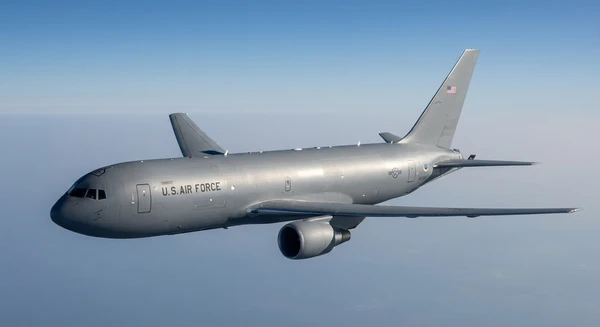
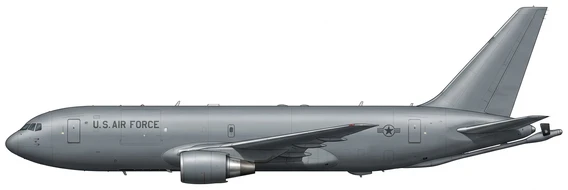
The Boeing KC-46 Pegasus is a military aerial refueling and strategic transport aircraft developed from the 767 airliner. In February 2011, the United States Air Force (USAF) selected Boeing as the winner of the KC-X competition to replace the KC-135 Stratotanker. The first airframe, a 767-2C, conducted its first flight on December 28, 2014. The program received Milestone C approval in August 2016. The USAF took delivery of the first aircraft in January 2019 and intends to procure up to 188 units under the original contract, with potential expansion to 288 aircraft.
The KC-46 airframe combines a 767-200ER fuselage with 767-300F wings, landing gear, and cargo flooring, alongside 767-400ER flaps. It is powered by two Pratt & Whitney PW4062 turbofans. The cockpit features four Rockwell Collins LCD screens derived from the 787 Dreamliner and utilizes a Maneuvering Characteristics Augmentation System (MCAS) with dual redundant angle of attack sensors. The aircraft has a fuel capacity of 212,299 pounds (96,297 kg) and a maximum payload of 65,000 pounds (29,000 kg), allowing for the transport of 18 cargo pallets, 114 passengers, or 54 aeromedical patients.
Refueling systems include a fly-by-wire boom, wing-mounted drogue pods, and a centerline drogue system. Unlike previous tankers, boom operators use a Remote Vision System (RVS) featuring multispectral cameras and 2D/3D displays rather than a direct line of sight. Survivability is supported by infrared countermeasures, electronic warfare capabilities, and manual flight controls.
The USAF first assigned the KC-46 to the 22d Air Refueling Wing at McConnell Air Force Base in 2019. The aircraft reached general operational status in September 2022. In June 2024, a KC-46 completed a 45-hour non-stop global flight. Operational history includes supporting Operation Epic Fury in February 2026. Export customers include the Japan Air Self-Defense Force, which operates six aircraft. Israel has ordered four aircraft with delivery scheduled for 2025.
Main Variants
- KC-46A: The primary production variant for the United States Air Force and export customers.
- 767-2C: The freighter-configured provision airframe used as the engineering manufacturing and design baseline.
- KC-767B: The local designation for six aircraft negotiated for purchase by Italy.