Airbus A310 MRTT vs KC-46 Pegasus
Airbus A310 MRTT vs KC-46 Pegasus at a glance — top speed 978 vs 914 km/h, range 8,889 vs 11,830 km, max takeoff weight 163,998 vs 188,240 kg, built 6 vs 108 units.
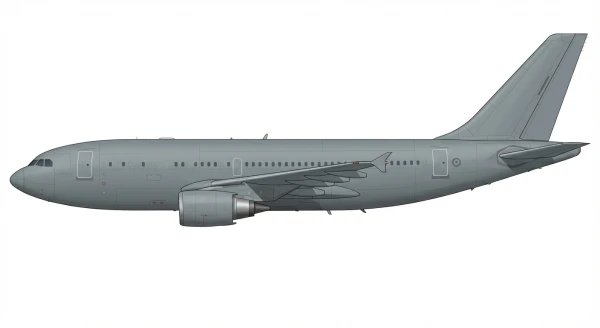
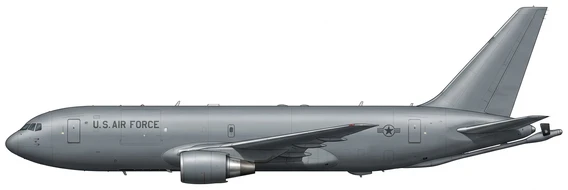
| Airbus A310 MRTT | KC-46 Pegasus | |
|---|---|---|
| Origin country | 🇪🇺 Europe | 🇺🇸 United States |
| Category | Military Special Mission Aircraft | Military Transport Aircraft |
| Manufacturer | Airbus | Boeing |
| First flight | 1 December 2003 | 28 December 2014 |
| Year introduced | 2004 | 2019 |
| Number produced | 6 units | 108 units |
| Average unit price | $108 million | $287 million |
| Wing area | 219.0 m² | -- m² |
| Wingspan | 43.9 m | 48.1 m |
| Height | 15.8 m | 15.9 m |
| Length | 47.5 m | 50.5 m |
| Maximum speed | 978 km/h | 914 km/h |
| Operational range | 8,889 km | 11,830 km |
| Service ceiling | 12,497 m | 12,200 m |
| Max. takeoff weight | 163,998 kg | 188,240 kg |
| Empty weight | 113,999 kg | 82,377 kg |
| Total thrust | 2 x 27,306 kgf | 2 x 280 kN |
Detailed Comparison
Airbus designed the A310 MRTT as an aftermarket conversion for existing A310-300C commercial airframes, utilizing purely hose-and-drogue refueling. Boeing engineered the KC-46 Pegasus as a new-build military derivative of the 767, integrating both a fly-by-wire boom and drogue systems to replace the USAF’s aging KC-135 fleet. The A310 MRTT is a low-volume, post-production conversion; the KC-46 is a mass-produced strategic asset.
Development and Design
The A310 MRTT program relied on refurbishing existing airliners, as standard A310 production ceased in 2007. Airbus Military integrated five auxiliary center tanks—adding 28,000 kg of fuel capacity—and wing-mounted Mk32B pods supplied by Flight Refuelling Ltd. It requires no boom operator; refueling is monitored via a night-vision capable video system from the cockpit.
Boeing built the KC-46 on a modified 767-2C baseline, pairing a 767-200ER fuselage with 767-300F wings and cargo floors. It incorporates a fly-by-wire refueling boom alongside wing and centerline drogue systems. Boeing replaced the traditional direct-line-of-sight boom operator window with a Remote Vision System (RVS), using multispectral cameras and 3D displays. This RVS suffered Category 1 deficiencies during development, causing visual distortion under certain lighting conditions and forcing Boeing into a hardware redesign (RVS 2.0).
Specifications and Performances
The KC-46 holds a clear structural and volumetric advantage. With a Maximum Takeoff Weight (MTOW) of 188,240 kg compared to the A310’s 163,998 kg, the Pegasus accommodates a baseline fuel load of 96,297 kg natively. The A310 requires five auxiliary tanks installed in the cargo hold just to increase its capacity by 28,000 kg.
The Boeing platform extends mission reach with an 11,830 km range, exceeding the A310 by nearly 3,000 km. While the A310 maintains a marginal speed advantage at 978 km/h (versus 914 km/h) and offloads at 15,000 liters per minute via its dual pods, the KC-46’s boom dictates its interoperability. It refuels heavy bombers and fifth-generation fighters, whereas the A310 is restricted entirely to probe-equipped receivers.
Deployment and usage
Production numbers define the operational footprint of both aircraft. Only six A310 MRTTs were built—four for Germany and two for Canada (designated CC-150 Polaris). They execute localized NATO taskings, such as Germany’s 2009 deployment to India refueling Eurofighter Typhoons.
Conversely, the KC-46 operates at scale. Boeing has delivered over 108 units to the USAF, alongside export orders for Japan and Israel. The USAF cleared the KC-46 for global combat operations in September 2022, leading to global deployments including Operation Epic Fury in 2026. It regularly executes marathon sorties, such as a documented 45-hour non-stop flight, leveraging its own aerial refueling receptacle—a capability the A310 lacks.
Conclusion
The KC-46 Pegasus holds the absolute edge in coalition warfare and strategic force projection. Its integrated boom, higher fuel capacity, and self-refueling capability make it interoperable with the entire NATO heavy bomber and fighter inventory. The A310 MRTT was a cost-effective, $108 million stopgap for air forces needing basic drogue refueling on a budget. Restricted to a fleet of six airframes and lacking boom capability, it functions solely as an interim tactical transport, entirely outclassed by the multi-system architecture and payload of the KC-46.