MD-900
American civil utility helicopter, recognized for its quiet operation, used worldwide for law enforcement and air ambulance services. Key figures: top speed 259 km/h, range 543 km, service ceiling 5,334 m, max takeoff weight 2,835 kg, built 5. In service with 1 air force as of 2026 — Mexico (4).
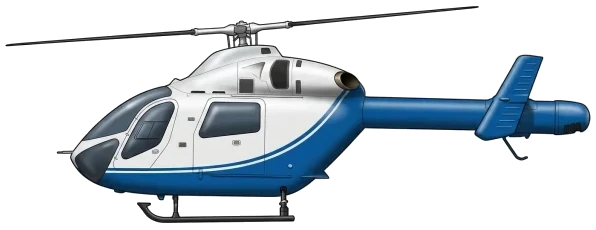
| Crew | 2 |
| Length | 9.9 m (32.4 ft) |
| Wingspan | 10.3 m (33.8 ft) |
| Height | 3.7 m (12.0 ft) |
| Empty weight | 1,531 kg (3,375 lbs) |
| Max. takeoff weight | 2,835 kg (6,250 lbs) |
| Powerplant | 2 × turboshafts Pratt & Whitney Canada PW206E 410 kW each |
| Maximum speed | 259 km/h (161 mph) |
| Operational range | 543 km (337 mi) |
| Service ceiling | 5,334 m (17,500 ft) |
| Climb rate | 5.1 m/s (16.7 ft/s) |

Description
In January 1989, McDonnell Douglas Helicopters announced the launch of the Explorer, initially known as the MDX, which was the first of their helicopters to incorporate the NOTAR system from its initial design. McDonnell Douglas partnered with Hawker de Havilland of Australia for airframe manufacturing. Ten prototypes were built, seven for ground-based tests. McDonnell Douglas became the launch customer for Pratt & Whitney Canada's PW200 turboshaft engines, exclusively using PW206As for the first 128 Explorers. The maiden flight, performed by ship #2 (N900MD), took place on 18 December 1992. FAA certification was granted on 2 December 1994, followed by JAA certification shortly after. IFR certification was delayed until February 1997. In September 1997, improvements, including the PW206E engine and revised inlets, led to the enhanced MD 902 Explorer. In 1999, Boeing spun off its civilian helicopter line, including the Explorer, to MD Helicopter Holdings Inc. Throughout the 2000s, the company recovered financially and invested in its supply chain. Later, the company focused on avionics upgrades, partnering with Universal Avionics and Genesys Aerosystems for glass cockpit installations.
Design
The MD Helicopters MD Explorer is characterized by a fully-articulated five-bladed main rotor system with bearingless composite flexbeams and rotor hub. The fuselage incorporates composite materials like carbon fiber for corrosion resistance and includes lightning strike protection. A distinctive feature is the NOTAR anti-torque system, which replaces the conventional tail rotor with a fan exhaust directed through slots in the tail boom, utilizing the Coandă effect for yaw control. This design is reported to reduce pilot workload and external noise levels while improving safety and control. The MD Explorer can be flown by a single pilot and accommodate up to six passengers. The aircraft has capacity for internal loads of up to 2,565 lb (1,163 kg) or a slung load capacity reaching 3,000 lb (1,361 kg).
Operational History
The MD Explorer has seen service in various roles across the globe, particularly within Europe, where almost 50% of all units produced by 2015 were in operation. Its roles have included emergency medical services (EMS), law enforcement, and military/para-military organizations. The Helicopter Interdiction Tactical Squadron of the United States Coast Guard flew the MH-90 Enforcer, an armed variant, between 1998 and 2000. While the MD Explorer continues to be technically in production, some operators have reported facing challenges in obtaining critical components.
Variants
Main Variants:
-
MD 900 Explorer: The initial production model, it is powered by two Pratt & Whitney Canada PW206A (or PW206E or PW207E) turboshaft engines.
-
MD 901 Explorer: A civil utility transport model intended to be powered by two Turbomeca Arrius turboshaft engines and feature tri-angel landing gear; this variant was not developed beyond the project phase.
-
MD 902: This is the marketing name for an enhanced version with Category A approval, powered by two Pratt & Whitney Canada PW206E or PW207E engines, featuring additional engine isolation and changes to the Integrated Instrument Display System.
-
MH-90 Enforcer: An armed version utilized by the United States Coast Guard between 1998 and 2000.
-
MD 969 Combat Explorer: An armed helicopter version of the MD Explorer.
Frequently Asked Questions
What type of aircraft is the MD-900?
What is the maximum speed of the MD-900?
What is the range of the MD-900?
When did the MD-900 first fly?
How many MD-900 have been built?
Which countries operate the MD-900?
What is the service ceiling of the MD-900?
- AUG 52026 Updated Powerplant updated in a site-wide editorial pass
- APR 72026 Updated Sources and cross-references refreshed
- FEB 72026 Updated Wingspan added
- JAN 122026 Updated Range updated in a site-wide editorial pass