MBB Bo 105
German light, twin-engine helicopter, known for its use in emergency medical services and military operations worldwide since the 1970s. Key figures: top speed 270 km/h, range 657 km, service ceiling 5,182 m, max takeoff weight 2,700 kg, unit price $0.55M, built 1,500. In service with 8 air forces as of 2026 — Indonesia (21), South Korea (12), Bahrain (6) and 5 others.
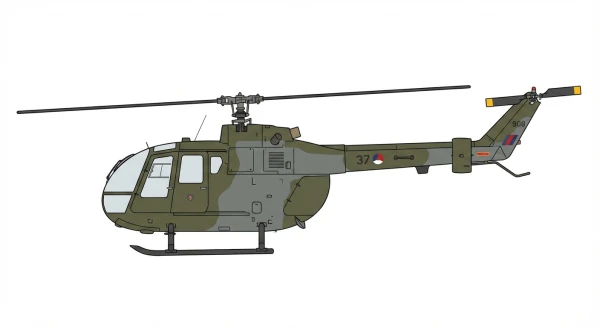
| Length | 11.9 m (38.9 ft) |
| Wingspan | 9.8 m (32.3 ft) |
| Height | 3.0 m (9.9 ft) |
| Empty weight | 1,675 kg (3,693 lbs) |
| Max. takeoff weight | 2,700 kg (5,952 lbs) |
| Powerplant | 2 × turboshafts Allison 250-C20R3 332 kW each |
| Maximum speed | 270 km/h (168 mph) |
| Operational range | 657 km (408 mi) |
| Service ceiling | 5,182 m (17,001 ft) |
| Climb rate | 8.0 m/s (26.2 ft/s) |
-
 Indonesia
21
Indonesia
21
-
 South Korea
12
South Korea
12
-
 Bahrain
6
Bahrain
6
-
 Philippines
5
Philippines
5
-
 Albania
4
Albania
4
-
 Chile
4
Chile
4
-
 Honduras
2
Honduras
2
-
 Peru
2
Peru
2
Description
The MBB Bo 105 is a light twin-engine multipurpose helicopter developed by Bölkow at Ottobrunn, West Germany, and subsequently produced by Messerschmitt-Bölkow-Blohm and then Eurocopter. Entering service in 1970, it was the world's first light twin-engine helicopter and the first rotorcraft capable of performing aerobatic manoeuvres such as inverted loops, thanks to its hingeless rotor. Around 1,640 examples were built, 1,404 of them in Germany, and delivered to operators in 55 countries.
Development
Development work began at Bölkow in 1964, work on the rigid rotor having started earlier. The second Bo 105A prototype made its first flight on 16 February 1967 at Ottobrunn, initially fitted with a Westland Scout main rotor and two Allison Model 250 turboshafts. Sud Aviation collaborated on the programme, a modified Alouette II serving as a test bed for the rotor. The third prototype received MAN Turbo 6022 turboshafts, and six pre-production aircraft were built. German certification was obtained on 13 October 1970, with the first deliveries going to ADAC Air Rescue and the Bavarian police, followed by FAA and CAA certification in 1972. The Bo 105C appeared in 1972, the Bo 105CB in 1976 with Allison 250-C20Bs, then the Bo 105CBS lengthened by 25 cm for the American medical market. Boeing-Vertol handled marketing in the United States. The Bo 105LS of 1984, produced with Eurocopter Canada, received Allison 250-C28Cs. Licence production was undertaken by PADC in the Philippines (44 units, 1977-1997), IPTN in Indonesia (122 units) and CASA in Spain. Production ended in 2001, with the Eurocopter EC135 taking over.
Design
The rotor is entirely hingeless, the rotor head consisting of a solid titanium block to which the four blades are bolted, the flexibility of the blades absorbing the movements normally handled by hinges. The blades are of glass-fibre reinforced plastic composite. In more than six million fleet flight hours, no rotor failure had been recorded as of 1991. The aircraft is certified to +3.5 g and -1 g. The cabin accommodates two pilots and up to three passengers on a removable rear bench, with cargo or stretchers loaded through large clamshell doors at the rear of the fuselage. In maritime configuration it can be fitted with auxiliary tanks, emergency flotation gear, an inflatable dinghy, folding blades and high-skid landing gear. The Mexican Bo 105s modernised in 2005 received FLIR sensors, GPS receivers and search radars.
Armament
Armament comprises two pods of 12 SNEB rockets or 28 SNIA rockets. In anti-tank configuration the aircraft carries six Euromissile HOT missiles (Bo 105P) or eight BGM-71 TOWs; four Stinger air-to-air missiles can also be fitted.
Operational History
The German Army decided in 1975 to acquire an anti-tank version, the Bo 105 PAH-1, with 212 examples delivered between 1979 and 1984. The command regarded it as an interim solution, criticising its lack of night-combat capability and self-protection; the Eurocopter Tiger was developed as its replacement. A further hundred aircraft were ordered in 1977 under the VBH observation helicopter programme. Withdrawal from German service took place on 13 December 2016, marked by a formation of 18 aircraft departing from Celle, after more than 1.38 million flight hours. Indonesian Bo 105s were employed during the East Timor crisis of 1999 and the Papua conflict. The Mexican Navy operates them for maritime reconnaissance from Uribe-class patrol vessels. The South Korean Army received twelve, co-produced by Eurocopter and Korea Aerospace Industries. In May 2014 the fleet had accumulated 8 million flight hours, with around 700 aircraft still in service.
Variants
- Bo 105C: initial version of 1972 fitted with two Allison 250-C20 turboshafts.
- Bo 105CB: main production version from 1975, powered by two 313 kW Allison 250-C20Bs.
- Bo 105CBS: utility transport version with the fuselage lengthened by 25 cm and an additional window.
- Bo 105P/PAH-1: anti-tank helicopter armed with HOT wire-guided missiles for the West German Army.
- NBO-105: version built under licence by IPTN between 1976 and 2008, 122 examples produced.
Frequently Asked Questions
What type of aircraft is the MBB Bo 105?
What is the maximum speed of the MBB Bo 105?
What is the range of the MBB Bo 105?
When did the MBB Bo 105 first fly?
How many MBB Bo 105 have been built?
Which countries operate the MBB Bo 105?
How much does a MBB Bo 105 cost?
What is the service ceiling of the MBB Bo 105?
- AUG 302026 Updated Description updated
- AUG 52026 Updated Climb rate added; powerplant updated
- JUL 272026 Updated Name updated
- APR 72026 Updated Picture credits updated in a site-wide editorial pass
- FEB 72026 Updated Bo 105: top speed added; Bo 105: wingspan added
- JAN 122026 Updated Range updated in a site-wide editorial pass