MQ-4 Triton
American unmanned surveillance aircraft, known for deployments in persistent maritime ISR missions. Key figures: top speed 610 km/h, range 15,200 km, service ceiling 16,800 m, max takeoff weight 14,628 kg, unit price $180M, built 30. In service with 2 air forces as of 2026 — United States (19), Australia (3).
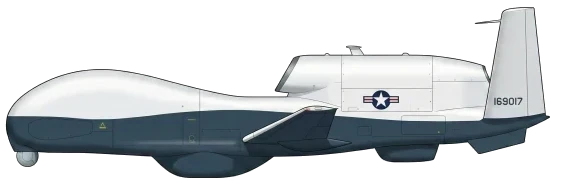
| Length | 14.5 m (47.6 ft) |
| Wingspan | 39.9 m (130.9 ft) |
| Empty weight | 6,781 kg (14,950 lbs) |
| Max. takeoff weight | 14,628 kg (32,249 lbs) |
| Powerplant | 1 × Rolls-Royce AE3007H turbofan engine |
| Maximum speed | 610 km/h (379 mph) |
| Operational range | 15,200 km (9,445 mi) |
| Endurance | 30 hours |
| Service ceiling | 16,800 m (55,118 ft) |
Recent Events — MQ-4 Triton
4 events →
Description
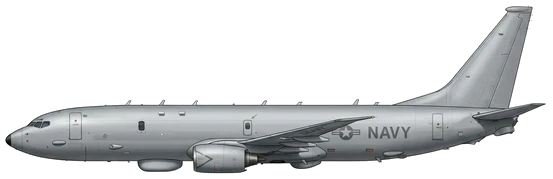
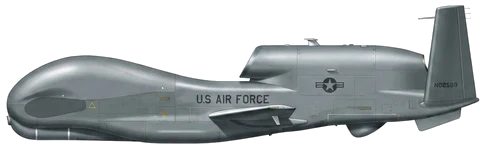
The Northrop Grumman MQ-4C Triton is an American high-altitude long-endurance unmanned aerial vehicle developed for maritime intelligence, surveillance, and reconnaissance operations. Operated by the United States Navy and Royal Australian Air Force, the aircraft conducts ocean surveillance, search and rescue, and target tracking to complement the Boeing P-8 Poseidon. The MQ-4C joined the US Navy fleet in 2018, achieved Initial Operational Capability in 2023, and entered Australian service in June 2024.
Development
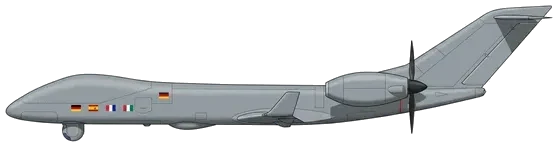
The program began under the US Department of Defense Broad Area Maritime Surveillance (BAMS) competition. Northrop Grumman was awarded the $1.16 billion contract on April 22, 2008, and the aircraft received the MQ-4C designation in September 2010. First flight took place on May 22, 2013, at Palmdale, California. The US Navy reduced its planned procurement from 68 operational airframes to a program of record of 27 in May 2023. Australia ordered four Tritons, while Denmark, Finland, Germany, and Norway announced plans in July 2026 to procure up to five aircraft for NATO operations. Germany previously selected the MQ-4C for signals intelligence before cancelling the order in favor of a modified Bombardier Global 6000 platform.
Design
The MQ-4C features a modified RQ-4 Global Hawk structure with airframe reinforcements, anti-icing systems, and lightning protection to permit low-altitude descents through cloud layers. Powered by a single Rolls-Royce AE 3007 turbofan engine, it achieves a maximum speed of 320 knots, a service ceiling of 56,000 feet, and an endurance exceeding 30 hours. Its primary surveillance payload is the AN/ZPY-3 Multi-Function Active Sensor X-band AESA radar with a 360-degree field of regard. Additional onboard systems include a Raytheon MTS-B electro-optical/infrared sensor, an Automatic Identification System, a passive electronic support measures suite, and airborne network relay capabilities.
Operational History
Unmanned Patrol Squadron Nineteen (VUP-19) became the US Navy's first Triton unit in October 2013, deploying two aircraft to Andersen Air Force Base in Guam in January 2020. The US Navy declared Initial Operational Capability in 2023 prior to completing Initial Operational Test and Evaluation due to fleet operational demand. The Royal Australian Air Force assigned its Tritons to No. 9 Squadron, taking delivery of its first operational aircraft on June 16, 2024. On April 9, 2026, a US Navy MQ-4C crashed in the Persian Gulf region while returning to Naval Air Station Sigonella.
Variants
- BAMS-D: A prototype variant based on the RQ-4A airframe created to support initial development testing for the Broad Area Maritime Surveillance program.
- MQ-4C SDD: System Development and Demonstration test aircraft produced for flight envelope expansion and sensor integration evaluation.
Frequently Asked Questions
What type of aircraft is the MQ-4 Triton?
What is the maximum speed of the MQ-4 Triton?
What is the range of the MQ-4 Triton?
When did the MQ-4 Triton first fly?
How many MQ-4 Triton have been built?
Which countries operate the MQ-4 Triton?
How much does a MQ-4 Triton cost?
What is the service ceiling of the MQ-4 Triton?
- AUG 132026 Updated Service entry corrected to the May 2018 US Navy introduction
- AUG 62026 Updated Description updated
- JUL 232026 Updated Sources and cross-references refreshed
- APR 82026 Updated Empty weight added
- APR 72026 Updated Sources and cross-references refreshed
- FEB 72026 Updated Endurance updated
- JAN 242026 Updated Price updated