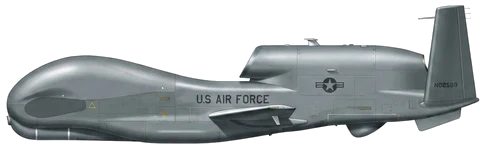
In the 1990s, development of uncrewed aerial intelligence platforms by the Air Force faced budget constraints, necessitating a selection between the Lockheed Martin RQ-3 DarkStar and the Global Hawk. The Global Hawk was chosen based on its operational range and payload capacity. The aircraft's initial flight occurred on 28 February 1998, originating from Edwards Air Force Base, California. The first seven aircraft were constructed under the DARPA Advanced Concept Technology Demonstration (ACTD) program to evaluate the design parameters and validate its capabilities. Due to operational requirements in the Middle East, prototype aircraft from the ACTD program were actively employed by the USAF in the War in Afghanistan. The aircraft entered initial low-rate production concurrently with engineering and manufacturing development. Nine production Block 10 aircraft were manufactured; two of these were transferred to the US Navy, and two others were deployed to Iraq. The delivery of the final Block 10 aircraft took place on 26 June 2006.
To increase mission capabilities, the airframe underwent redesign, involving elongation of the nose section and enlargement of the wingspan. This modified aircraft, designated RQ-4B Block 20, is designed to carry an internal payload of up to 3,000 lb (1,360 kg). The first Block 20 aircraft, the 17th Global Hawk airframe produced, was formally presented on 25 August 2006, and conducted its maiden flight on 1 March 2007. Developmental testing for the Block 20 configuration was conducted throughout 2008. Further iterations include the RQ-4B Block 30 configured for multi-intelligence (multi-INT) collection using synthetic aperture radar (SAR), electro-optical/infrared (EO/IR) sensors, and the Airborne Signals Intelligence Payload (ASIP). The RQ-4B Block 40 variant is equipped with the multi-platform radar technology insertion program (MP-RTIP) active electronically scanned array (AESA) radar designed for wide-area ground surveillance.
Design
The Global Hawk UAV system comprises the RQ-4 air vehicle and a ground element. The air vehicle incorporates sensor packages, communication systems, and other mission equipment. The ground element includes a Launch and Recovery Element (LRE), a Mission Control Element (MCE), and associated ground communications equipment. Each RQ-4 is powered by an Allison Rolls-Royce AE3007H turbofan engine, providing 7,050 lbf (31.4 kN) of thrust. The fuselage features aluminum, semi-monocoque construction paired with a V-tail configuration. The wings are fabricated from composite materials.
The operational capabilities of the RQ-4 are focused on intelligence, surveillance, and reconnaissance (ISR). The RQ-4A Block 10 variant was equipped with a payload capacity of 2,000 lb (910 kg), supporting a sensor suite that included synthetic aperture radar (SAR) and electro-optical (EO) and infrared (IR) sensors. The redesigned RQ-4B Block 20 configuration features an increased internal payload capacity of 3,000 lb (1,360 kg), accommodating upgraded SAR and EO/IR sensors. A Universal Payload Adapter (UPA) has been developed to allow integration of up to 1,200 lb (540 kg) of sensors, situated within a canoe-shaped fairing mounted on the fuselage underside. This facilitates carriage of sensors such as the U-2's Optical Bar Camera (OBC) and Senior Year Electro-Optical Reconnaissance System (SYERS-2B/C) on the RQ-4. Potential sensor integrations also include the UTC Aerospace Systems MS-177 multispectral sensor, intended to replace SYERS-2. This sensor includes modernized optronics and a gimbaled rotation system capable of increasing the field of view by 20 percent. For platform self-defense, the aircraft can be fitted with a suite consisting of the AN/AVR-3 laser warning receiver, AN/APR-49 radar warning receiver, a jamming system, and the ALE-50 towed decoy.
Operational History
Following the events of September 11, 2001, the standard acquisition process was accelerated, leading to the deployment of early developmental Global Hawk models into overseas contingency operations commencing in November 2001. ACTD prototypes were employed in the War in Afghanistan and the Iraq War. Since April 2010, Global Hawks operating from Beale Air Force Base have utilized a Northern Route via Canada to reach South-East Asia, contributing to reduced transit times and improved maintenance profiles. However, the program experienced the loss of four prototype aircraft, out of a total of six or seven, due to accidents attributed to technical failures or maintenance issues. Notwithstanding these incidents, the aircraft's data-collection performance has facilitated its use in operations such as Operation Inherent Resolve (OIR) against the Islamic State of Iraq and the Levant (ISIL), where it provided real-time imagery and signals intelligence. The type has also been utilized in support of humanitarian aid and disaster relief missions; for example, RQ-4s flew 300 hours over affected areas in Japan following the 2011 Tōhoku earthquake and tsunami. In June 2019, a U.S. Navy BAMS-D designated RQ-4A was destroyed by Iranian forces.
Variants
Main Variants:
-
RQ-4A: The initial production version used by the USAF, primarily for imagery intelligence (IMINT), carrying a 2,000 lb payload consisting of synthetic aperture radar (SAR) with electro-optical (EO) and infrared (IR) sensors.
-
RQ-4B: An improved variant featuring an increased payload capacity of 3,000 lb, a larger wingspan, and upgraded SAR and EO/IR sensors to enhance surveillance capabilities.
-
RQ-4D Phoenix: The designation for the NATO Alliance Ground Surveillance (AGS) variant, intended to provide broad area surveillance capabilities to NATO members.
-
RQ-4E Euro Hawk: A version developed for the German Air Force based on the RQ-4B, equipped with an EADS reconnaissance payload for signals intelligence (SIGINT), although the order was later cancelled.
-
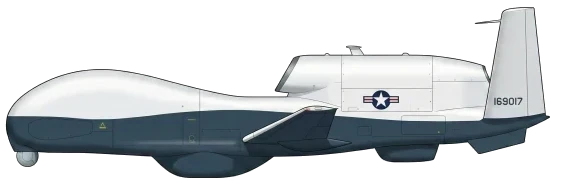
MQ-4C Triton: A naval variant developed for the U.S. Navy’s Broad Area Maritime Surveillance (BAMS) role, designed for maritime surveillance with specialized wing design for rapid altitude changes.