MV-75 Cheyenne II
American tiltrotor assault aircraft developed by Bell from the V-280 Valor demonstrator under the U.S. Army's Future Long-Range Assault Aircraft program to replace the UH-60 Black Hawk. Key figures: top speed 556 km/h, range 3,900 km, service ceiling 6,000 m, max takeoff weight 14,000 kg.
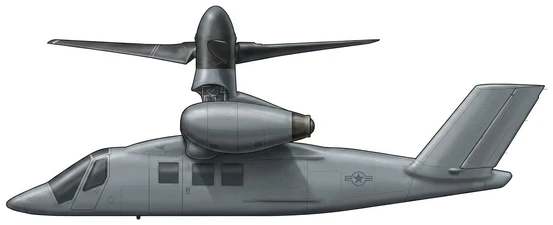
| Crew | 4 (2 pilots, 2 crew chiefs) |
| Length | 15.4 m (50.5 ft) |
| Wingspan | 24.9 m (81.8 ft) |
| Height | 7 m (23.0 ft) |
| Empty weight | 8,200 kg (18,078 lbs) |
| Max. takeoff weight | 14,000 kg (30,865 lbs) |
| Powerplant | 2 × Rolls-Royce AE 1107F 5,220 kW each |
| Maximum speed | 556 km/h (345 mph) |
| Operational range | 3,900 km (2,423 mi) |
| Service ceiling | 6,000 m (19,685 ft) |
| Climb rate | 23.0 m/s (75.5 ft/s) |
Description
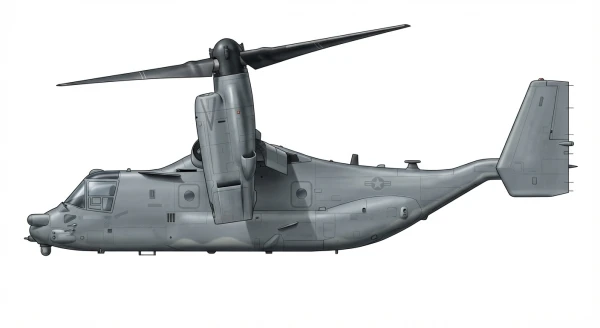
The Bell MV-75 Cheyenne II is a tiltrotor aircraft being developed for the United States Army's Future Vertical Lift initiative. It originated from the Bell V-280 Valor technology demonstrator, unveiled in 2013 and first flown on 18 December 2017, which won the Future Long-Range Assault Aircraft (FLRAA) competition in December 2022 against the Sikorsky-Boeing Defiant X to replace the UH-60 Black Hawk. The type was designated YMV-75A in November 2024, became the MV-75 in May 2025, and was named Cheyenne II in April 2026.
Design
Unlike the V-22 Osprey, the MV-75's engines remain fixed while the rotors and drive shafts tilt, and a driveshaft through the straight composite wing lets one engine drive both rotors if the other fails. The aircraft has a V-tail, retractable landing gear, triple-redundant fly-by-wire controls, a crew of four and capacity for 14 troops, with dual cargo hooks rated for a 4,500 kg load. Designed for a 520 km/h cruise and a 556 km/h top speed, the demonstrator reached 560 km/h in testing. The production aircraft switches from the prototype's GE T64 to the Rolls-Royce AE 1107F, raising power from 5,000 to 7,000 shp per engine.
Operational History
The V-280 demonstrator retired in 2021 after 214 flight hours. Bell completed the first two MV-75 wing structures in June 2026, with the first prototype expected by the end of 2026 and flight testing from early 2027. Limited user tests are planned for 2027-2028, with fielding targeted for 2031. Published specifications reflect the V-280 demonstrator; production figures have not yet been released.
Frequently Asked Questions
What type of aircraft is the MV-75 Cheyenne II?
What is the maximum speed of the MV-75 Cheyenne II?
What is the range of the MV-75 Cheyenne II?
When did the MV-75 Cheyenne II first fly?
What is the service ceiling of the MV-75 Cheyenne II?
- JUL 232026 Created Page created: MV-75 Cheyenne II