Atlas Oryx
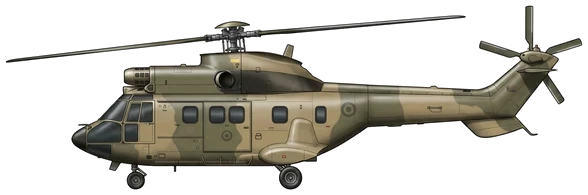
South African medium-sized utility helicopter, developed in the 1980s and introduced in the early 1990s, used primarily for transport, search and rescue, and peacekeeping operations. Key figures: top speed 306 km/h, range 303 km, service ceiling 7,162 m, max takeoff weight 8,000 kg, built 50. In service with 1 air force as of 2026 — South Africa (37).
| Crew | 3 |
| Length | 15.5 m (50.7 ft) |
| Wingspan | 15.6 m (51.2 ft) |
| Height | 5.1 m (16.9 ft) |
| Wing area | 191 m² (2055.9 sqft) |
| Empty weight | 3,600 kg (7,937 lbs) |
| Max. takeoff weight | 8,000 kg (17,637 lbs) |
| Powerplant | 2 × Turbomeca Makila IA1 1,400 kW each |
| Maximum speed | 306 km/h (190 mph) |
| Operational range | 303 km (188 mi) |
| Service ceiling | 7,162 m (23,497 ft) |
| Climb rate | 15.25 m/s (50.0 ft/s) |

Description
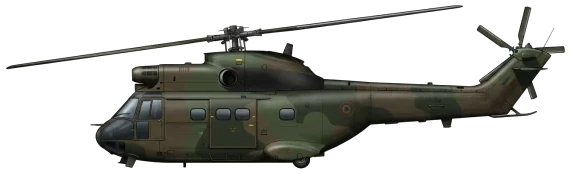
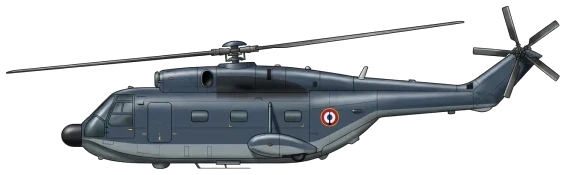
The Atlas Aircraft Corporation (now Denel Aeronautics) developed the Atlas Oryx in the early 1980s to meet the transport needs of the South African Air Force (SAAF). This development was prompted by the Border War and the United Nations arms embargo under Resolution 418, which prevented South Africa from importing foreign transport helicopters like the Aérospatiale SA 330 Puma. The Oryx was developed in parallel with the Denel Rooivalk attack helicopter, using the Puma as a design basis. A single Puma (no. 177) was converted as a prototype, and quantity production was authorized in the late 1980s. The SAAF publicly revealed the helicopter in 1991. Although Atlas claimed the Oryx was an indigenous programme, legal disputes and reports alleged that Aérospatiale supplied disassembled Super Puma kits to South Africa via Portuguese intermediaries. In 2006, the SAAF initiated a mid-life upgrade for 35 Oryx airframes to extend their service life.
Design
The Oryx is a medium-sized utility helicopter structurally equivalent to the Eurocopter AS332 Super Puma. It features the basic Puma airframe but incorporates locally produced carbon-composite materials and a tailboom extended by 50 cm. Power is provided by two Turbomeca Makila IA1 turboshaft engines, rated at 1,400 kW each, managed by an automatic system that advances the power of the remaining engine in the event of an engine failure. Equipment includes dust filters, a 50-meter hydraulic hoist for two personnel, and an optional internal A-frame for simultaneous abseiling by four personnel. Coastal units feature emergency flotation gear on the sponsons and nose.
Armament
For armament, the Oryx can carry up to two door-mounted 7.62 mm machine guns, specifically FN MAG or Denel SS-77 models. Later upgrades integrated flare dispensers and updated Threat Warning Receivers.
Operational History
The SAAF is the primary operator of the Oryx, deploying the type for transport, search and rescue, naval replenishment, and firefighting. The helicopter carries up to 20 troops, or six stretchers with four medical attendants, and supports a 3,000 kg internal or 4,500 kg external payload. SAAF deployed Oryx helicopters to the Democratic Republic of Congo starting in 2003 to support UN peacekeeping missions. Budgetary constraints led the SAAF to declare ten Oryx helicopters surplus in 2003.
Variants
-
Electronic warfare variant: This version is configured for stand-off communications and radar jamming, equipped with a Grinaker Systems Technologies GSY 1501 jamming system and either a starboard log periodic antenna or dome-shaped door antennas.
-
Oryx Mk. 2: Developed for the South African National Antarctic Programme, this variant is painted in a red and white scheme and features uprated de-icing equipment for Southern Ocean and Antarctic operations.
Frequently Asked Questions
What type of aircraft is the Atlas Oryx?
What is the maximum speed of the Atlas Oryx?
What is the range of the Atlas Oryx?
When did the Atlas Oryx first fly?
How many Atlas Oryx have been built?
Which countries operate the Atlas Oryx?
What is the service ceiling of the Atlas Oryx?
- JUL 272026 Updated Name updated
- JUL 232026 Updated Sources and cross-references refreshed
- JUL 12026 Created Page created: Oryx