AS332 Super Puma
French medium-sized utility helicopter, developed in the late 1970s, extensively used for military transport, offshore support, and search-and-rescue operations. Key figures: top speed 327 km/h, range 851 km, service ceiling 5,180 m, max takeoff weight 9,150 kg, built 890. In service with 2 air forces as of 2026 — Switzerland (14), China (6).
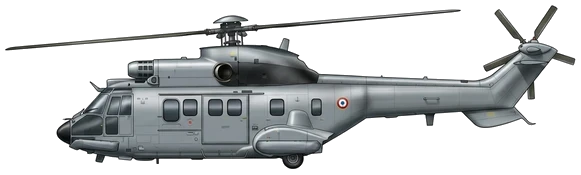
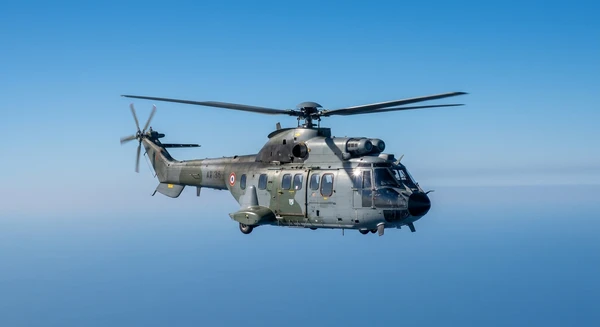
| Crew | 2 |
| Length | 16.8 m (55.1 ft) |
| Wingspan | 16.2 m (53.1 ft) |
| Height | 5.0 m (16.3 ft) |
| Wing area | 206.1 m² (2218.7 sqft) |
| Empty weight | 4,660 kg (10,274 lbs) |
| Max. takeoff weight | 9,150 kg (20,172 lbs) |
| Powerplant | 2 × Turbomeca Makila 1A2 1,376 kW each |
| Maximum speed | 327 km/h (203 mph) |
| Operational range | 851 km (529 mi) |
| Service ceiling | 5,180 m (16,995 ft) |
| Climb rate | 7.4 m/s (24.3 ft/s) |


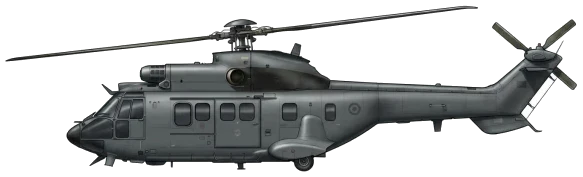
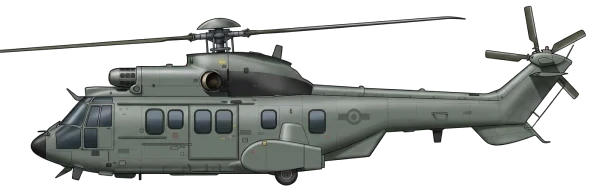
Description
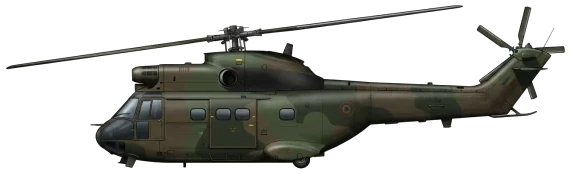
The AS332 Super Puma is a twin-engine, medium-sized utility helicopter developed by Aérospatiale and subsequently manufactured by Eurocopter and Airbus Helicopters. Development began in 1974 as an evolution of the SA 330 Puma, featuring a redesigned fuselage for improved damage tolerance and crashworthiness. The SA 331 preproduction prototype first flew on September 5, 1977, followed by the first Super Puma prototype on September 13, 1978. By 1987, the production rate averaged three helicopters per month. As of 2005, 565 units had been delivered or were on order. Manufacturing was also established under license in Indonesia by PT Dirgantara Indonesia, and assembly later shifted to a facility in Brasov, Romania, for the H215 redesignated version.
Design
The aircraft is powered by two Turbomeca Makila turboshaft engines driving a four-bladed composite main rotor and a five-bladed tail rotor. The design includes a retractable tricycle landing gear with high energy-absorption qualities and a monocoque tail boom with strike protection. Fuel is housed in six internal tanks with crashworthy plumbing. The cockpit features a duplex digital autopilot and four multifunction liquid crystal displays. The main cabin, accessible via sliding plug doors, can be configured for 15 passengers in the short-fuselage version or 20 in the stretched version. Specialized maritime variants include additional corrosion protection, a folding tail rotor boom, sonar equipment, and Omera search radar.
Armament
In maritime configurations, the AS332 can be armed with two Exocet anti-ship missiles. The Nigerian Air Force has utilized weaponized versions for anti-insurgency operations. Other military equipment includes engine exhaust-gas deflectors, FLIR turrets, and cargo sling poles for external payloads.
Operational History
The French Army deployed the Super Puma within its Force d'Action Rapide for operations in Africa and the Middle East, including the 1994 intervention in Rwanda. The Swiss Air Force utilizes the type for intelligence, surveillance, target acquisition, and reconnaissance. During the war in Afghanistan, both the Swedish and Spanish air forces operated Super Pumas for combat search and rescue (SAR) and medical evacuation. The Hellenic Air Force employs the AS332 C1 for long-range SAR and CSAR missions. In the civilian sector, the aircraft is used for offshore oil platform support in the North Sea by operators such as Bristow Helicopters and CHC Helicopters.
Variants
- AS 332B: The primary military version of the helicopter.
- AS 332C1: A search and rescue variant equipped with search radar and a six-stretcher interior configuration.
- AS 332F: A maritime version designed for anti-submarine and anti-surface warfare.
- AS 332L: A civilian variant featuring a lengthened fuselage, expanded cabin space, and more powerful engines.
- AS 332L2 Super Puma Mk 2: A transport version fitted with a Spheriflex rotor head and Electronic Flight Instrument System (EFIS).
Frequently Asked Questions
What type of aircraft is the AS332 Super Puma?
What is the maximum speed of the AS332 Super Puma?
What is the range of the AS332 Super Puma?
When did the AS332 Super Puma first fly?
How many AS332 Super Puma have been built?
Which countries operate the AS332 Super Puma?
What is the service ceiling of the AS332 Super Puma?
- MAY 102026 Created Page created: AS332 Super Puma