PA-44 Seminole
American twin-engined light aircraft, recognized for its widely-used operational training during the late 20th century. Key figures: top speed 311 km/h, range 1,695 km, service ceiling 5,200 m, max takeoff weight 1,724 kg, unit price $0.6M, built 926. In service with 1 air force as of 2026 — Peru (1).
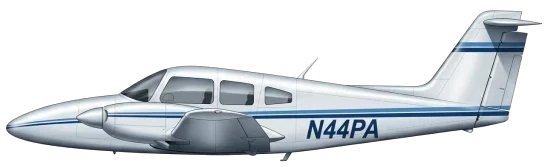
| Crew | 1 |
| Length | 8.4 m (27.6 ft) |
| Wingspan | 11.8 m (38.6 ft) |
| Height | 2.6 m (8.5 ft) |
| Wing area | 17.1 m² (183.8 sqft) |
| Empty weight | 1,068 kg (2,355 lbs) |
| Max. takeoff weight | 1,724 kg (3,801 lbs) |
| Powerplant | 2 × Lycoming O-360-E1A6 air-cooled flat four 130 kW each |
| Maximum speed | 311 km/h (193 mph) |
| Operational range | 1,695 km (1,053 mi) |
| Service ceiling | 5,200 m (17,060 ft) |
| Climb rate | 6.8 m/s (22.3 ft/s) |

Description
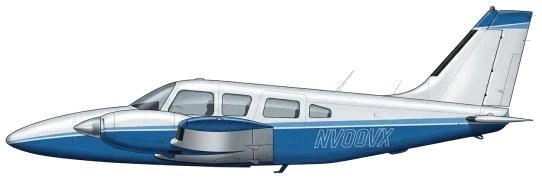
The Piper PA-44 Seminole is a twin-engined development of the Piper Cherokee single-engined aircraft, primarily intended for multi-engine flight training. The first prototype Seminole took flight in May 1976, and the design was publicly announced on February 21, 1978. Certification was achieved on March 10, 1978, with the aircraft introduced as a 1979 model in late 1978.
Design
Initial production models featured two 180 hp Lycoming O-360-E1A6D engines; the right-hand engine was a Lycoming LO-360-E1A6D variant, rotating in the opposite direction. This counter-rotating engine configuration eliminates the critical engine, enhancing control during engine shutdown or failure. Later production models utilized Lycoming O-360-A1H6 engines. The PA-44 also incorporates a high T-tail. A turbocharged variant, the PA-44-180T Turbo Seminole, certified on November 29, 1979, included two 180 hp Lycoming TO-360-E1A6D engines to improve performance at high altitudes. The aircraft is equipped with Hartzell fully-feathering metal constant-speed propellers, measuring 6 ft 2 in in diameter.
Production of both versions initially ceased in 1982, with 361 Seminoles and 87 Turbo Seminoles built during this period. Production restarted in 1988 with modifications to the electrical systems and instrumentation. Production stopped again in 1990 but resumed in 1995.
Operational History
The Piper PA-44 Seminole has seen operational use in both civil and military sectors. Its main role is in air charter companies and flight schools, where it serves as a multi-engine trainer. However, it is also operated by private individuals and companies for personal transport. Military operators include the Royal Jordanian Air Force and the Peruvian Air Force.
Variants
Main Variants:
-
PA-44-180 Seminole: The base model, powered by two Lycoming O-360-E1A6D or two O-360-A1H6 engines.
-
PA-44-180T Turbo Seminole: Features two Lycoming TO-360-E1A6D engines with turbochargers for improved high-altitude performance.
-
PA-44 Seminole DX: A proposed variant that would have used two Continental Motors CD-170 diesel engines.
Frequently Asked Questions
What type of aircraft is the PA-44 Seminole?
What is the maximum speed of the PA-44 Seminole?
What is the range of the PA-44 Seminole?
When did the PA-44 Seminole first fly?
How many PA-44 Seminole have been built?
Which countries operate the PA-44 Seminole?
How much does a PA-44 Seminole cost?
What is the service ceiling of the PA-44 Seminole?
- AUG 52026 Updated Climb rate added
- JUL 232026 Updated Sources and cross-references refreshed
- APR 72026 Updated Sources and cross-references refreshed