Beechcraft Baron
American light, twin-engined piston aircraft, utilized globally for business, personal, and flight training purposes since the mid-20th century. Key figures: top speed 370 km/h, range 1,745 km, service ceiling 6,005 m, max takeoff weight 2,313 kg, unit price $1M, built 6,884. In service with 6 air forces as of 2026 — Turkey (5), Uruguay (3), Indonesia (2) and 3 others.
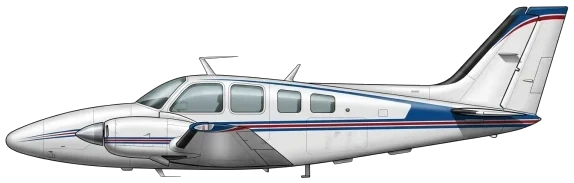
| Length | 9 m (29.5 ft) |
| Wingspan | 11.3 m (37.1 ft) |
| Height | 3.0 m (9.7 ft) |
| Wing area | 18.5 m² (199.2 sqft) |
| Empty weight | 1,432 kg (3,157 lbs) |
| Max. takeoff weight | 2,313 kg (5,099 lbs) |
| Powerplant | 2 × pistons engine Continental IO-470L 194 kW each |
| Maximum speed | 370 km/h (230 mph) |
| Operational range | 1,745 km (1,084 mi) |
| Service ceiling | 6,005 m (19,701 ft) |
| Climb rate | 8.5 m/s (27.9 ft/s) |


Description
The Beechcraft Baron is a light twin-engined piston aircraft with a low wing, introduced in 1961. It was developed from the Beechcraft Travel Air, itself a combination of the Bonanza fuselage with the tail surfaces of the T-34 Mentor trainer. Three basic types were produced: the short-body 55 and 56 and the long-body 58, which remains the current model. Beyond the civil market, the Baron served as the US Army's T-42A Cochise instrument trainer and in small numbers with more than a dozen air arms.
Development
The Baron was created by replacing the Travel Air's tail with the fully swept fin of the Debonair, streamlining the engine nacelles and fitting six-cylinder engines, to compete with the Piper Aztec and the Cessna 310. The first model, the Baron 55, entered production in 1961 with two 260 hp (190 kW) IO-470-L engines and four to six seats. The 55 series remained in production until 1983, with 3,651 built; the B55 alone accounted for 1,951 aircraft, about half of 55-series sales. The C55 of 1966 introduced 285 hp (213 kW) IO-520-C engines and a nose lengthened by 30 cm (12 in) for baggage; the D55 added three-blade propellers, and the E55 was built from 1970 to 1982.
The Baron 56TC, first flown on 25 May 1966, served as a testbed for the turbocharged 380 hp (280 kW) Lycoming TIO-541 of the Duke; about 90 were built between 1967 and 1971. The long-body Baron 58 first flew on 23 June 1969, with the fuselage stretched by 25 cm (10 in), double rear doors and club seating, and the cabin moved forward on the wing to correct an aft centre of gravity; 2,124 were built, with the pressurised 58P and turbocharged 58TC following from 1976 under a new type certificate. A panel redesign came in 1984 and the G58, with a Garmin G1000 glass cockpit, in 2005. In November 2025 Textron Aviation announced that Baron production would end once current orders were fulfilled.
Design
The Baron is a conventional low-wing monoplane with retractable undercarriage and two piston engines in streamlined nacelles. The B55 is 8.53 m (28 ft) long with a span of 11.53 m (37 ft 10 in); empty weight is 1,432 kg (3,156 lb) and maximum take-off weight 2,313 kg (5,100 lb). Maximum speed is 380 km/h (205 kn) at sea level, cruising speed 350 km/h (190 kn) at 7,000 ft, range 1,745 km (942 nmi) and service ceiling 6,000 m (19,700 ft). The Baron 58 uses 300 hp (220 kW) Continental IO-520 or IO-550 engines at a gross weight of 2,450 kg (5,400 lb). The turbocharged 58P and 58TC cruise at 410 km/h (220 kn) at 20,000 ft. The G58 Baron ISR, introduced in 2013 for the Puerto Rico Police Department, carries an electro-optical/infrared camera, an operator console and a data link.
Military service
The US Army bought 65 B55s as the T-42A Cochise instrument trainer for the Army Aviation School in 1965-1966, and five more off the civil line in 1971 for transfer to the Turkish Army. By 1993 the remaining aircraft had gone to the Army Reserve and National Guard and were no longer in standard use; nearly all were later sold as surplus, one going to the US Army Aviation Museum. The Brazilian Air Force designated its 95-C55s C-55. Other military operators have included the Argentine Army (retired in 1983), the air forces of Bolivia, the Dominican Republic, Haiti, Mexico, Paraguay, Peru, Rhodesia, Spain, Turkey, Uruguay and the United States, the Indonesian Navy (two G58s), Mexican naval aviation and Panama's National Aeronaval Service. On 15 June 1987 a Contra-operated Baron 56TC modified to carry rockets was shot down over Nueva Segovia in Nicaragua and crashed 6 km inside Honduras; its three occupants were injured and captured. The Bolivian Air Force lost its only Baron in a crash on 2 May 2020.
Variants
- Baron 55: short-body series (95-55 to E55) built 1961-1983; 3,651 made.
- Baron 56TC / A56TC: turbocharged version with 380 hp Lycoming TIO-541 engines; about 90 built 1967-1971.
- Baron 58: long-body model first flown in 1969; 2,124 built, continued as the G58 from 2005.
- Baron 58P / 58TC: pressurised and turbocharged versions, 1976-1985; 495 and 151 built.
- G58 Baron ISR: surveillance version with EO/IR camera, operator console and data link, 2013.
- T-42A Cochise: US Army instrument trainer version of the B55; 70 procured.
- C-55: Brazilian Air Force designation of the 95-C55.
- SFERMA SF-60A Marquis: conversion with two 530 hp (400 kW) Astazou X turboprops; at least ten converted.
Frequently Asked Questions
What type of aircraft is the Beechcraft Baron?
What is the maximum speed of the Beechcraft Baron?
What is the range of the Beechcraft Baron?
When did the Beechcraft Baron first fly?
How many Beechcraft Baron have been built?
Which countries operate the Beechcraft Baron?
How much does a Beechcraft Baron cost?
What is the service ceiling of the Beechcraft Baron?
- OCT 52026 Updated Description rewritten: Baron 55, 56TC and 58 development, US Army T-42A Cochise and military operators
- JUL 232026 Updated Sources and cross-references refreshed
- APR 72026 Updated Picture credits updated in a site-wide editorial pass
- FEB 72026 Updated Top speed added
- JAN 122026 Updated Range updated in a site-wide editorial pass