Pegasus II
Greek medium-altitude long-endurance unmanned aerial vehicle, developed since the early 1980s and upgraded in the mid-2000s, used for intelligence, surveillance and reconnaissance missions. Key figures: top speed 194 km/h, service ceiling 3,658 m, max takeoff weight 250 kg, unit price $1M, built 16. In service with 1 air force as of 2026 — Greece (16).
| Length | 4.3 m (14.1 ft) |
| Wingspan | 6.2 m (20.3 ft) |
| Max. takeoff weight | 250 kg (551 lbs) |
| Powerplant | 1 × Zanzottera 498 PRO-B 28 kW each |
| Maximum speed | 194 km/h (121 mph) |
| Endurance | 15 hours |
| Service ceiling | 3,658 m (12,001 ft) |
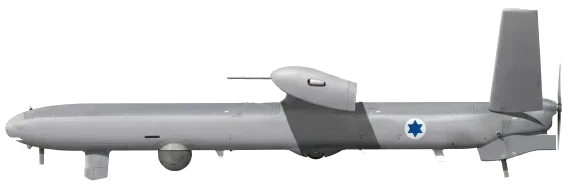
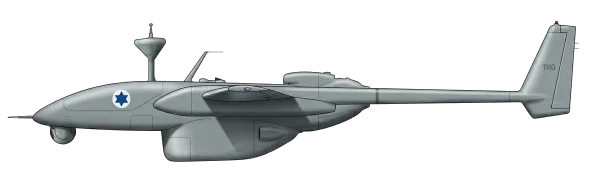
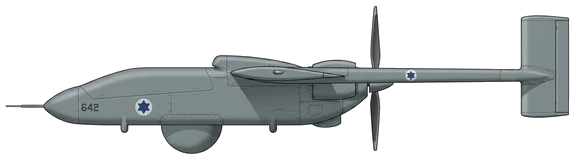
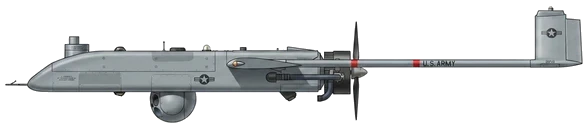
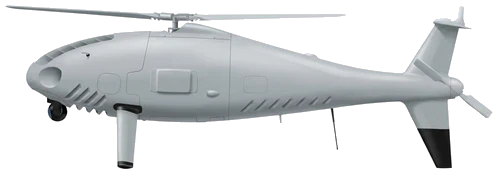
Description
The HAI E1-79 Pegasus II (Greek: ΕΑΒ Ε1-79 Πήγασος) is a Greek medium-altitude long-endurance unmanned aerial vehicle produced by Hellenic Aerospace Industry (HAI/EAB). It entered service with the Hellenic Air Force in 2005 as the upgraded derivative of the first-generation Pegasus, which had become operational in 1992. Its primary mission is intelligence, surveillance and reconnaissance over-battlefield (ISR-OB), and it is the only indigenously developed UAV to reach operational status in Hellenic Air Force service.
Development
Development of the original Pegasus was conducted jointly by the Hellenic Air Force Research and Development Centre (KETA) and HAI, beginning in 1979, with the prototype's maiden flight in 1982. Ten first-generation aircraft, along with ground station infrastructure, were built by HAI, with additional airframes produced by the State Aircraft Factory (KEA) for performance optimisation; the type became operational in 1992. The first-generation aircraft had a length of 2.1 m, a wingspan of 5 m, a maximum speed of 160 km/h, a minimum speed of 75 km/h, a takeoff weight of 130 kg and an endurance of 3.5 hours. The upgraded Pegasus II (Block I) was introduced in 2005, with 16 units built by KEA and HAI between 2005 and 2007. Four remain operational, together with their ground stations and equipment.
Design
The Pegasus II uses a conventional UAS layout with a slab-sided fuselage, high-mounted wings and a twin-boom configuration, the booms extending from the trailing edge of each mainplane and terminating in vertical tailplanes joined by a shared horizontal surface. Propulsion is by a single Zanzottera 498 PRO-B piston engine of 38 hp (28 kW) at 6,700 rpm driving a pusher propeller. The undercarriage is fixed tricycle type and the aircraft takes off from wheels. A protruding fairing above the fuselage houses a disc-shaped telecommunications antenna, and a trainable turret under the fuselage carries sensor and camera equipment. Composite materials are used widely in the airframe. Dimensions are 4.3 m in length and 6.2 m in wingspan, with a takeoff weight of 250 kg, maximum payload of 50 kg, maximum speed of 105 kt (194 km/h), operational ceiling of 12,000 ft (3,658 m) and endurance of 15 hours. The ground control team numbers four: a mission commander, internal pilot, payload operator and external pilot. The aircraft has been evaluated as an ELINT payload carrier; use as a weapons carrier has been limited by the small payload capacity.
Operational History
Greece is the sole operator. The Hellenic Air Force operates four Pegasus II with the 390 UAS Squadron "Acheron" of the 110 Combat Wing at Larissa, the squadron having relocated there from Aktio. The 390 UAS Squadron was the first operational UAS squadron in Hellenic Air Force history.
Variants
- E1-79 Pegasus: First-generation aircraft with 5 m wingspan, 130 kg takeoff weight and 3.5 hours endurance, operational from 1992; ten built.
- E1-79 Pegasus II (Block I): Enlarged MALE version with new electronics, composite construction, 250 kg takeoff weight and 15 hours endurance, introduced in 2005; 16 built.
Frequently Asked Questions
What type of aircraft is the Pegasus II?
What is the maximum speed of the Pegasus II?
How many Pegasus II have been built?
Which countries operate the Pegasus II?
How much does a Pegasus II cost?
What is the service ceiling of the Pegasus II?
- AUG 202026 Updated Unit price filled (1.0 $M, estimate) for the UAV inventory weighting.
- AUG 202026 Created Pegasus II (HAI E1-79) page created: specs, description, Greece origin/operator, 5 related aircraft