R-99 Erieye
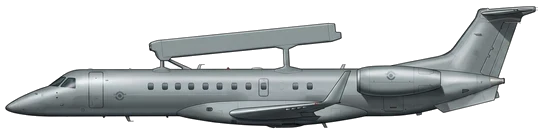
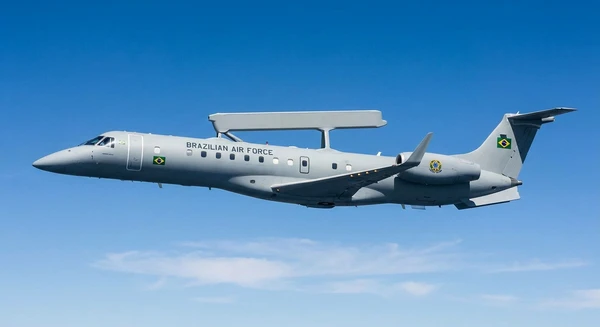
Brazilian airborne early warning and control (AEW&C) aircraft based on the Embraer ERJ-145 regional jet, fitted with the dorsal Saab Erieye radar. Key figures: top speed 833 km/h, range 3,000 km, service ceiling 11,278 m, max takeoff weight 24,100 kg. In service with 3 air forces as of 2026 — Brazil (5), Greece (4), Mexico (3).
| Crew | 7 (2 flight crew, 5 mission operators) |
| Length | 29.9 m (98.0 ft) |
| Wingspan | 20.0 m (65.7 ft) |
| Height | 6.8 m (22.2 ft) |
| Wing area | 51.2 m² (550.9 sqft) |
| Empty weight | 12,591 kg (27,758 lbs) |
| Max. takeoff weight | 24,100 kg (53,131 lbs) |
| Powerplant | 2 × Rolls-Royce AE 3007 40 kN each |
| Maximum speed | 833 km/h (518 mph) |
| Operational range | 3,000 km (1,864 mi) |
| Endurance | 8 hours |
| Service ceiling | 11,278 m (37,001 ft) |


Description
Development of the Embraer R-99, the military designation for the EMB-145-RS, began in the 1990s to meet a Brazilian Air Force (FAB) requirement. Based on the ERJ 145 civil regional jet, the aircraft is powered by two Rolls-Royce AE1 3007 turbofans providing 20% more thrust than the civil version. The first flight occurred in 1999, and the type entered service with the FAB in 2001. In 2013, the FAB initiated a modernization program to update the electronics and radar of its E-99 fleet, delivering the first upgraded E-99M on November 27, 2020.
Design
The E-99 AEW&C variant carries a Saab Microwave Systems Erieye active electronically scanned array (AESA) radar. The modernized E-99M utilizes an Erieye-ER radar, which increased detection range from 450 km to 723 km, allowing tracking of assets from vessels and rubber dinghies to hovering helicopters. The R-99 remote sensing variant uses a synthetic aperture radar, electro-optical and FLIR systems, a multi-spectral scanner, and signals intelligence suites. The EMB 145 MP maritime patrol version omits the multi-spectral scanner and side-looking radar but retains ELINT and C3I capabilities. The proposed P-99 anti-submarine warfare variant was designed to carry torpedoes and anti-ship missiles on four underwing hardpoints, though no prototype was flown.
Operational History
The FAB operates five E-99s and three R-99s. Export users include Greece (four EMB-145-H), Mexico (one EMB-145-SA and two EMB-145-MP), and India, which operates three EMB-145-I aircraft fitted with an indigenous AESA radar and mission systems under No. 200 Squadron IAF. In September 2003, a Brazilian R-99 located 71 hostages in Peru by detecting VHF signals. In June 2009, a Brazilian R-99 used its synthetic aperture radar to locate wreckage from Air France Flight 447. Hellenic Air Force EMB-145-Hs flew missions during the 2011 Libyan intervention and monitored NATO airspace over Romania and Bulgaria during the 2022 Russian invasion of Ukraine.
Variants
-
R-99A/E-99/EMB 145 AEW&C: An airborne early warning and control aircraft equipped with the Saab Erieye AESA radar.
-
R-99B/R-99/EMB 145 MULTI INTEL: A remote sensing and signals intelligence platform equipped with a synthetic aperture radar, FLIR, and a multi-spectral scanner.
-
EMB 145 MP: A maritime patrol aircraft sharing sensors with the R-99B but lacking the multi-spectral scanner and side-looking radar.
-
P-99: A proposed anti-submarine warfare variant designed to carry weapons on four underwing hardpoints.
Frequently Asked Questions
What type of aircraft is the R-99 Erieye?
What is the maximum speed of the R-99 Erieye?
What is the range of the R-99 Erieye?
When did the R-99 Erieye first fly?
Which countries operate the R-99 Erieye?
What is the service ceiling of the R-99 Erieye?
- OCT 32026 Updated Alternative names updated
- JUN 302026 Created Page created: R-99 Erieye