Sea Harrier
British naval short take-off and vertical landing jet fighter, reconnaissance and attack aircraft, developed in the late 1970s and operated from aircraft carriers for air defence and ground attack until the early 21st century. Key figures: top speed 1,145 km/h, range 3,222 km, service ceiling 16,000 m, max takeoff weight 11,884 kg, unit price $16M, built 111.
| Crew | 1 |
| Length | 14.2 m (46.5 ft) |
| Wingspan | 7.7 m (25.3 ft) |
| Height | 3.7 m (12.2 ft) |
| Wing area | 18.7 m² (201.1 sqft) |
| Empty weight | 6,616 kg (14,586 lbs) |
| Max. takeoff weight | 11,884 kg (26,200 lbs) |
| Powerplant | 1 × Rolls-Royce Pegasus 106 96 kN each |
| Maximum speed | 1145 km/h (711 mph) |
| Operational range | 3,222 km (2,002 mi) |
| Service ceiling | 16,000 m (52,493 ft) |
| Climb rate | 250.0 m/s (820.2 ft/s) |
- Air-to-Air Short-Range AIM-9 Sidewinder
- Air-to-Air Short-Range Matra R550 Magic
- Air-to-Air Medium-Range AIM-120 AMRAAM
- Air-to-Air Medium-Range Rafael Derby
- Anti-Radiation ALARM
- Anti-Radiation Martel missile
- Anti-Ship Sea Eagle
- Gun Pod 30 mm ADEN cannon
- Rocket Pod Matra rocket pods (SNEB 68 mm rockets)
- Unguided Bomb Iron bombs
- Cluster Bomb Cluster bombs
- Nuclear WE.177A
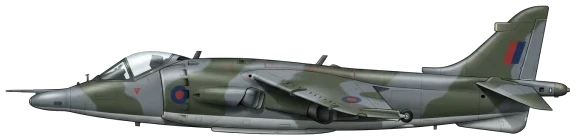
Description
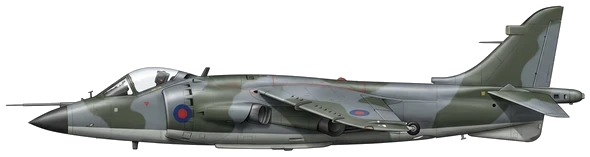
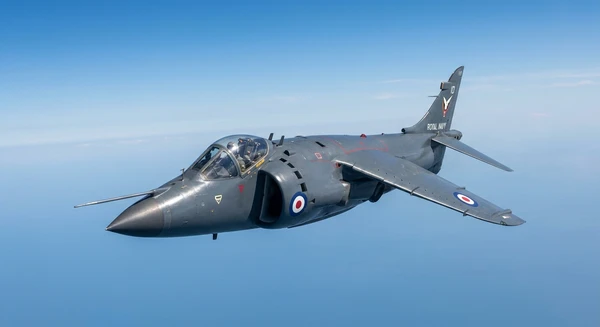
The British Aerospace Sea Harrier is a naval short take-off and vertical landing (V/STOL) jet fighter, reconnaissance, and attack aircraft. Developed from the Hawker Siddeley Harrier, the navalized variant was ordered by the Royal Navy in 1975 to provide air defense for task groups centered on Invincible-class carriers. The prototype conducted its first flight on 20 August 1978, and the aircraft entered service as the FRS1 in April 1980. British Aerospace delivered 57 FRS1 aircraft between 1978 and 1988, followed by an order for 18 new-build FA2 variants in 1990.
Design
The subsonic Sea Harrier is powered by a single Rolls-Royce Pegasus turbofan engine equipped with four vectorable nozzles. Aerodynamic modifications from the land-based Harrier GR3 include a raised cockpit with a bubble canopy and an extended forward fuselage to accommodate radar systems. The airframe utilizes corrosion-resistant alloys and specialized coatings for maritime operations. The FRS1 variant uses the Ferranti Blue Fox radar, while the FA2 version is equipped with the Blue Vixen pulse-doppler radar and the Pegasus Mk 106 engine. In 2005, an "Autoland" system was tested to enable automated vertical landings at sea.
Armament
Armament is carried on four under-wing pylons, one centerline fuselage pylon, and two attach points for 30 mm ADEN cannon pods. The aircraft has a maximum payload capacity of 8,000 lb. Air-to-air ordnance includes the AIM-9 Sidewinder and, on the FA2 variant, the AIM-120 AMRAAM. Surface-attack munitions include the Sea Eagle anti-ship missile, ALARM and Martel anti-radiation missiles, and Matra rocket pods containing 68 mm SNEB rockets. The aircraft is also cleared for unguided iron bombs and the WE.177A.
Operational History
The Sea Harrier's primary combat deployment occurred during the 1982 Falklands War, where 28 aircraft operated from HMS Invincible and HMS Hermes. Sea Harriers recorded 20 air-to-air victories during the conflict with no air-to-air losses, though two were lost to ground fire and four to accidents. In the 1990s, the aircraft participated in the Bosnian War, Operation Allied Force, and Operation Palliser. The Royal Navy retired the type in 2006. The Indian Navy, the sole export customer, procured 30 aircraft beginning in 1983. These operated from the carriers INS Vikrant and INS Viraat, undergoing upgrades with Elta EL/M-2032 radars and Derby missiles before their final retirement in 2016.
Variants
- Sea Harrier FRS.1: Initial production version configured for fighter, reconnaissance, and strike missions with Blue Fox radar.
- Sea Harrier FRS.51: Export variant for the Indian Navy, initially equipped with Matra R550 Magic missiles.
- Sea Harrier FA2: Upgraded model featuring Blue Vixen pulse-doppler radar and AIM-120 AMRAAM compatibility.
Frequently Asked Questions
What type of aircraft is the Sea Harrier?
What is the maximum speed of the Sea Harrier?
What is the range of the Sea Harrier?
When did the Sea Harrier first fly?
How many Sea Harrier have been built?
Which countries operate the Sea Harrier?
How much does a Sea Harrier cost?
What is the service ceiling of the Sea Harrier?
- AUG 122026 Updated Range corrected to the ferry range with drop tanks
- MAY 102026 Created Page created: Sea Harrier