Shenyang J-35
China's first carrier-capable fifth-generation stealth multirole fighter Key figures: top speed 1,905 km/h, range 3,500 km, service ceiling 16,000 m, max takeoff weight 28,000 kg, unit price $60M, built 57. In service with 1 air force as of 2026 — China (57).
| Crew | 1 |
| Length | 17.3 m (56.8 ft) |
| Wingspan | 11.5 m (37.7 ft) |
| Height | 4.8 m (15.7 ft) |
| Max. takeoff weight | 28,000 kg (61,729 lbs) |
| Powerplant | 2 × Guizhou WS-19 afterburning turbofan 8,892 kgf each |
| Maximum speed | 1905 km/h (Mach 1.8) |
| Operational range | 3,500 km (2,175 mi) |
| Service ceiling | 16,000 m (52,493 ft) |

- CM-506KG precision guided glide bomb
- 500 kg deep-penetration bomb
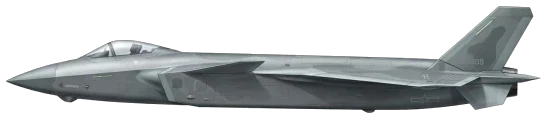

Description
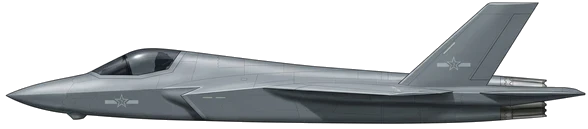
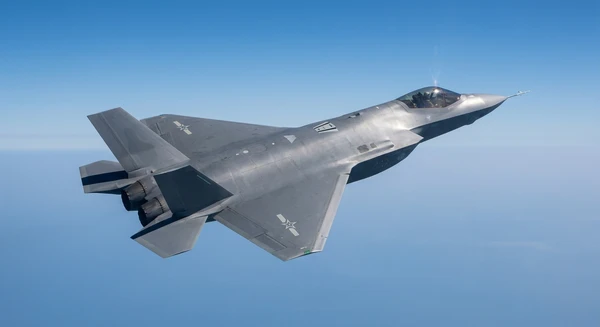
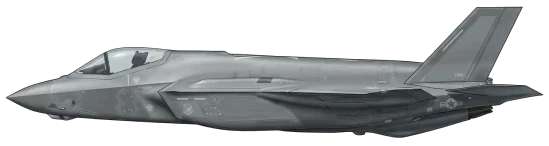
The Shenyang J-35 is a twin-engine, all-weather stealth multirole fighter manufactured by Shenyang Aircraft Corporation (SAC). The aircraft was developed from the FC-31 Gyrfalcon, a privately funded prototype that first flew on October 31, 2012. Following interest from the People's Liberation Army, a modified carrier-based variant optimized for catapult-assisted takeoff (CATOBAR) conducted its maiden flight on October 29, 2021. A land-based variant, designated J-35A, performed its first flight on September 26, 2023, and officially debuted at the 2024 China International Aviation & Aerospace Exhibition. On September 3, 2025, Chinese state media announced the J-35 and J-35A had entered service with the People's Liberation Army Naval Air Force (PLANAF) and Air Force (PLAAF).
Design
The airframe uses a conventional configuration with a blended body, trapezoidal wings, and canted swept-back vertical stabilizers. Stealth features include edge-aligned control surfaces, serpentine S-ducts to obscure engine blades, and sawtooth edges on compartment doors and antennas. A retractable Luneburg lens is fitted to the fuselage to manage radar signatures. The avionics suite includes the KLJ-7A active electronically scanned array (AESA) radar, a distributed aperture system (DAS) for optical early warning, and a chin-mounted electro-optical targeting system (EOTS). The cockpit is equipped with a single-piece multi-function touchscreen display, a side stick or center stick controller, and a helmet-mounted display system.
Early prototypes utilized Klimov RD-93 engines, which were replaced by the indigenous Guizhou WS-13E. The J-35 uses the WS-21 (WS-13X) as an interim powerplant, providing 93.2 kN of thrust. The intended final production engine is the Guizhou WS-19, designed for approximately 110–116 kN of thrust to allow for supercruise. The aircraft features a retractable refueling probe and has a combat radius of 1,250 km on internal fuel.
Armament
For armament, the J-35 contains a centerline internal weapons bay with six hardpoints and six additional external hardpoints on the wings. It has a maximum payload capacity of 8,000 kg. Internal carriage options include PL-10, PL-15, and PL-21 air-to-air missiles. Surface-strike munitions include the CM-506KG precision-guided glide bomb, 500 kg deep-penetration bombs, and supersonic land-attack or anti-ship missiles.
Operational History
In operational testing, the J-35 was certified for CATOBAR operations on September 22, 2025, following successful launches from the aircraft carrier Fujian using electromagnetic catapults. In June 2025, Pakistan officially announced plans to acquire the aircraft, with delivery expected within two years.
Variants
- FC-31 No. 31003: The second flying prototype featuring a modified airframe, WS-13E engines, and upgraded electronics.
- J-35: The naval variant featuring a catapult launch bar, folding wings, and a recovery tailhook for carrier operations.
- J-35A: The land-based variant designed for the PLAAF with a smaller wing area and a single-wheel nose landing gear.
- J-35AE: The export-specific version of the land-based J-35A first revealed in May 2026.
- J-31B Gyrfalcon: A variant unveiled in 2024 featuring side weapon bays and a larger airframe than early prototypes.
Frequently Asked Questions
What type of aircraft is the Shenyang J-35?
What is the maximum speed of the Shenyang J-35?
What is the range of the Shenyang J-35?
When did the Shenyang J-35 first fly?
How many Shenyang J-35 have been built?
Which countries operate the Shenyang J-35?
How much does a Shenyang J-35 cost?
What is the service ceiling of the Shenyang J-35?
- AUG 272026 Updated Unit price re-based (flyaway cost of the most-produced variant, then-year USD convention)
- AUG 102026 Updated Sources and cross-references refreshed
- AUG 52026 Updated Thrust updated
- AUG 12026 Updated Manufacturer updated
- JUL 272026 Updated Sources and cross-references refreshed
- MAY 232026 Updated Powerplant updated
- MAY 202026 Updated Description added