KF-21 Boramae vs Shenyang J-35
KF-21 Boramae vs Shenyang J-35 at a glance — top speed 2,200 vs 1,905 km/h, range 2,900 vs 3,500 km, max takeoff weight 25,401 vs 28,000 kg.
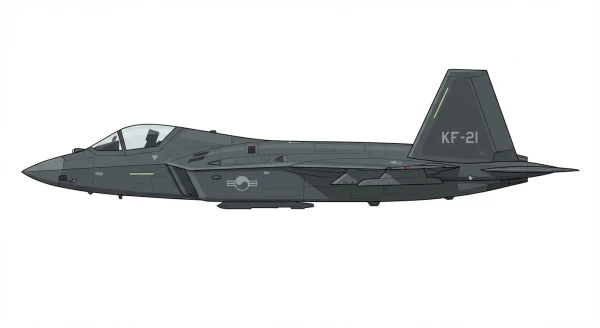
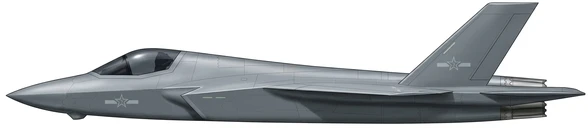
| KF-21 Boramae | Shenyang J-35 | |
|---|---|---|
| Origin country | 🇰🇷 South Korea | 🇨🇳 China |
| Category | Combat Aircraft | Combat Aircraft |
| Manufacturer | KAI | Shenyang |
| First flight | 19 July 2022 | 29 October 2021 |
| Year introduced | 2026 | 2025 |
| Number produced | N/A | 57 units |
| Average unit price | $87.5 million | $60 million |
| Wing area | 46.0 m² | -- m² |
| Wingspan | 11.2 m | 11.5 m |
| Height | 4.8 m | 4.8 m |
| Length | 16.8 m | 17.3 m |
| Maximum speed | 2200 km/h | 1905 km/h |
| Operational range | 2,900 km | 3,500 km |
| Service ceiling | 16,764 m | 16,000 m |
| Max. takeoff weight | 25,401 kg | 28,000 kg |
| Empty weight | 11,793 kg | -- kg |
| Total thrust | 2 x 9,983 kgf | 2 x 8,892 kgf |
Detailed Comparison
The Shenyang J-35 operates as China’s first purpose-built, carrier-capable stealth fighter, designed to project naval airpower in the Indo-Pacific. The KAI KF-21 Boramae trades immediate low-observable geometry for lower developmental risk, prioritizing the rapid fielding of a 4.5-generation airframe powered by mature Western subsystems to recapitalize South Korea's aging interceptor fleet.
Development and Design
SAC developed the J-35 from the privately funded FC-31 prototype, pivoting the airframe to meet People's Liberation Army Navy (PLAN) requirements for the CATOBAR-equipped carrier Fujian. Its design strictly adheres to fifth-generation low-observable principles: internal weapons bays, serpentine S-ducts obscuring engine turbine blades, and edge-aligned control surfaces. KAI executed a pragmatic, risk-averse route with the KF-21. Designed to replace legacy F-4 and F-5 fleets, the Boramae utilizes an iterative block approach. Block I and II rely on external weapons carriage, inherently limiting radar cross-section (RCS) reduction but accelerating the manufacturing timeline. KAI defers full stealth capabilities and internal bays to the proposed Block III (KF-21EX) standard.
Specifications and Performances
At a maximum takeoff weight of 28,000 kg, the J-35 is heavier and geared toward extended maritime operations, yielding a 3,500 km range compared to the KF-21's localized 1,000 km combat radius constraint. While KAI quotes a higher top speed of 2,200 km/h, this kinematic performance degrades predictably when carrying its 7,700 kg payload externally. The KF-21 bypasses engine development hurdles entirely by adopting licensed twin F414-KI turbofans, guaranteeing dispatch reliability and immediate integration of allied ordnance:
- AIM-120 AMRAAM and MBDA Meteor for beyond-visual-range engagements
- GBU-32/B JDAM for precision ground strike
- IRIS-T and AIM-9X Sidewinder for short-range intercepts
Conversely, the J-35’s true potential hinges on domestic engine maturation. Until the planned 116 kN WS-19 engines fully replace the interim 93.2 kN WS-21s, the airframe lacks the thrust-to-weight ratio required for supercruise.
Deployment and usage
Neither airframe possesses operational combat history. The J-35 achieved certification for electromagnetic catapult launches aboard the Fujian in September 2025, marking the PLAN’s transition away from ski-jump carriers. Beijing is simultaneously pushing the land-based J-35A into the PLAAF to complement the heavier J-20, while securing an export order from Pakistan to counter India's Rafale acquisitions. The KF-21 enters Republic of Korea Air Force service in 2026. Seoul mandates 120 active units by 2032 to maintain force mass against North Korean artillery and armor. KAI markets the platform heavily as an ITAR-free alternative to the F-35 for nations facing budget or export constraints, though partner nation Indonesia has frequently defaulted on its 20% program funding obligations.
Conclusion
The J-35 holds the tactical edge in contested, penetrating strike and fleet defense missions. Its internal carriage and edge-aligned geometry allow it to operate inside adversary air defense networks where the KF-21 would be detected early due to its external payload. However, the KF-21 is the superior platform for rapid force recapitalization and coalition interoperability. By eschewing immediate internal-bay requirements, South Korea delivered a heavily armed, reliable fighter that avoids the chronic turbofan development bottlenecks plaguing Chinese aviation. For nations requiring immediate, mature combat mass with European missile compatibility, the KF-21 is the necessary procurement; for operating inside a modern anti-access/area denial environment, the J-35 dictates the standard.