Shenyang J-35 vs Su-57 Felon
Shenyang J-35 vs Su-57 Felon at a glance — top speed 1,905 vs 2,135 km/h, range 3,500 vs 4,500 km, max takeoff weight 28,000 vs 35,000 kg, built 57 vs 32 units.
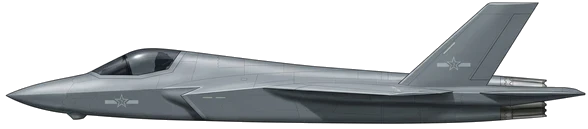

| Shenyang J-35 | Su-57 Felon | |
|---|---|---|
| Origin country | 🇨🇳 China | 🇷🇺 Russia |
| Category | Combat Aircraft | Combat Aircraft |
| Manufacturer | Shenyang | Sukhoi |
| First flight | 29 October 2021 | 29 January 2010 |
| Year introduced | 2025 | 2020 |
| Number produced | 57 units | 32 units |
| Average unit price | $60 million | $42 million |
| Wing area | -- m² | 78.8 m² |
| Wingspan | 11.5 m | 14.1 m |
| Height | 4.8 m | 4.6 m |
| Length | 17.3 m | 20.1 m |
| Maximum speed | 1905 km/h | 2135 km/h |
| Operational range | 3,500 km | 4,500 km |
| Service ceiling | 16,000 m | 20,000 m |
| Max. takeoff weight | 28,000 kg | 35,000 kg |
| Empty weight | -- kg | 18,500 kg |
| Total thrust | 2 x 8,892 kgf | 2 x 14,500 kgf |
Detailed Comparison
Russia's Sukhoi Su-57 Felon and China's Shenyang J-35 occupy distinct weight classes and doctrinal roles within their respective fifth-generation ecosystems. Sukhoi engineered a 35,000 kg heavy air-superiority platform reliant on thrust-vectoring and frontal stealth, while Shenyang evolved a 28,000 kg medium-weight, carrier-optimized multirole fighter. The Su-57 represents a protracted 20-year procurement effort yielding just 32 units. Conversely, the J-35 rapidly transitioned from a privately funded 2012 technology demonstrator to a dual-branch PLA asset with 57 airframes built by 2025.
Development and Design
Sukhoi’s PAK FA program, initiated in 1999, suffered from structural fatigue issues and repeated engine delays, ultimately losing its co-development partner, India, in 2018. The Su-57 sacrifices all-aspect low observability for aerodynamic performance. Its design leverages adjustable vortex controllers (LEVCONs) and 3D thrust-vectoring Saturn AL-41F1 engines for post-stall maneuverability. Its stealth geometry is compromised by exposed engine faces, only partially obscured by blocker grids. The J-35 prioritizes broad-spectrum signature reduction. Evolving from the FC-31, Shenyang incorporated cleaner S-ducts, sawtooth compartment doors, and edge-aligned control surfaces. Initially reliant on Russian RD-93s, the J-35 program cycled through interim WS-21s to integrate the indigenous 110–116 kN WS-19 turbofans.
Specifications and Performances
The Su-57 dictates the high-altitude, high-speed kinetic fight. With a maximum takeoff weight of 35,000 kg and a top speed of 2,135 km/h, it outpaces the J-35, which peaks at 1,905 km/h. Sukhoi integrated a complex internal carriage system utilizing two tandem main bays and two side bays. The J-35 opts for a simpler, single ventral bay carrying up to six PL-15 missiles, supplemented by external hardpoints.
Primary kinematic and structural differences dictate their deployment:
- The Su-57 utilizes a 78.8 m² wing area and thrust-vectoring nozzles to gain a clear aerodynamic advantage in within-visual-range engagements.
- The J-35 accepts kinetic penalties to integrate structural reinforcements required for electromagnetic catapult launches and arrested recoveries.
Deployment and usage
The Russian Aerospace Forces confine the Su-57 to standoff roles to avoid combat losses. During the invasion of Ukraine, the aircraft has operated primarily within Russian airspace to launch long-range munitions like the Kh-69. Despite this risk aversion, a Ukrainian drone strike damaged an airframe at Akhtubinsk air base in 2024. The J-35 lacks combat history but actively conducts carrier qualifications, executing electromagnetic catapult launches from the carrier Fujian in late 2025. Unlike the Su-57, which has failed to secure foreign buyers, the J-35 secured its first export order from Pakistan in June 2025.
Conclusion
The J-35 holds the advantage in all-aspect low observability, industrial scalability, and export viability. The Su-57 outclasses the J-35 in raw kinematics, range, and heavy weapons carriage—functioning effectively as a standoff missile truck—but its compromised stealth geometry and stagnant production line limit its operational utility. The J-35 provides a mass-produced fifth-generation carrier fighter that directly projects Chinese naval aviation capabilities, achieving the program execution and market penetration that the Su-57 failed to deliver.


