Skeldar V-200
Swedish medium-range vertical takeoff and landing unmanned aerial vehicle helicopter, developed in the early 21st century, used for military surveillance, intelligence gathering, and light cargo transportation. Key figures: top speed 140 km/h, range 100 km, service ceiling 3,000 m, max takeoff weight 245 kg. In service with 2 air forces as of 2026 — Canada (6), Germany (2).
| Length | 4.0 m (13.2 ft) |
| Wingspan | 4.6 m (15.1 ft) |
| Height | 1.3 m (4.3 ft) |
| Max. takeoff weight | 245 kg (540 lbs) |
| Maximum speed | 140 km/h (87 mph) |
| Operational range | 100 km (62 mi) |
| Endurance | 6 hours |
| Service ceiling | 3,000 m (9,843 ft) |
Description
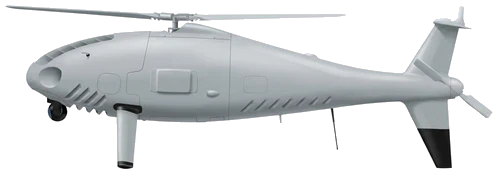
The UMS Skeldar V-200 is a medium-range vertical takeoff and landing (VTOL) unmanned aerial vehicle (UAV) developed by the Swedish aerospace company Saab. Development of the system began in 2005 as a derivative of CybAero's APID 55 UAV. Saab unveiled the precursor Skeldar V-150 in June 2006 at the Eurosatory exhibition in Paris, France, before developing the V-200 designation. In 2009, Saab partnered with Swiss UAV to jointly market the V-200 alongside the Neo S-300 and Koax X 240, using a common ground control station. Saab subsequently partnered with UMS in late 2015 to establish the joint company UMS Skeldar.
Design
The V-200 is powered by a 55 hp (41 kW) engine, providing a maximum speed of 140 km/h, a mission radius of 100 km, and an endurance of over six hours. It has a length of 4.031 meters, a main rotor diameter of 4.6 meters, and a maximum takeoff weight of 245 kg. The aircraft can operate up to a service ceiling of 3,000 meters and requires less than 15 minutes of takeoff preparation time. It can take off and land autonomously within a 15-by-15-meter area. The V-200 features a modular payload capacity of 40 kg, supporting systems such as electro-optical and infrared (EO/IR) 3D mapping, laser pointers, range finders, signals intelligence (SIGINT) equipment, and a light cargo hook. A crew of two to four personnel operates the system. The control station can integrate into ground vehicles, such as armored personnel carriers or trucks, or into naval combat management systems and operator consoles.
Operational History
The V-200 is configured for surveillance, intelligence gathering, light cargo transportation, and electronic warfare. It is operated by the Belgian Navy and the Royal Netherlands Navy for use on future mine countermeasure vessels (MCMVs), with the first scheduled to be operational in 2024. The Royal Canadian Navy operates the system under the designation CU-176 Gargoyle. Additional operators include the Indonesian Ministry of Defence and the Spanish Navy, which has conducted trials with the aircraft. In September 2018, the German Navy selected the V-200B variant for its K130 Braunschweig-class corvettes; however, following multiple delays, the project was cancelled in July 2024.
Variants
- Skeldar V-150: The initial version of the UAV system, unveiled at the Eurosatory exhibition in June 2006.
- Skeldar V-200: The developed version of the VTOL UAV system.
- UMS Skeldar V-200B: A variant selected by the German Navy in 2018 for corvette operations before the procurement was cancelled in 2024.
Frequently Asked Questions
What type of aircraft is the Skeldar V-200?
What is the maximum speed of the Skeldar V-200?
What is the range of the Skeldar V-200?
Which countries operate the Skeldar V-200?
What is the service ceiling of the Skeldar V-200?
- JUL 62026 Created Page created: Skeldar V-200