Sokol Altius
Russian unmanned aerial vehicle, introduced in 2021, with high-altitude, long-endurance operations yet to be operationally deployed. Key figures: top speed 350 km/h, range 10,000 km, service ceiling 12,000 m, max takeoff weight 6,000 kg, built 3.
| Length | 11.6 m (38.1 ft) |
| Wingspan | 28.5 m (93.5 ft) |
| Empty weight | 6,000 kg (13,228 lbs) |
| Max. takeoff weight | 6,000 kg (13,228 lbs) |
| Powerplant | 2 × turboprop engines |
| Maximum speed | 350 km/h (217 mph) |
| Operational range | 10,000 km (6,214 mi) |
| Endurance | 48 hours |
| Service ceiling | 12,000 m (39,370 ft) |
Description
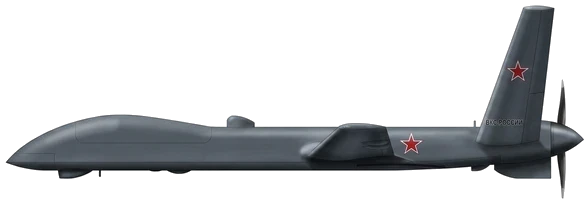
The Sokol Altius (also Altair) is a Russian medium-altitude long-endurance (MALE) unmanned combat aerial vehicle developed by OKB Sokol, the former Simonov Design Bureau in Kazan, with Tranzas, and built by the Kazan division of the Ural Civil Aviation Plant (UZGA) for the Russian Aerospace Forces and Navy. It is intended for reconnaissance, strike and electronic attack. The programme began in 2011 and the first demonstrator flew in 2016; after three demonstrator designs and repeated delays, a pre-series batch was reported ordered in 2021 and the Russian defence minister declared testing complete that December, although a Western assessment in March 2023 still placed it in state testing.
Development
The programme started in October 2011, when the Russian Ministry of Defence awarded OKB Sokol a 3 billion ruble contract. It produced three demonstrators: the Altair, unveiled in 2014 and first flown in 2016; the larger Altius-M, first seen in 2017; and the Altius-U, which the Ministry said made a fully automatic 32-minute maiden flight to 800 m (2,600 ft) on 20 August 2019, after the project had been transferred to UZGA at the end of 2018. The Altius-RU is the fourth configuration and the one intended for serial production. Russian media reported in August 2019 that a satellite-controlled naval version, in reconnaissance and anti-ship strike variants, had been decided on early that year.
Development ran well behind the original plan, which had called for full operational capability by 2018. Costs rose and Russia lost access to the imported engines originally used, forcing it to develop a domestic powerplant. In April 2018 the authorities arrested the design bureau's director general on suspicion of embezzling 900 million rubles allocated to the project. Russian media reported in September 2019 that the Altius would form the backbone of Russia's heavy drone fleet, and on 20 February 2021 a state contract was reported for a pre-series "installation batch" to be built by UZGA's Kazan division. In December 2021 the Russian defence minister said Altius-RU trials had been completed. The US Treasury designated UZGA on 26 January 2023, naming it as the Altius developer and saying it had used its personnel to repair UAVs used in Russia's full-scale invasion of Ukraine.
Design
The Altius follows a conventional layout with a high-mounted wing of large span and a V-tail, and makes wide use of composite structural materials; it has retractable tricycle landing gear and, according to the manufacturer, fully automatic take-off and landing. It is powered by two VK-800C turboprop engines developed by the Klimov Design Bureau. The Altius-M demonstrator has a reported length of 11.6 m (38 ft), a wingspan of 28.5 m (93 ft 6 in) and a cruising speed of 150–250 km/h (93–155 mph). The Altius-U demonstrator has an empty weight of 6,000 kg (13,228 lb), a maximum take-off weight of 8,000 kg (17,637 lb) and a payload of 1,000 kg (2,200 lb), with a range of 10,000 km (6,200 mi) and a service ceiling of 12,000 m (39,000 ft).
Endurance is given as more than 24 hours by the Russian defence ministry, while UZGA claimed up to 48 hours in 2021, together with a ceiling of 14,000 m (46,000 ft), a 2 t (4,400 lb) combat payload and a combat radius of about 3,500 km (2,200 mi). The ministry describes the sensor fit as optical, signals and radar reconnaissance equipment, and UZGA claimed in 2021 that the Altius-RU was the first Russian UAV to pass both control commands and reconnaissance data over a satellite link.
Armament
The Altius-U demonstrator flew with two underwing pylons. The Russian defence minister said in December 2021 that the Altius-RU carries the universal weapons complex already fielded on the Orion UAV, comprising free-fall and guided small-calibre bombs and guided missiles, and Russian media reported its first bombing strikes on ground targets during tests in June 2021. A 2020 Air Force Technology feature also listed the Grom family of glide bombs among its possible payloads.
Operational History
Although the Russian defence minister declared Altius-RU testing complete in December 2021, the type's service status remains unclear: a March 2023 assessment by the CNA research organisation described it as single examples still under state testing, listed it as not present in Ukraine, judged it highly unlikely to appear there any time soon and noted that serial production, scheduled for 2023–2025, could be delayed further by Western sanctions. On 8 July 2025 an Altius crashed into a house on a dacha plot north of Kazan, about 1 km (0.6 mi) short of the runway at Borisoglebskoye airfield, while landing from a test flight; no casualties were reported, and UZGA said that unidentified external electronic-warfare equipment had disrupted its satellite navigation, after which the aircraft continued on inertial navigation.
Variants
- Altair: First demonstrator, unveiled in 2014 and first flown in 2016.
- Altius-M: Second, larger demonstrator, of which three were built, first seen in 2017.
- Altius-U: Third and last demonstrator ("U" for udarny, combat), first flown in 2019, with a new satellite communication system that extended its flight range.
- Altius-RU: Fourth configuration ("RU" for razvedyvatelno-udarny, reconnaissance-strike), the final design for serial production.
Frequently Asked Questions
What type of aircraft is the Sokol Altius?
What is the maximum speed of the Sokol Altius?
What is the range of the Sokol Altius?
When did the Sokol Altius first fly?
How many Sokol Altius have been built?
Which countries operate the Sokol Altius?
What is the service ceiling of the Sokol Altius?
- OCT 32026 Updated Description expanded with flight testing, weapons trials, US Treasury sanctions on the developer and the July 2025 crash
- OCT 32026 Updated Description updated with the programme history, service entry in 2021 and the July 2025 crash
- AUG 132026 Updated Service entry year corrected in both the specification and the lede — the drone was accepted after its 2021 trials, not at first flight
- APR 82026 Updated Empty weight added
- APR 72026 Updated Picture credits updated in a site-wide editorial pass