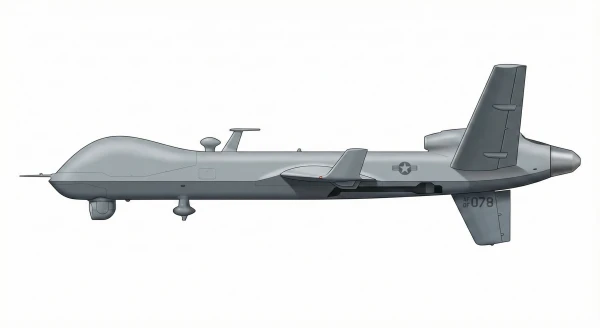
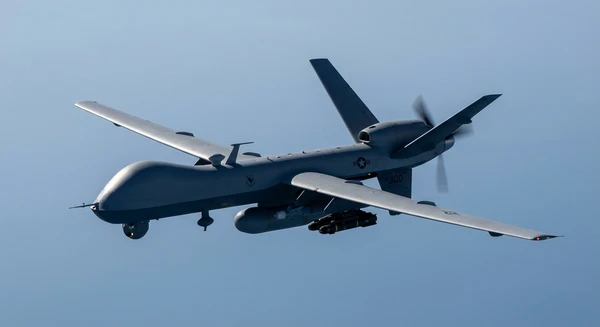
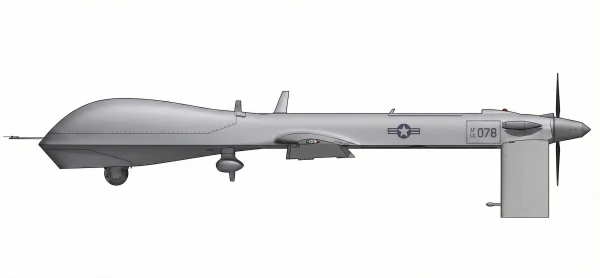
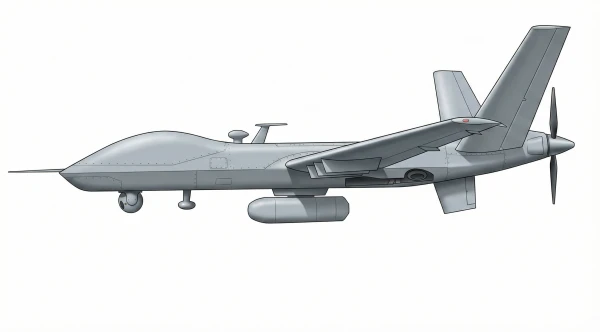
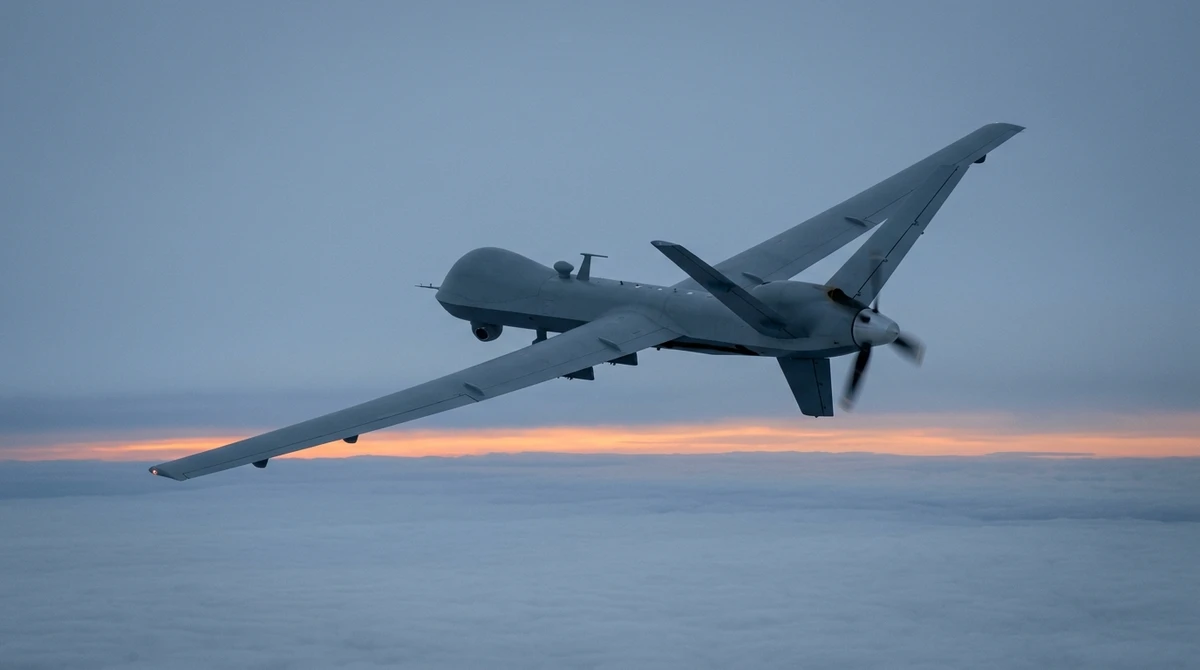
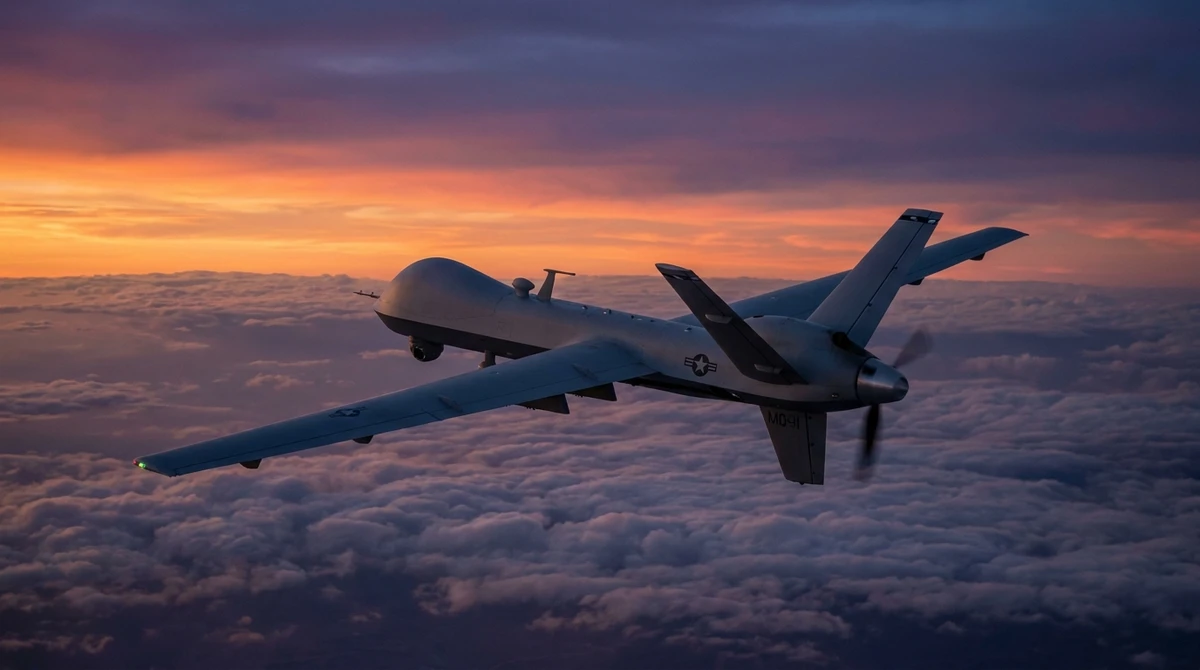
The General Atomics MQ-9 Reaper is a medium-altitude long-endurance remotely piloted aircraft developed in the United States by General Atomics Aeronautical Systems. Designed primarily as a hunter-killer unmanned aerial vehicle, the aircraft entered evaluation service with the United States Air Force in 2002 and began combat operations in 2007. It is known as the first hunter-killer UAV designed for long-endurance surveillance and strike operations.
Development
Design work began with the Predator B-001 proof-of-concept airframe, designed by Abraham Karem, which first flew on 2 February 2001 with an AlliedSignal Garrett TPE331-10T turboprop. The U.S. Air Force ordered two evaluation prototypes designated YMQ-9 in October 2001 and took delivery in 2002. Production expanded to provide persistent loitering capability over combat areas. As of May 2021, the U.S. Air Force operated over 300 MQ-9 aircraft out of a planned program total of 433 units.
Design
The MQ-9 features a 66-foot wingspan and a 950-shaft-horsepower Honeywell TPE331-10 turboprop engine. Flight operations are controlled remotely from a Ground Control Station by a pilot and sensor operator. Integrated systems include the Raytheon AN/DAS-1 Multi-Spectral Targeting System and Lynx Multi-mode synthetic aperture radar. Trailing-arm landing gear modifications increased gross takeoff weight to 11,700 pounds and supported automated takeoff and landing capability.
Armament
The aircraft carries up to 3,800 pounds of payload across seven hardpoints, with 3,000 pounds allocated to external stores. Standard armaments include up to eight AGM-114 Hellfire air-to-ground missiles, GBU-12 Paveway II laser-guided bombs, and GBU-38 Joint Direct Attack Munitions. It can also carry Brimstone missiles, AIM-9 Sidewinders, and external fuel tanks.
Operational History
The U.S. Air Force activated its first Reaper unit, the 432nd Wing, in May 2007 and conducted its first missile strike in Afghanistan in October 2007. The MQ-9 has seen combat across Iraq, Syria, Libya, Mali, Somalia, and Yemen. Export customers include the United Kingdom, France, Italy, Spain, the Netherlands, India, and Japan. Operational losses include ground destructions and surface-to-air missile shootdowns over Yemen, Libya, and Syria. The heaviest attrition in the type's history came with the war with Iran. US officials told the Washington Post in August 2026 that at least 45 Reapers had been lost since the war began — roughly a quarter of the fleet and more than 1.3 billion dollars of airframes — counting both combat losses and non-combat write-offs, including aircraft that crashed after their control links failed. Losses have been concentrated around the Strait of Hormuz, where the Reaper's low operating altitude and slow cruise leave it exposed to Iranian air defences.
Variants
-
MQ-9 Block 5: Upgraded variant featuring increased electrical power capacity, dual ARC-210 radios, higher gross takeoff weight, and automatic landing capabilities.
-
Reaper ER: Extended-range version equipped with external fuel tanks, heavy-weight landing gear, and alcohol-water injection to increase endurance to 34 hours.
-
MQ-9B SkyGuardian: Certifiable variant compliant with NATO STANAG 4671 standards, featuring a 79-foot wingspan, winglets, and over 40 hours of endurance.
-
SeaGuardian: Maritime variant of the MQ-9B fitted with a 360-degree surface search radar, AIS, and anti-submarine sonobuoy dispenser pods.
-
Guardian: Maritime surveillance variant operated by U.S. Customs and Border Protection equipped with a SeaVue marine search radar.