A400M Atlas vs An-178
A400M Atlas vs An-178 at a glance — top speed 780 vs 990 km/h, range 3,300 vs 3,680 km, max takeoff weight 141,000 vs 51,000 kg, built 174 vs 1 units.
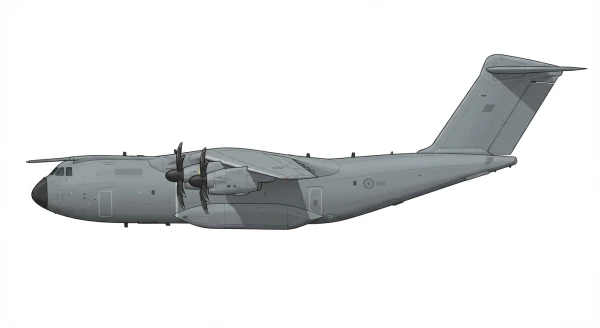
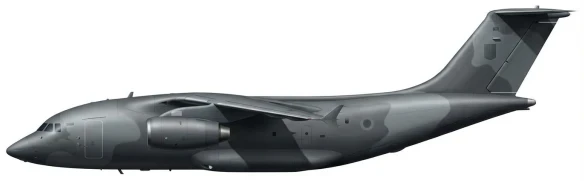
| A400M Atlas | An-178 | |
|---|---|---|
| Origin country | 🇪🇺 Europe | 🇺🇦 Ukraine |
| Category | Military Transport Aircraft | Military Transport Aircraft |
| Manufacturer | Airbus | Antonov |
| First flight | 11 December 2009 | 7 May 2015 |
| Year introduced | 2013 | 2023 |
| Number produced | 174 units | 1 units |
| Average unit price | $152 million | $35 million |
| Wing area | 221.5 m² | -- m² |
| Wingspan | 42.4 m | 30.6 m |
| Height | 14.7 m | 9.6 m |
| Length | 45.1 m | 32.2 m |
| Maximum speed | 780 km/h | 990 km/h |
| Operational range | 3,300 km | 3,680 km |
| Service ceiling | 12,500 m | 12,000 m |
| Max. takeoff weight | 141,000 kg | 51,000 kg |
| Empty weight | 66,500 kg | 18,350 kg |
| Total thrust | 4 x 8,203 kW | 2 x 7,502 kgf |
Detailed Comparison
The Airbus A400M Atlas occupies the procurement space between tactical C-130s and strategic C-17s, functioning as a 37-tonne airlift asset for European NATO members. The Antonov An-178 scales up a regional civilian jet airframe to target the 13-to-18-tonne niche previously held by Soviet-era An-12s. The A400M is a mature, widely fielded multinational program with 174 units delivered, while the An-178 remains a single flying prototype, its production halted by the 2022 Russian invasion of Ukraine.
Development and Design
Driven by European requirements to replace aging Transalls and Hercules, the A400M architecture revolves around the Europrop TP400-D6 turboprop engines. Generating 8,203 kW each with counter-rotating propellers, this configuration provides the required thrust for short, unpaved runway operations while cruising at speeds near Mach 0.72. The manufacturer utilized composite materials for over 30 percent of the airframe, including the 42.4-meter carbon fiber wingspan, reducing structural weight to offset the heavy propulsion system.
Antonov derived the An-178 from the An-158 regional airliner, widening the fuselage diameter from 3.35 to 3.9 meters to accommodate standard military cargo containers and installing a rear ramp. Equipped with two Progress D-436-148FM turbofans producing 7,502 kgf of thrust, the An-178 retains the An-158’s flight deck and fly-by-wire systems to minimize development costs.
Specifications and Performances
The payload capacity and procurement cost dictate entirely different operational models for these airframes.
- The A400M ($152.0 million) operates at a 141,000 kg maximum takeoff weight, lifting 37 tonnes over 3,700 km.
- The An-178 ($35.0 million) maxes out at 51,000 kg MTOW, carrying an 18-tonne payload over 1,000 km, or 10 tonnes to 4,000 km.
The An-178 achieves a higher maximum speed of 990 km/h via its twin turbofans, compared to the A400M's 780 km/h. However, the A400M's turboprop design maximizes low-speed lift and austere field performance, requiring 1,150 meters for takeoff fully loaded.
Deployment and usage
The A400M maintains a continuous combat deployment record since 2013. The French Armée de l'Air operated early production blocks in Operation Serval and Barkhane, utilizing the aircraft's dust-landing capabilities on unpaved Sahel strips. RAF Atlas fleets executed high-tempo airlift cycles during the 2021 Kabul airport evacuations, and the aircraft regularly conducts mixed airdrops of heavy equipment and airborne infantry.
The An-178 lacks operational history. Its sole prototype accrued roughly 200 flight hours in testing. Pre-war domestic orders for 16 units stalled when Antonov's Hostomel facilities became a battleground in early 2022. Export agreements with Peru and Saudi Arabia collapsed due to these delivery blockades and pre-war supply chain issues regarding Russian-sourced components.
Conclusion
The Airbus A400M holds the edge in all military airlift requirements. It successfully bridged the tactical-strategic gap, providing NATO with heavy-lift capacity into austere environments that a C-17 cannot access and a C-130 cannot carry. The An-178 cannot compete in the modern export market; stripped of its manufacturing base and supply chains, the An-178 is a stranded asset, while the A400M actively dictates European air logistics.