AW139 vs AW149
AW139 vs AW149 at a glance — top speed 310 vs 310 km/h, range 1,061 vs 1,009 km, max takeoff weight 6,400 vs 8,600 kg, built 1,100 vs 31 units.
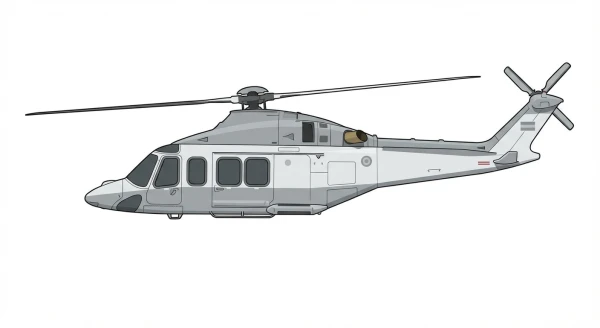
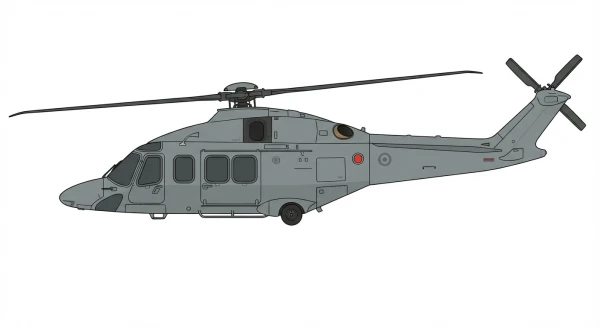
| AW139 | AW149 | |
|---|---|---|
| Origin country | 🇬🇧 United Kingdom🇮🇹 Italy | 🇬🇧 United Kingdom🇮🇹 Italy |
| Category | Military Helicopters | Military Helicopters |
| Manufacturer | AgustaWestland | AgustaWestland |
| First flight | 3 February 2001 | 13 November 2009 |
| Year introduced | 2003 | 2014 |
| Number produced | 1100 units | 31 units |
| Average unit price | $15 million | $16 million |
| Wingspan | 13.8 m | 14.6 m |
| Height | 3.7 m | 5.1 m |
| Length | 13.8 m | 17.6 m |
| Maximum speed | 310 km/h | 310 km/h |
| Operational range | 1,061 km | 1,009 km |
| Service ceiling | 6,096 m | 6,095 m |
| Max. takeoff weight | 6,400 kg | 8,600 kg |
| Empty weight | 3,622 kg | 4,720 kg |
| Total thrust | 2 x 1,141 kW | 2 x 1,476 kW |
Detailed Comparison
The Leonardo AW139 constitutes the benchmark for the modern militarized commercial off-the-shelf (COTS) rotorcraft strategy, securing over 1,100 orders through aggressive adaptability and cost-efficiency. Conversely, the AW149 represents a specific attempt to upsize that architecture into a dedicated military utility helicopter capable of challenging the Sikorsky UH-60 Black Hawk. While the AW139 dominates the intermediate twin market through ubiquity, the AW149 addresses the requirement for crashworthiness and payload capacity that exceeds the structural limits of a civilian-derived airframe.
Development and Design
The AW139 emerged from the dissolved Bell/Agusta joint venture, prioritizing speed, glass-cockpit ergonomics (Honeywell Primus EPIC), and passenger comfort for the VIP and offshore oil markets. Its militarization, seen in the AW139M and USAF MH-139 Grey Wolf, involves retrofitting armor, FLIR, and defensive aid suites onto a commercial shell. This approach yields lower acquisition costs but imposes weight penalties on a non-military airframe.
The AW149, launched in 2006, serves as a "Super-Medium" evolution. Leonardo engineered the fuselage for military survivability from the outset, incorporating landing gear rated for 9.5 m/s sink speeds—drastically higher than the civilian 2 m/s certification standard of the AW139. Additionally, the AW149 utilizes an open architecture avionics suite designed to integrate weapon systems without the proprietary bottlenecks found when up-arming civilian platforms.
Specifications and Performances
A 2,200 kg gap in Maximum Takeoff Weight (MTOW) defines the operational disparity. The AW139 maxes out at 6,400 kg (upgradable to 6,800 kg), while the AW149 reaches 8,600 kg. This mass increase is supported by General Electric CT7-3E1 engines providing 1,476 kW each, overshadowing the AW139’s Pratt & Whitney PT6C-67C (1,141 kW).
While both airframes list a top speed of 310 km/h, the AW149 trades agility for load-out flexibility. It utilizes four standard hardpoints capable of carrying AGM-114 Hellfire missiles or 12-tube rocket pods. While the AW139M can mount external stores, doing so significantly degrades its power-to-weight ratio compared to the purpose-built AW149. The AW149's larger cabin accommodates fully equipped infantry squads, whereas the AW139's seating density is optimized for civilian transport, often requiring reduction for combat-loaded troops.
Deployment and Usage
The AW139 possesses a logistical footprint unrivaled in its class. Operators like the Irish Air Corps, Italian Air Force, and US Air Force utilize it for roles ranging from permissive environment troop transport to ICBM field security. Its primary military advantage is the global availability of parts due to the massive civilian fleet, lowering sustainment costs.
The AW149 struggled initially, losing the Turkish Utility Helicopter Program to the S-70i Black Hawk. However, recent procurements by Egypt (24 units) and Poland (32 units) signal a shift. Poland’s decision to locally produce the AW149 highlights its role as a non-ITAR alternative to US platforms for nations seeking industrial offsets and heavy-utility capabilities without Sikorsky’s political restrictions.
Conclusion
The AW139 remains the superior choice for constabulary duties, search and rescue (SAR), and light security roles where operating costs outweigh ballistic survivability. It is a commercial aircraft drafted into service, excellent for non-combat environments.
The AW149 is the definitive combat transport between the two. It offers the crashworthiness, transmission durability, and weapon payload required for air assault and frontline utility. However, the AW149’s market viability relies on operators prioritizing European sourcing; in a straight competition for combat utility, it competes against the ubiquitous Black Hawk, while the AW139 has successfully carved out its own niche below that weight class.