B-2 Spirit vs Tu-160 Blackjack
B-2 Spirit vs Tu-160 Blackjack at a glance — top speed 972 vs 2,220 km/h, range 11,000 vs 12,300 km, max takeoff weight 170,200 vs 274,877 kg, built 21 vs 37 units.

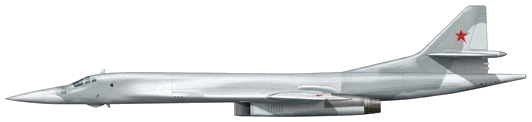
| B-2 Spirit | Tu-160 Blackjack | |
|---|---|---|
| Origin country | 🇺🇸 United States | 🇷🇺 Ex-USSR |
| Category | Bombers | Bombers |
| Manufacturer | Northrop | Tupolev |
| First flight | 17 July 1989 | 19 December 1981 |
| Year introduced | 1993 | 1987 |
| Number produced | 21 units | 37 units |
| Average unit price | $750 million | $250 million |
| Wing area | 478.0 m² | 232.0 m² |
| Wingspan | 52.0 m | 55.7 m |
| Height | 5.0 m | 13.1 m |
| Length | 21.0 m | 54.1 m |
| Maximum speed | 972 km/h | 2220 km/h |
| Operational range | 11,000 km | 12,300 km |
| Service ceiling | 15,240 m | 16,000 m |
| Max. takeoff weight | 170,200 kg | 274,877 kg |
| Empty weight | 71,668 kg | 109,769 kg |
| Total thrust | 4 x 7,847 kgf | 4 x 24,983 kgf |
Detailed Comparison
The Northrop B-2 Spirit and Tupolev Tu-160 Blackjack embody fundamentally different solutions to the strategic bomber mission, with the B-2 prioritizing all-aspect stealth for airspace penetration and the Tu-160 focusing on high-speed flight and long-range standoff weapons. The B-2 is a specialized, subsonic penetrator, while the Tu-160 is a versatile supersonic cruise missile carrier. The B-2's development was a technology-driven effort to defeat advanced air defenses, whereas the Tu-160 was a Soviet response to the American B-1 program, designed for both high-altitude supersonic dash and low-level flight.
Development and Design
The B-2 Spirit emerged from the top-secret Advanced Technology Bomber project. Its design is a pure flying wing, which maximizes aerodynamic efficiency and is essential for its low-observable (stealth) characteristics. This required pioneering computer-aided design and manufacturing to achieve the necessary surface tolerances. The entire airframe is a trade-off for stealth, sacrificing supersonic speed for an exceptionally low radar, infrared, and acoustic signature. This design philosophy aims to render traditional support aircraft for electronic warfare and air defense suppression less necessary.
The Tu-160 Blackjack utilizes a more conventional, albeit massive, variable-geometry wing design. This allows it to optimize its wing sweep for different flight regimes: swept forward for efficient low-speed flight and landing, and swept back for reduced drag during its Mach 2+ supersonic dash. Its design prioritizes speed and payload delivery from the edge of enemy airspace, relying on long-range cruise missiles like the Kh-55MS to strike targets from a safe distance.
Specifications and Performances
While both aircraft carry an identical maximum ordnance load of 40,000 kg (88,000 lb), their performance envelopes are drastically different. The Tu-160 is significantly larger, heavier (274,877 kg MTOW vs. the B-2's 170,200 kg), and dramatically faster, with a top speed of 2,220 km/h compared to the B-2's subsonic 972 km/h. This speed is enabled by its four powerful Kuznetsov NK-32 afterburning turbofans. The B-2's range is listed at 12,000 km, slightly less than the Tu-160's 14,000 km, though both have global reach with aerial refueling. The B-2's key performance metric is not speed, but its ability to operate undetected within sophisticated Integrated Air Defense Systems (IADS), a capability the Tu-160 lacks.
Deployment and usage
The B-2 has an extensive and documented combat history, serving as a "first night" asset in multiple conflicts including Kosovo, Afghanistan, Iraq, and Libya. Its operational concept involves flying extremely long-duration, non-stop missions from its home base in Missouri or forward operating locations, penetrating contested airspace to deliver precision munitions like JDAMs and the Massive Ordnance Penetrator (MOP). Serviceability of its low-observable coatings has been a noted maintenance challenge.
The Tu-160's operational use was minimal in the immediate post-Soviet era, with a significant portion of the fleet being repatriated from Ukraine. In recent years, a modernized fleet has been used by Russia primarily as a standoff weapons platform, launching cruise missiles from permissive airspace. Production of the modernized Tu-160M variant has resumed, indicating its continued role as a key component of Russia's strategic deterrent.
Conclusion
The B-2 Spirit is a highly specialized and costly asset, representing a singular focus on penetrating strike through stealth. Its effectiveness is tied to its ability to remain undetected, making it a unique tool for dismantling advanced air defenses. In contrast, the Tu-160 is a more conventional strategic bomber that leverages speed and long-range missiles. It functions as a powerful deterrent and a flexible standoff strike platform, trading survivability within contested airspace for the ability to launch attacks from vast distances. Each represents a logical, yet divergent, response to the challenges of strategic power projection.

