Bayraktar TB2 vs TAI Anka
Bayraktar TB2 vs TAI Anka at a glance — top speed 222 vs 217 km/h, range 300 vs 2,500 km, max takeoff weight 1,200 vs 1,700 kg, built 600 vs 102 units.

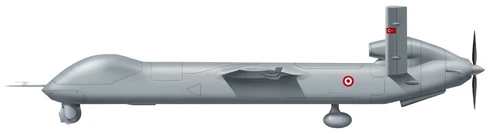
| Bayraktar TB2 | TAI Anka | |
|---|---|---|
| Origin country | 🇹🇷 Turkey | 🇹🇷 Turkey |
| Category | Military Drones | Military Drones |
| Manufacturer | Baykar | TAI |
| First flight | 1 August 2014 | 30 December 2010 |
| Year introduced | 2014 | 2017 |
| Number produced | 600 units | 102 units |
| Average unit price | $5 million | $30 million |
| Wingspan | 12.0 m | 17.5 m |
| Length | 6.5 m | 8.6 m |
| Maximum speed | 222 km/h | 217 km/h |
| Operational range | 300 km | 2,500 km |
| Service ceiling | 8,239 m | 9,144 m |
| Max. takeoff weight | 1,200 kg | 1,700 kg |
| Empty weight | 650 kg | 700 kg |
| Total thrust | -- | 1 x 130 kW |
Detailed Comparison
The Bayraktar TB2 and TAI Anka operate in separate doctrinal spaces within the Turkish military export catalog. The TB2 functions as a mass-producible, attritable tactical strike asset, while the Anka is a heavier, persistence-focused intelligence, surveillance, and reconnaissance (ISR) node capable of limited strike.
Development and Design
The TB2 emerged from a mandate by the Presidency of Defense Industries, accelerated by U.S. restrictions on armed UAV exports to Turkey. Baykar engineered a modular, carbon-fiber composite airframe with an inverted V-tail and a pusher-propeller configuration. The focus was low unit cost ($5.0 million) and rapid manufacture, resulting in over 600 units built to date. Conversely, state-owned TAI initiated the Anka program in 2004 to satisfy a Turkish Armed Forces requirement for a domestic medium-altitude long-endurance (MALE) platform. The Anka prioritizes payload versatility through an open architecture, accommodating complex sensors like synthetic-aperture radar (SAR) and ground moving target indicator (GMTI), which the smaller TB2 cannot carry.
Specifications and Performances
The physical disparities between the two airframes dictate their deployment limits. The Anka operates with a 1700 kg maximum takeoff weight (MTOW), compared to the TB2’s 1200 kg. This translates directly to payload capability:
- The Anka accommodates 350 kg, integrating heavy electronic warfare (EW) sensors or radar alongside munitions.
- The TB2 is restricted to 150 kg, usually limited to an EO/IR turret and four light munitions.
Both systems carry Roketsan’s MAM-L and MAM-C micro-munitions. The Anka's TEI-PD170 diesel engine and larger wingspan (17.5 m versus 12.0 m) yield a 30-hour endurance and a 9144 m service ceiling, edging out the TB2's 27 hours and 8239 m. The most distinct capability gap lies in communications: the baseline TB2 relies on line-of-sight data links (150–300 km), whereas the Anka-S incorporates SATCOM for beyond-line-of-sight reach.
Deployment and Usage
Baykar has exported the TB2 to 31 countries, making it a ubiquitous tactical strike asset. In Syria, Libya, Nagorno-Karabakh, and Ukraine, operators utilized the TB2 in localized saturation tactics to target point defenses and armor. Combat feedback from Ukraine confirms high vulnerability to layered modern air defenses (IADS), categorizing the airframe as semi-attritable. The Anka, with 102 units built, sees a more conservative operational footprint. The Turkish National Intelligence Organization utilizes the Anka-I variant specifically for signals intelligence. In combat over Syria during Operation Spring Shield, Ankas served primarily as high-altitude target coordinators for ground artillery and F-16s, maintaining standoff distances, though they still suffered operational losses to adversarial fire.
Conclusion
The Bayraktar TB2 holds the edge in contested, high-attrition tactical environments where volume and low replacement costs are required to overwhelm localized air defenses. Its low price point allows commanders to risk airframes for direct kinetic effects. The TAI Anka is the optimal platform for sustained, theater-level ISR and electronic warfare. For militaries requiring a disposable strike and anti-armor asset, the TB2 is the logical procurement. For forces prioritizing deep-look radar capabilities and secure, long-range patrol beyond line-of-sight, the Anka justifies its $30.0 million price tag.