Bayraktar TB2 vs MQ-9 Reaper
Bayraktar TB2 vs MQ-9 Reaper at a glance — top speed 222 vs 300 km/h, range 300 vs 1,850 km, max takeoff weight 1,200 vs 4,760 kg, built 600 vs 300 units.

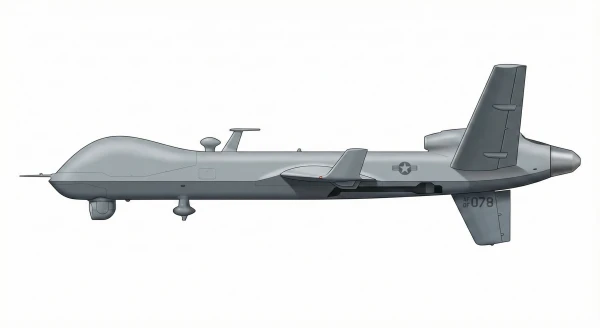
| Bayraktar TB2 | MQ-9 Reaper | |
|---|---|---|
| Origin country | 🇹🇷 Turkey | 🇺🇸 United States |
| Category | Military Drones | Military Drones |
| Manufacturer | Baykar | General Atomics |
| First flight | 1 August 2014 | 1 February 2001 |
| Year introduced | 2014 | 2007 |
| Number produced | 600 units | 300 units |
| Average unit price | $5 million | $30 million |
| Wingspan | 12.0 m | 20.0 m |
| Length | 6.5 m | 11.0 m |
| Maximum speed | 222 km/h | 300 km/h |
| Operational range | 300 km | 1,850 km |
| Service ceiling | 8,239 m | 15,000 m |
| Max. takeoff weight | 1,200 kg | 4,760 kg |
| Empty weight | 650 kg | 2,223 kg |
Detailed Comparison
The Bayraktar TB2 and MQ-9 Reaper are both categorized as Medium-Altitude, Long-Endurance (MALE) military drones, yet they originate from different strategic contexts and occupy distinct tiers of capability and cost. The Turkish-developed TB2 is a lightweight, cost-effective tactical platform that has seen widespread export and combat use. In contrast, the American-made MQ-9 Reaper is a larger, more powerful, and significantly more expensive system, designed as a high-altitude "hunter-killer" for a major global power.
Development and Design
The Bayraktar TB2’s development was spurred by Turkey’s need for an indigenous armed UAV, partially in response to a U.S. export ban. This resulted in a pragmatic and modular design philosophy focused on affordability and exportability. It features a blended wing body, an inverted V-tail, and a Rotax 912 piston engine in a pusher configuration. The MQ-9 Reaper was an evolutionary development from the earlier MQ-1 Predator, explicitly designed to carry more ordnance and fly higher and faster. Its core innovation was the integration of a powerful Honeywell TPE331-10GD turboprop engine, which fundamentally transformed its performance envelope and established it as a premier hunter-killer platform.
Specifications and Performances
The performance disparity between the two aircraft is substantial. The Reaper's Max Takeoff Weight of 4,760 kg is nearly four times that of the TB2's 1,200 kg. This translates directly to payload capacity; the Reaper can carry over 1,700 kg of munitions, including heavy ordnance like AGM-114 Hellfire missiles and GBU-38 JDAMs. The TB2 is limited to a 150 kg payload, typically comprising smaller laser-guided munitions like the MAM series. The Reaper's turboprop engine also grants it a significant advantage in operational altitude, with a service ceiling of 15,000 m compared to the TB2's 8,239 m, offering better protection from many air defense systems. While the baseline TB2 is limited to a line-of-sight control range of around 150 km, the Reaper's standard satellite communication link provides a near-global operational reach.
Deployment and usage
The two drones fulfill different operational roles. The TB2 has proven highly effective as a tactical asset in conflicts where adversaries possess limited or degraded air defenses, such as in Syria, Libya, and the Second Nagorno-Karabakh War. Its low unit cost of $5 million makes it an attritable asset, allowing commanders to accept a higher level of risk. The MQ-9 Reaper, with a price tag of $30 million, is a strategic asset typically deployed in permissive airspace where air superiority is assured. It has been a workhorse for the U.S. in Afghanistan and Iraq, conducting persistent ISR and precision strikes against high-value targets. Both platforms have demonstrated vulnerability to sophisticated, integrated air defense systems, as evidenced by losses in Yemen and Libya for the Reaper and in Ukraine for the TB2.
Conclusion
The Bayraktar TB2 and MQ-9 Reaper are not direct competitors but rather define different segments of the UCAV market. The TB2 has been instrumental in democratizing armed drone technology, providing a potent and affordable tactical capability to a growing number of nations. Its success lies in its cost-effectiveness in specific, lower-intensity conflict environments. The MQ-9 Reaper remains a premier strategic ISR and strike platform, offering superior range, altitude, and firepower for major military powers. The choice between the two is dictated less by a direct comparison of performance and more by a nation's budget, strategic objectives, and the anticipated operational environment.