Boeing 727 vs Tu-154 Careless
Boeing 727 vs Tu-154 Careless at a glance — top speed 1,017 vs 913 km/h, range 4,720 vs 6,600 km, max takeoff weight 95,028 vs 104,000 kg, built 1,832 vs 1,026 units.
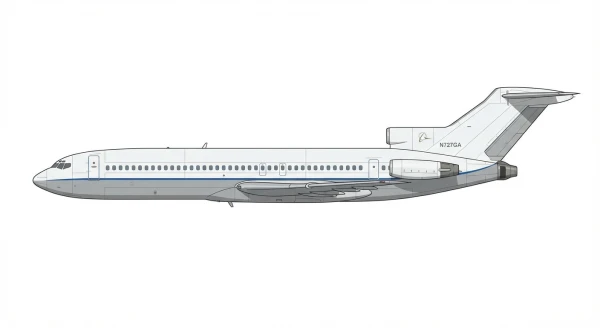
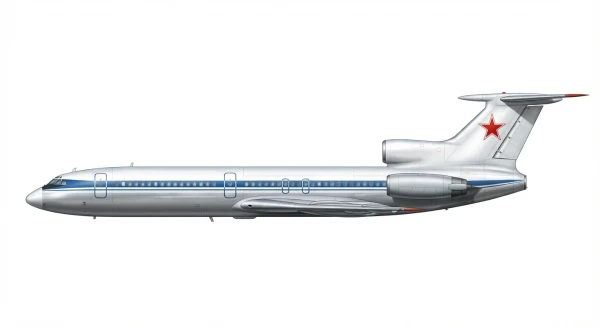
| Boeing 727 | Tu-154 Careless | |
|---|---|---|
| Origin country | 🇺🇸 United States | 🇷🇺 Ex-USSR |
| Category | Military Transport Aircraft | Military Transport Aircraft |
| Manufacturer | Boeing | Tupolev |
| First flight | 9 February 1963 | 4 October 1968 |
| Year introduced | 1964 | 1972 |
| Number produced | 1832 units | 1026 units |
| Average unit price | $5 million | $45 million |
| Wing area | 157.9 m² | 202.0 m² |
| Wingspan | 33.0 m | 37.6 m |
| Height | 10.0 m | 11.4 m |
| Length | 46.7 m | 48.0 m |
| Maximum speed | 1017 km/h | 913 km/h |
| Operational range | 4,720 km | 6,600 km |
| Service ceiling | 12,802 m | 12,100 m |
| Max. takeoff weight | 95,028 kg | 104,000 kg |
| Empty weight | 45,359 kg | 55,300 kg |
| Total thrust | 3 x 6,577 kgf | 3 x 10,503 kgf |
Detailed Comparison
Western and Soviet military planners adapted first-generation narrow-body commercial trijets to fill the gap between tactical airlifters and strategic heavy transports. The Boeing 727 and Tupolev Tu-154 both utilize a T-tail, rear-engine layout and were engineered for austere airfield operations, yet they diverge sharply in structural philosophy and military integration. The 727 dominated Western markets before filtering into secondary military roles, whereas the Tu-154 served as the primary troop and VIP transport backbone for the Warsaw Pact and successor states.
Development and Design
Boeing engineered the 727 to satisfy conflicting US airline requirements, resulting in a trijet configuration powered by Pratt & Whitney JT8D turbofans. To enable operations from short runways, Boeing integrated a high-lift wing utilizing Krueger flaps and triple-slotted Fowler flaps, achieving a maximum lift coefficient of 3.0. A built-in airstair and APU provided ground independence.
Tupolev designed the Tu-154 to replace the An-10 and Il-18 in the harsh Soviet operating environment. While mimicking the 727's layout, Tupolev prioritized rough-field capability over weight savings. The Tu-154 incorporates oversized, six-wheel main landing gear bogies that retract into wing pods. This distributes the aircraft's weight across a larger footprint, permitting operations from gravel and packed-snow runways that would cause severe foreign object damage to a 727.
Specifications and Performances
The 727-200 operates with an empty weight of 45,359 kg and reaches a maximum speed of 1,017 km/h, outpacing the Tu-154's 900 km/h top speed. However, the Tu-154 sacrifices speed for reach. Its 6,600 km range exceeds the 727's 4,720 km limit, a requirement dictated by the geographic expanse of the Soviet Union.
Tupolev equipped the early Tu-154 with Kuznetsov NK-8-2 turbofans. These engines run hotter and consume more fuel than the 727's JT8D engines, reducing time-on-wing and increasing maintenance hours per flight cycle. The Tu-154's heavier empty weight (50,700 kg) directly stems from its ruggedized landing gear and reinforced lower fuselage.
Deployment and usage
Military operators utilized the 727 primarily for logistics and VIP transport, with specialized exceptions.
- Iraq deployed the 'Faw-727' during the Iran-Iraq War, modifying the airframe into an ELINT platform using Thomson-CSF TMV-018 Syrel and Raphael-TH pods.
- Military transport commands in Colombia, Ecuador, and Afghanistan utilized 727-100QCs for quick-change cargo/troop movements.
The Tu-154 saw deeper, institutionalized combat deployment. Russian Aerospace Forces (VKS) rely on the Tu-154 for troop rotations into Syria and Open Skies treaty monitoring (Tu-154M-LK-1). The fleet suffers from a high attrition rate in military service, underscored by the 2010 Polish Air Force crash in Smolensk and the 2016 Russian Ministry of Defense crash in the Black Sea, largely attributed to outdated avionics and human error rather than structural failure.
Conclusion
The Boeing 727 holds the edge in mechanical reliability, operating costs, and adaptability for electronic warfare modifications. Its JT8D engines and global parts network make it the logical choice for air forces requiring standard logistics transport from paved runways.
The Tu-154 has the edge in expeditionary airlift in unimproved theaters. Its six-wheel bogies and structural reinforcement allow it to land troops and cargo on unpaved or damaged airstrips where a 727 would suffer catastrophic undercarriage failure.