C-160 Transall vs Douglas DC-3
C-160 Transall vs Douglas DC-3 at a glance — top speed 513 vs 413 km/h, range 1,853 vs 2,540 km, max takeoff weight 51,000 vs 13,154 kg, built 214 vs 10,174 units.
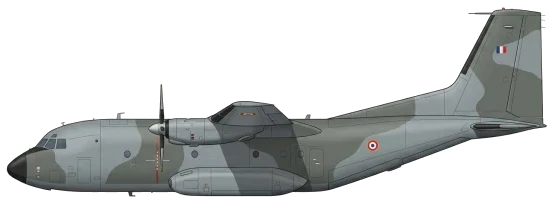
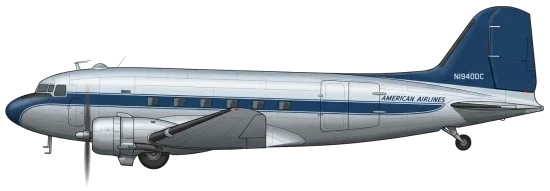
| C-160 Transall | Douglas DC-3 | |
|---|---|---|
| Origin country | 🇩🇪 Germany🇫🇷 France | 🇺🇸 United States |
| Category | Military Transport Aircraft | Military Transport Aircraft |
| Manufacturer | Transall | Douglas |
| First flight | 25 February 1963 | 23 December 1941 |
| Year introduced | 1967 | 1936 |
| Number produced | 214 units | 10174 units |
| Average unit price | $12 million | $80K |
| Wing area | 160.0 m² | 91.7 m² |
| Wingspan | 40.0 m | 29.0 m |
| Height | 11.7 m | 5.6 m |
| Length | 32.4 m | 22.7 m |
| Maximum speed | 513 km/h | 413 km/h |
| Operational range | 1,853 km | 2,540 km |
| Service ceiling | 8,230 m | 7,071 m |
| Max. takeoff weight | 51,000 kg | 13,154 kg |
| Empty weight | 29,000 kg | 6,450 kg |
| Total thrust | 2 x 4,549 kW | 3 x 875 kW |
Detailed Comparison
The C-160 Transall and Douglas DC-3 (specifically the C-47 military variant) illustrate the evolution of tactical airlift capabilities from the piston-engine era to the turboprop modernization of the Cold War. While the DC-3 established the foundational logistics of modern air transport through mass production and reliability, the C-160 was engineered specifically to address the limitations of earlier generations, introducing rear-loading ramps and specialized tactical capabilities for semi-prepared fields.
Development and Design
The Douglas DC-3 originated as a commercial airliner designed to compete with the Boeing 247, featuring a low-wing monoplane design and conventional "taildragger" landing gear. Its military adaptation relied on a side cargo door, effectively limiting the dimensions of transportable freight to what could be manually loaded or forklifted. Conversely, the C-160 resulted from a specific 1957 Franco-German requirement to replace the Nord Noratlas. The Transall consortium designed a purpose-built tactical lifter with a high-mounted wing and a fuselage featuring an upswept tail and rear-access ramp. This configuration, combined with landing gear capable of "kneeling" to lower the fuselage, allows for the direct roll-on/roll-off loading of vehicles—a logistical impossibility for the standard DC-3.
Specifications and Performances
Performance metrics highlight the drastic shift in airlift requirements between the 1930s and 1960s. The C-160 utilizes two Rolls-Royce Tyne turboprops (4,549 kW each) to lift a 16,000 kg payload, nearly six times the DC-3's approximately 2,700 kg capacity. While the DC-3 offers a significant range of 2,540 km compared to the C-160's 1,853 km, the Transall provides superior tactical utility. Its pressurized hull and ability to land on 400-meter airstrips via steep 20-degree descents allow it to operate in contested forward areas inaccessible to the DC-3. Furthermore, the C-160's cargo hold dimensions (3.15 m width) are specifically compatible with international railway gauges, contrasting with the DC-3's narrower, passenger-centric fuselage.
Deployment and Usage
The DC-3 saw ubiquitous service with over 10,000 units built, defining Allied logistics during World War II through massive troop and supply movements. Its usage was characterized by volume, availability, and adaptability across global theaters. The C-160, with only 214 units produced, served in specialized, high-intensity tactical roles across Africa and the Middle East. Operational history ranges from the Turkish invasion of Cyprus to French operations in Zaire (Battle of Kolwezi) and Mali. Unlike the standard DC-3, the C-160 platform proved adaptable for complex electronic warfare roles, notably the C-160G Gabriel SIGINT variant used in the Gulf War, and aerial refueling missions.
Conclusion
The Douglas DC-3 represents the genesis of military air transport, relying on commercial availability and robust simplicity to sustain operations on a strategic scale. The C-160 Transall represents the maturation of that concept into a dedicated tactical science. While the DC-3 offered strategic mobility through sheer numbers, the C-160 provided the specific airlift capabilities—rear loading, heavy payload, and rough-field performance—required for modern rapid reaction forces.