Douglas DC-3
American commercial airliner, renowned for significant contributions to World War II airlift operations, frequently used for cargo and passenger transport. Key figures: top speed 413 km/h, range 2,540 km, service ceiling 7,071 m, max takeoff weight 13,154 kg, unit price $0.08M, built 10,174. In service with 4 air forces as of 2026 — Thailand (8), Colombia (6), Mali (1) and 1 other.
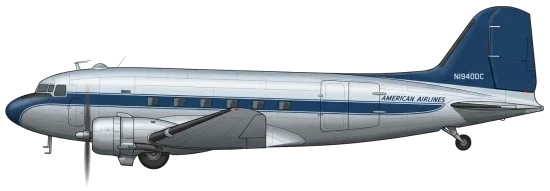
| Length | 22.7 m (74.5 ft) |
| Wingspan | 29 m (95.1 ft) |
| Height | 5.6 m (18.2 ft) |
| Wing area | 91.7 m² (987.0 sqft) |
| Empty weight | 6,450 kg (14,220 lbs) |
| Max. takeoff weight | 13,154 kg (29,000 lbs) |
| Powerplant | 3 × turboprops Pratt & Whitney Canada PT6A-45 875 kW each |
| Maximum speed | 413 km/h (257 mph) |
| Operational range | 2,540 km (1,578 mi) |
| Service ceiling | 7,071 m (23,199 ft) |
| Climb rate | 5.8 m/s (19.0 ft/s) |


Description
The Douglas DC-3 is a twin-engine propeller-driven airliner built by the Douglas Aircraft Company in the United States. It entered service with American Airlines on 26 June 1936 and was used for passenger, cargo and military transport duties. By 1939, roughly 90% of the world's airline flights were flown by DC-3s or derivatives, and the type remains in limited commercial and military use as of 2025.
Development
"DC" stands for Douglas Commercial. The line began when Transcontinental and Western Air asked Donald Douglas for an aircraft to compete with United Airlines' Boeing 247, producing the DC-1 in 1933 and the DC-2 in 1934. American Airlines CEO C. R. Smith then persuaded Douglas to develop a sleeper version to replace American's Curtiss Condor II biplanes; the DC-2 cabin, 66 in (1.7 m) wide, was too narrow for side-by-side berths. Development was led by chief engineer Arthur E. Raymond, and the prototype Douglas Sleeper Transport first flew on 17 December 1935 with chief test pilot Carl Cover. Its cabin was 92 in (2,300 mm) wide; a 21-seat day version received the DC-3 designation. DST production ended in mid-1941 and civil DC-3 production in early 1943 after 607 aircraft. Total output including military variants reached 16,079: 10,048 C-47 and C-53 derivatives at Santa Monica, Long Beach and Oklahoma City, 4,937 Lisunov Li-2s built in the Soviet Union between 1939 and 1950, and 487 Showa and Nakajima L2Ds in Japan. Peak military production was 4,853 aircraft in 1944.
Design
The DC-3 is an all-metal low-wing monoplane with conventional landing gear, a wingspan of 95 ft (29.0 m) and a length of 64 ft 5 in (19.7 m). Early civil aircraft used two Wright R-1820 Cyclone 9 radials; the 14-cylinder Pratt & Whitney R-1830 Twin Wasp of 1,200 hp (890 kW) was fitted to most military versions and to converted ex-military airframes, driving three-bladed Hamilton Standard 23E50 constant-speed propellers. Cruising speed is 183 kn (339 km/h), range 1,370 nmi (2,540 km) and service ceiling 23,200 ft (7,100 m). Capacity is 21 to 32 passengers or 6,000 lb (2,700 kg) of cargo, and the aircraft can operate from grass and dirt strips. Turboprop conversions from the 1950s onward have used Rolls-Royce Dart, Armstrong Siddeley Mamba and Pratt & Whitney Canada PT6A engines.
Operational History
American, United, TWA, Eastern and Delta ordered more than 400 DC-3s before the war. KLM took delivery of its first in 1936 for the Amsterdam–Batavia–Sydney route and bought 23 in total. Cubana de Aviación opened Havana–Miami service with a DC-3 in 1945. The last US Navy C-117 was retired on 12 July 1976 and the last USMC C-117 in June 1982; the US Forest Service retired its final example in December 2015.
Variants
- DST: Sleeper variant with Wright R-1820 Cyclone engines and up to 16 berths, convertible to 24 day seats.
- DC-3A: Day version with 1,000–1,200 hp Pratt & Whitney R-1830 Twin Wasp engines.
- DC-3B: TWA version with R-1820 Cyclones and a smaller convertible forward sleeper cabin.
- DC-3S Super DC-3: Fuselage lengthened by 39 in, revised outer wings and taller tail, R-2000 or R-1820 engines; five built.
- Basler BT-67: Stretched, re-engined conversion with PT6A-67R turboprops and modern avionics.
Frequently Asked Questions
What type of aircraft is the Douglas DC-3?
What is the maximum speed of the Douglas DC-3?
What is the range of the Douglas DC-3?
When did the Douglas DC-3 first fly?
How many Douglas DC-3 have been built?
Which countries operate the Douglas DC-3?
How much does a Douglas DC-3 cost?
What is the service ceiling of the Douglas DC-3?
- AUG 302026 Updated Description updated
- AUG 52026 Updated Climb rate added
- JUL 272026 Updated Name updated
- APR 72026 Updated Sources and cross-references refreshed
- FEB 72026 Updated Ceiling added
- JAN 242026 Updated Top speed updated
- JAN 122026 Updated Range added; price added