208 Caravan vs DHC-6 Twin Otter
208 Caravan vs DHC-6 Twin Otter at a glance — top speed 344 vs 315 km/h, range 1,980 vs 1,480 km, max takeoff weight 3,970 vs 5,670 kg, built 3,000 vs 985 units.
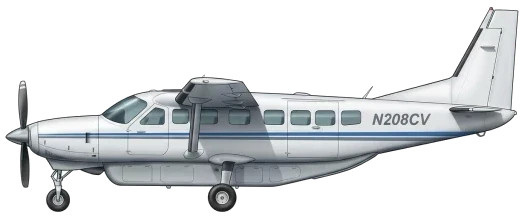
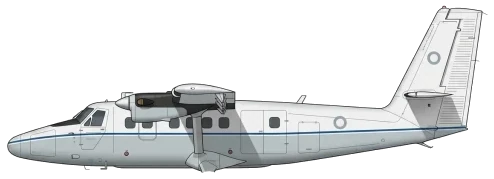
| 208 Caravan | DHC-6 Twin Otter | |
|---|---|---|
| Origin country | 🇺🇸 United States | 🇨🇦 Canada |
| Category | Military Transport Aircraft | Military Transport Aircraft |
| Manufacturer | Cessna | De Havilland Canada |
| First flight | 9 December 1982 | 20 May 1965 |
| Year introduced | 1984 | 1966 |
| Number produced | 3000 units | 985 units |
| Average unit price | $2.1 million | $7 million |
| Wing area | 26.0 m² | 39.0 m² |
| Wingspan | 15.9 m | 20.0 m |
| Height | 4.3 m | 6.0 m |
| Length | 12.7 m | 15.8 m |
| Maximum speed | 344 km/h | 315 km/h |
| Operational range | 1,980 km | 1,480 km |
| Service ceiling | 7,600 m | 7,620 m |
| Max. takeoff weight | 3,970 kg | 5,670 kg |
| Empty weight | 2,073 kg | 3,175 kg |
| Total thrust | 1 x 505 kW | 2 x 410 kW |
Detailed Comparison
The Cessna 208 Caravan and DHC-6 Twin Otter occupy the same light utility turboprop market segment but serve divergent military requirements: the former prioritizes operating economics and range for foreign internal defense (FID) and low-intensity conflict, while the latter targets payload redundancy and extreme short-field performance for specialized logistics. While the Caravan has evolved into a strike-capable ISR platform, the Twin Otter remains a dedicated mobility truck for austere environments.
Development and Design
Cessna designed the 208 in the early 1980s primarily for commercial freight, specifically to meet Federal Express requirements for a single-engine hauler. Its design philosophy emphasizes simplicity and low operating costs, utilizing a fixed tricycle gear and a single PT6A engine. The later integration of the Garmin G1000 glass cockpit and hardpoints for the AC-208 variant represents a retrofit approach to militarization, converting a logistics aircraft into a budget-conscious close air support (CAS) platform.
Conversely, the DHC-6 Twin Otter, originating in 1965, was purpose-built by De Havilland Canada as a STOL replacement for the single-engine Otter. Its design integrates double-slotted trailing-edge flaps and flaperons, prioritizing lift over speed. The twin-engine configuration provides safety redundancy essential for maritime, jungle, and polar operations—capabilities maintained in the Series 400 and Viking Air production restarts. While the Caravan is a commercial truck adapted for war, the Twin Otter is a bush plane drafted into service.
Specifications and Performance
The performance data highlights a clear doctrinal split. The Twin Otter offers a maximum takeoff weight of 5,670 kg, significantly overshadowing the Caravan's 3,970 kg, allowing for heavier logistical loads. More critically, the DHC-6 achieves a climb rate of 8.1 m/s—more than double the Caravan’s 3.9 m/s. This allows the Twin Otter to operate in constrained mountainous terrain where rapid ascent is mandatory.
However, the Caravan wins on efficiency and endurance. It delivers a range of 1,980 km compared to the Twin Otter's 1,480 km and a higher maximum speed of 344 km/h. Economically, the disparity is stark: the Caravan’s unit cost of ~$2.1 million is less than a third of the Twin Otter’s ~$7.0 million. The Caravan provides 80% of the utility for 30% of the price, provided the mission profile does not require extreme STOL or over-water redundancy.
Deployment and Usage
The AC-208 Combat Caravan has become the standard for "building partner capacity" programs. The US Air Force has procured these for the Iraqi, Afghan, and Lebanese armed forces, equipping them with AGM-114 Hellfire missiles. In Iraq, the AC-208 functioned effectively as a low-cost COIN asset, conducting precision strikes against insurgents in environments where air superiority was guaranteed. Its single-engine architecture is accepted as a calculated risk for overland missions.
The Twin Otter (designated UV-18 in US service) serves a different master. It is favored for parachute operations, special operations forces (SOF) insertion, and extraction in regions lacking prepared runways. Its twin-engine reliability makes it the standard for Antarctic research programs and maritime patrols in the Maldives and Vietnam. Unlike the Caravan, the Twin Otter is rarely armed; its value lies in accessing airfields that other fixed-wing aircraft cannot, bridging the gap between heavy lift helicopters and conventional tactical transports.
Conclusion
The Cessna 208 Caravan is the superior choice for budget-constrained air forces requiring a multi-role platform for ISR, light strike, and liaison duties. Its combat record in the Middle East validates its utility as a low-cost force multiplier in uncontested airspace.
The DHC-6 Twin Otter retains the edge in purely logistical and mobility operations within complex terrain. For operators requiring over-water safety, high-altitude performance, or landing zones under 1,000 feet, the Twin Otter’s twin-engine power and STOL wing design justify its significantly higher procurement cost.


-
 Peru
15
Peru
15
-
 Chile
13
Chile
13
-
 United Arab Emirates
11
United Arab Emirates
11
- All 17 operators →