210 Centurion vs O-2 Skymaster
| American single-engine six-seat light aircraft, produced from 1957 to 1986, used by several air forces for liaison and light transport. | |
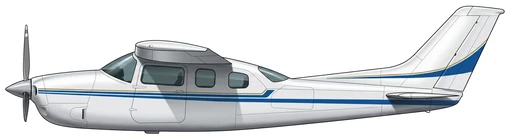
|
|
| Origin country | 🇺🇸 United States |
| Category | Military Transport Aircraft |
| Manufacturer | Cessna |
| First flight | -- |
| Year introduced | 1957 |
| Number produced | 9240 units |
| Average unit price | -- |
| American military forward air control and psychological operations aircraft, used between 1967 and 2010. | |
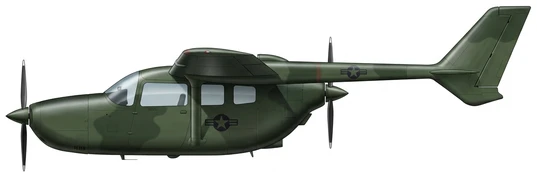
|
|
| Origin country | 🇺🇸 United States |
| Category | Combat Aircraft |
| Manufacturer | Cessna |
| First flight | 1 January 1967 |
| Year introduced | 1967 |
| Number produced | 532 units |
| Average unit price | -- |
| Wing area | 16.3 m² ◉ |
| Wingspan | 11.2 m ◉ |
| Height | 3.0 m ◉ |
| Length | 8.6 m ◉ |
| Maximum speed | 378 km/h ◉ |
| Operational range | 1,667 km ◉ |
| Service ceiling | 8,230 m ◉ |
| Max. takeoff weight | 1,814 kg ◉ |
| Empty weight | 1,045 kg ◉ |
| Total thrust | 1 x 231 kW ◉ |
| Wing area | 18.8 m² ◉ |
| Wingspan | 11.6 m ◉ |
| Height | 2.8 m ◉ |
| Length | 9.1 m ◉ |
| Maximum speed | 320 km/h ◉ |
| Operational range | 1,710 km ◉ |
| Service ceiling | 6,000 m ◉ |
| Max. takeoff weight | 2,449 kg ◉ |
| Empty weight | 1,292 kg ◉ |
| Total thrust | 2 x 80 kW ◉ |
Performance Radar Chart
Detailed Comparison
Loading analysis...
Generating comparison analysis...
Unable to generate comparison at this time.
Frequently Asked Questions
Which is faster, the 210 Centurion or O-2 Skymaster?
The 210 Centurion is faster with a maximum speed of 378 km/h compared to the O-2 Skymaster's 320 km/h, a difference of 58 km/h.
Which has longer range, the 210 Centurion or O-2 Skymaster?
The O-2 Skymaster has a longer range at 1,710 km compared to the 210 Centurion's 1,667 km.
Which can fly higher, the 210 Centurion or O-2 Skymaster?
The 210 Centurion has a higher service ceiling at 8,230 meters (27,001 ft) compared to the O-2 Skymaster's 6,000 meters (19,685 ft).
Which is heavier, the 210 Centurion or O-2 Skymaster?
The O-2 Skymaster has a higher maximum takeoff weight at 2,449 kg compared to the 210 Centurion's 1,814 kg.
Which is larger, the 210 Centurion or O-2 Skymaster?
The O-2 Skymaster is longer at 9.1 meters compared to the 210 Centurion's 8.6 meters.
Which entered service first, the 210 Centurion or O-2 Skymaster?
The 210 Centurion entered service first in 1957, 10 years before the O-2 Skymaster which entered service in 1967.
Which has been built in greater numbers, the 210 Centurion or O-2 Skymaster?
The 210 Centurion has been produced in greater numbers with 9,240 units compared to 532 units of the O-2 Skymaster.