Hermes 450 vs IAI Heron
Hermes 450 vs IAI Heron at a glance — top speed 176 vs 207 km/h, range 300 vs 1,000 km, max takeoff weight 550 vs 1,270 kg.
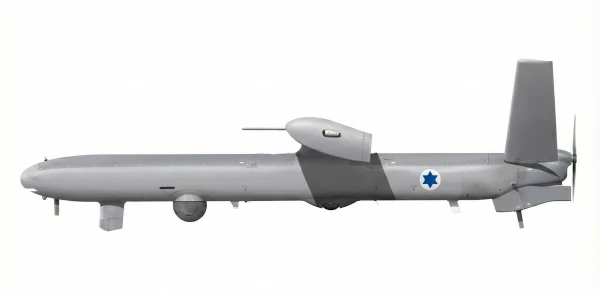
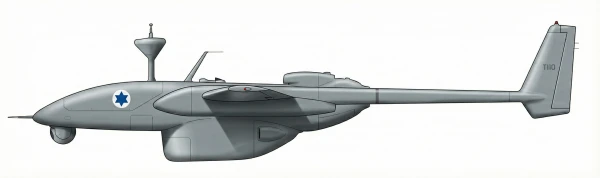
| Hermes 450 | IAI Heron | |
|---|---|---|
| Origin country | 🇮🇱 Israel | 🇮🇱 Israel |
| Category | Military Drones | Military Drones |
| Manufacturer | Elbit | IAI |
| First flight | 1 January 1994 | 1 January 1994 |
| Year introduced | 1998 | 2005 |
| Number produced | N/A | N/A |
| Average unit price | $2 million | $9.5 million |
| Wingspan | 10.5 m | 16.6 m |
| Length | 6.1 m | 8.5 m |
| Maximum speed | 176 km/h | 207 km/h |
| Operational range | 300 km | 1,000 km |
| Service ceiling | 5,500 m | 10,000 m |
| Max. takeoff weight | 550 kg | 1,270 kg |
| Empty weight | 450 kg | -- kg |
| Total thrust | 1 x 39 kW | -- |
Detailed Comparison
Elbit’s Hermes 450 and IAI’s Heron entered development concurrently in 1994 but address separate tiers of the Israel Defense Forces' (IDF) intelligence and strike architecture. The Hermes 450 operates as a tactical, brigade-level asset combining localized ISR with direct strike capabilities, while the Heron fills the Medium-Altitude Long-Endurance (MALE) requirement, providing theater-level surveillance without organic kinetic options.
Development and Design
Elbit designed the Hermes 450 around a compact, rugged form factor. The airframe utilizes a cylindrical fuselage, high straight wings, and a V-tail, powered by a 70-horsepower R902(W) Wankel rotary engine. This layout maximizes the power-to-weight ratio for tactical payloads up to 180 kg. The Hermes 450 was structurally designed to accommodate underwing hardpoints for four Rafael Spike or Mikholit missiles. IAI engineered the Heron (Machatz-1) strictly for persistence and sensor variety. Built around a Rotax 914 engine, the Heron integrates automatic launch and recovery (ALR) and SATCOM links for over-the-horizon operations. IAI explored arming the Heron under Project Cheetah, but those plans were abandoned, leaving the platform dedicated to carrying up to 250 kg of heavier radar, COMINT, and ELINT packages.
Specifications and Performances
The Heron operates in a different aerodynamic class than the Hermes 450, reflecting its $9.5 million unit cost versus the Hermes' $2.0 million price tag.
- The Heron has a maximum takeoff weight of 1,270 kg, more than double the Hermes 450’s 550 kg.
- Endurance heavily favors the Heron at 52 hours compared to the Hermes' 17 hours (up to 30 hours in the LE variant).
- The Heron’s 10,000 m service ceiling keeps it above most tactical short-range air defenses (SHORAD), whereas the Hermes is restricted to 5,500 m.
This lower operating altitude exposes the Hermes 450 to man-portable air-defense systems (MANPADS), a vulnerability reflected in its combat losses.
Deployment and usage
The Hermes 450 is the IDF’s primary hunter-killer platform. Operated by Squadron 161, it conducts time-sensitive targeting in Gaza and Lebanon. Its low altitude and localized flight profiles result in periodic attrition; Hezbollah downed multiple airframes in 2006 and during the 2023-2024 border clashes. Azerbaijan and Georgia also lost units to ground fire in regional conflicts. The UK procured a modified version, the Thales Watchkeeper WK450, relying on its tactical footprint for deployments in Afghanistan and Iraq.
The Heron operates as a theater-level overwatch asset. During the 2008–2009 Gaza operations, the IDF decentralized Heron control, piping video feeds directly to advancing ground brigades. Internationally, the Heron secured leasing contracts with Canada, Australia, and Germany for operations in Afghanistan, where its 1,000 km range and long loiter time provided continuous route scanning and forward operating base security.
Conclusion
The Hermes 450 holds the edge in tactical hunter-killer operations where immediate sensor-to-shooter links are required. Its $2 million unit cost makes it expendable enough for contested airspace where attrition is expected. The IAI Heron is the superior platform for theater-level, persistent ISR. Its 52-hour endurance and 10,000 m ceiling dictate its use in permissive environments requiring extended loiter times, such as maritime patrol, border monitoring, and deep-look intelligence gathering.