Ka-50 Hokum "Black Shark" vs Ka-52 Alligator Hokum-B
Ka-50 Hokum "Black Shark" vs Ka-52 Alligator Hokum-B at a glance — top speed 315 vs 300 km/h, range 460 vs 460 km, max takeoff weight 10,800 vs 10,800 kg, built 19 vs 196 units.
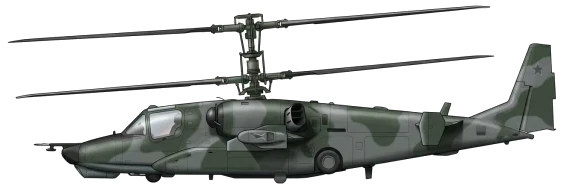
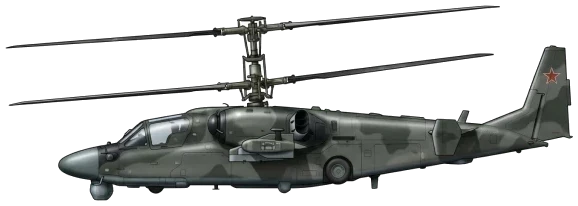
| Ka-50 Hokum "Black Shark" | Ka-52 Alligator Hokum-B | |
|---|---|---|
| Origin country | 🇷🇺 Ex-USSR | 🇷🇺 Russia |
| Category | Military Helicopters | Military Helicopters |
| Manufacturer | Kamov | Kamov |
| First flight | 17 June 1982 | 25 June 1997 |
| Year introduced | 1995 | 2011 |
| Number produced | 19 units | 196 units |
| Average unit price | $16 million | $16 million |
| Wing area | -- m² | 330.3 m² |
| Wingspan | 14.5 m | 7.8 m |
| Height | 4.9 m | 5.0 m |
| Length | 16.0 m | 15.9 m |
| Maximum speed | 315 km/h | 300 km/h |
| Operational range | 460 km | 460 km |
| Service ceiling | 5,500 m | 5,500 m |
| Max. takeoff weight | 10,800 kg | 10,800 kg |
| Empty weight | 7,700 kg | 7,800 kg |
| Total thrust | 2 x 1,641 kW | 2 x 1,790 kW |
Detailed Comparison
The Ka-50 "Black Shark" and Ka-52 "Alligator" originate from the same V-80 prototype program but represent a fundamental divergence in attack helicopter philosophy. While both are built around Kamov's signature coaxial contra-rotating rotor system, which eliminates the need for a tail rotor and provides exceptional agility, the Ka-50 is a specialized single-seat anti-tank platform, whereas the Ka-52 is a more versatile two-seat command and attack helicopter. The Ka-50’s design was a unique Soviet-era experiment to create a heavily armed and armored "flying tank" operated by a single pilot, a concept that proved the airframe's capabilities but also highlighted the immense workload placed on the operator. The Ka-52 was developed specifically to resolve this issue.
Development and Design
The development of the Ka-50 in the 1980s was revolutionary. Its coaxial design offered superior power efficiency and a smaller, more agile airframe. Key innovations included extensive cockpit armor and the NPP Zvezda K-37-800 ejection seat, a feature almost unheard of in helicopters, which required pyrotechnic separation of the rotor blades. However, operational testing revealed that a single pilot managing flight, navigation, and complex weapons systems was excessively demanding, limiting its effectiveness in dynamic, multi-threat environments.
The Ka-52 "Alligator" is a direct evolution, conceived to function as a reconnaissance and command helicopter for groups of Ka-50s. Its defining feature is the two-seat, side-by-side cockpit, which allows for efficient crew resource management: one pilot focuses on flight and maneuvering while the weapon systems officer (WSO) manages sensors, armament, and communications. This configuration, along with the integration of a nose-mounted radar system and advanced avionics, transforms the platform from a pure striker into a true multi-role asset capable of all-weather, day/night operations and network-centric warfare.
Specifications and Performances
Despite the Ka-52's increased empty weight (7800 kg vs 7700 kg) and wider frontal profile, its core performance metrics remain similar to the Ka-50, leveraging the same Klimov TV3-117VK powerplants and 10,800 kg maximum takeoff weight. The Ka-50 has a marginally higher maximum speed of 315 km/h compared to the Ka-52's 300 km/h, likely due to the cleaner aerodynamics of its single-seat nose. Conversely, the Ka-52 demonstrates a slightly improved climb rate of 12 m/s versus the Ka-50's 10 m/s, suggesting refinements to the flight control system. The most significant performance differentiator is not in flight characteristics but in combat capability. The two-person crew and advanced sensors of the Ka-52 provide superior situational awareness and engagement effectiveness, particularly with guided munitions like the Vikhr missile, making it a more formidable system in a modern battlespace.
Deployment and usage
The operational histories of the two aircraft highlight their differing fates. The Ka-50 saw very limited production (around 19 units) and its combat deployment was largely confined to trial missions during the Second Chechen War. These operations validated the airframe's survivability and the potency of its armament but did not lead to widespread adoption.
In contrast, the Ka-52 has been produced in much larger numbers (over 196 units) and has become a frontline asset for the Russian Aerospace Forces. It has been extensively deployed in Syria and the 2022 invasion of Ukraine. In these conflicts, it has been used for close air support, armed reconnaissance, and escort duties, demonstrating effectiveness with its long-range missiles. However, this extensive use has also exposed its vulnerabilities, with significant losses reported, particularly to man-portable air-defense systems (MANPADS).
Conclusion
The Ka-50 was an ambitious but ultimately flawed concept. Its single-pilot design, while innovative, proved to be its operational undoing, relegating it to a developmental stepping stone rather than a mainstream combat system. The Ka-52 represents a pragmatic and successful correction of this course. By incorporating a second crew member and superior avionics, Kamov transformed the agile Hokum airframe into a far more practical and capable multi-role attack helicopter. The limited service of the "Black Shark" compared to the extensive, ongoing combat deployment of the "Alligator" provides a clear verdict on which design philosophy proved more viable for the realities of modern warfare.

