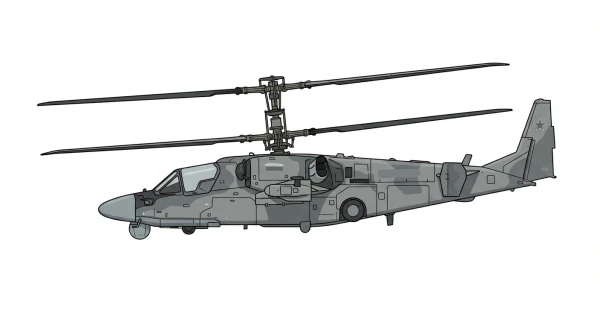
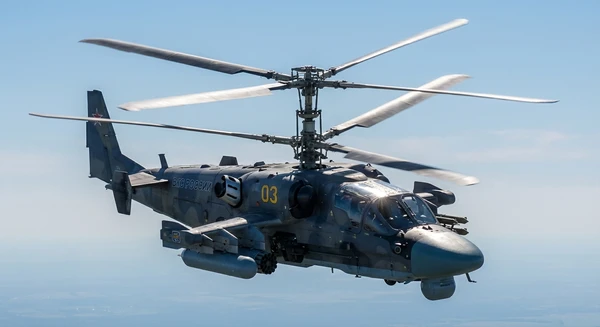
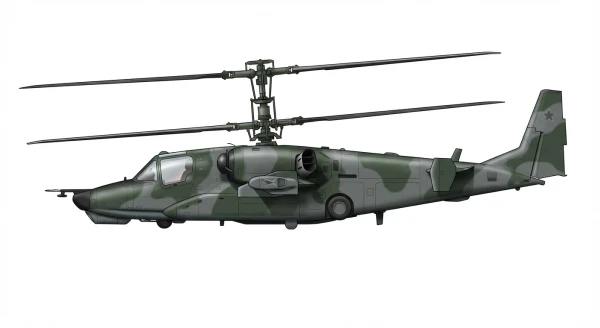
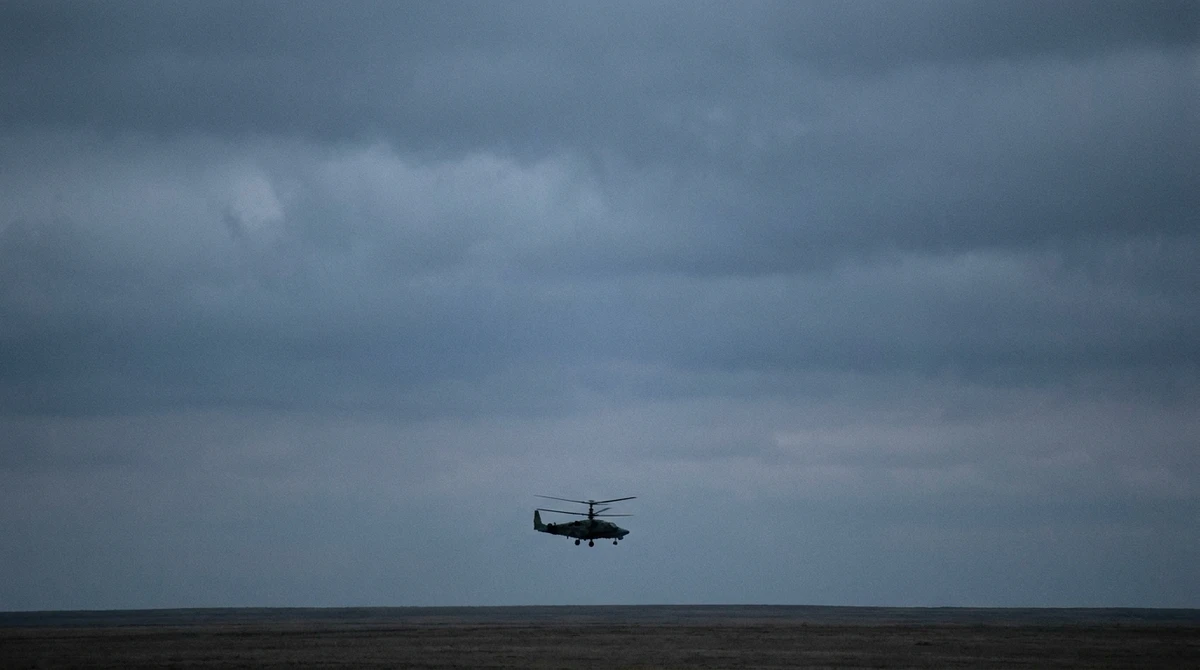
The Kamov Ka-52 "Alligator" (NATO reporting name Hokum-B) is a Russian two-seat attack and reconnaissance helicopter derived from the single-seat Ka-50 "Black Shark". Built by the Progress Arsenyev Aviation Company in Arsenyev, Primorsky Krai, it entered service with the Russian Air Force in May 2011. It retains the Kamov coaxial contra-rotating rotor system and is distinguished by its side-by-side cockpit. Unit cost was US$16 million as of 2023.
Development
In the early 1980s, during comparative testing of the V-80 (Ka-50 prototype) against the Mi-28, Kamov proposed a dedicated battlefield reconnaissance and target-designation helicopter based on the Ka-60. Economic conditions in the late 1980s ended that programme, and Kamov instead installed the reconnaissance and target designation suite on a modified Ka-50, which required a second crew member. A side-by-side seating arrangement was chosen on the basis of crew co-operation trials. Manufacture of the first Ka-52 airframe began in mid-1996. The first phase of state trials (ГСИ) was completed in December 2008, with serial production starting at Arsenyev by the end of that year. By September 2010 the 696th Instructor and Research Helicopter Regiment at Torzhok operated eight aircraft for development work, and four series machines were delivered to the 344th Centre for Combat Training in December 2010. A 2011 contract worth 120 billion rubles covered 146 helicopters through 2020; in February 2018 the Russian Ministry of Defence announced a requirement for 114 aircraft of an upgraded standard.
Design
Compared with the Ka-50, the Ka-52 has a rounder nose profile housing a radar for targeting, with a day/night TV/thermal sighting system in a spherical turret beneath the nose; some examples carry a mast-mounted radar for aerial targets and a second sighting system above the cockpit. A Phazotron radio-locator feeds a cockpit multi-function display and permits operation at night and in adverse weather. Both crew have helmet-mounted rangefinders and can use night-vision eyepieces. Armour and cannon magazine capacity were reduced to hold weight parity with the Ka-50; rate of climb fell from 10 to 8 m/s and maximum positive load factor to 3.0 g, largely offset by the VK-2500 engine. Protection includes a radar warning receiver, electronic warfare system, and wingtip pods each containing two dispensers with 32 × 26 mm chaff/flare cartridges.
Armament
The Ka-52 retains the side-mounted, semi-rigidly fixed 30 mm Shipunov 2A42 cannon with dual feed and a cyclic rate of 200–800 rounds per minute. It has six wing hardpoints against four on the Ka-50, with pylons tiltable 10 degrees downward and a payload above 2,000 kg. Typical loads include twelve 9K121 Vikhr laser-guided anti-tank missiles with a range of about 8 km, Ataka missiles, S-8 and S-13 rocket pods, Igla air-to-air missiles, bombs, UPK-23-250 gun pods, and external fuel tanks. The LMUR missile gives an attack range of 15 km.
Operational History
Ka-52s were deployed to Syria from 2015, defending the Russian base at Latakia, escorting search and rescue helicopters, and supporting special forces; one crashed near Mayadin on 5 May 2018. The type was used again in Syria in December 2024. In the Russo-Ukrainian War it has been employed intensively, notably against the 2023 Ukrainian counteroffensive, where a shortage of Ukrainian SHORAD assisted its operations. Losses have been heavy: Oryx visually confirmed 66 destroyed or damaged as of 3 December 2025 (52 destroyed, 13 damaged, one captured), including five destroyed by tactical missiles at Berdiansk airport on 18 October and two by HIMARS in Belgorod Oblast on 23 March 2025. Recorded shoot-downs involved Stugna-P, MANPADS, Martlet, RBS-70 and, in March 2026, a fiber-optic FPV drone. Egypt ordered 46 aircraft in 2015, receiving the first three in July 2017 and 19 by year-end; the type formally entered Egyptian Air Force service on 6 December 2018. Russian Aerospace Forces held 133 aircraft as of 2022. Algeria was negotiating for 12 Ka-52Es as of 2022.
Variants
- Ka-52 "Alligator": Two-seat side-by-side cockpit version for the Russian Aerospace Forces.
- Ka-52E: Export version sold to Egypt, with anti-corrosion materials, reinforced fuselage, new landing gear, OES-52 optronic system, Arbalet-52 radar and President-S self-protection suite.
- Ka-52K "Katran": Naval variant with folding blades and wings, reinforced landing gear, four pylons, and planned Kh-35 and Kh-38 capability.
- Ka-52M: Upgraded version with GOES-451M targeting turret, stronger undercarriage wheels, revised cockpit ergonomics and LMUR integration; first ten delivered 9 January 2023.