F-86 Sabre vs MiG-15 Fagot
F-86 Sabre vs MiG-15 Fagot at a glance — top speed 1,127 vs 1,075 km/h, range 2,454 vs 2,520 km, max takeoff weight 9,621 vs 6,105 kg, built 9,860 vs 17,310 units.
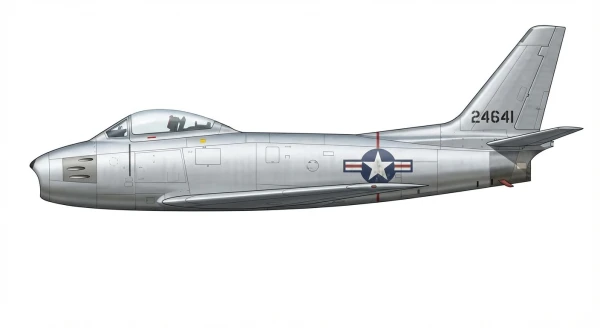
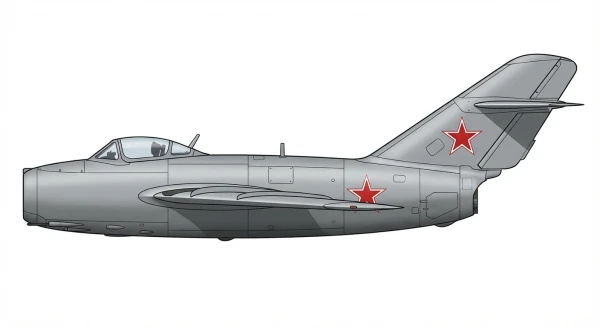
| F-86 Sabre | MiG-15 Fagot | |
|---|---|---|
| Origin country | 🇺🇸 United States | 🇷🇺 Ex-USSR |
| Category | Combat Aircraft | Combat Aircraft |
| Manufacturer | North American | Mikoyan-Gurevich |
| First flight | 1 October 1947 | 19 December 1947 |
| Year introduced | 1949 | 1949 |
| Number produced | 9860 units | 17310 units |
| Average unit price | $1.2 million | $200K |
| Wing area | 28.1 m² | 20.6 m² |
| Wingspan | 11.3 m | 10.1 m |
| Height | 4.4 m | 3.7 m |
| Length | 11.4 m | 10.1 m |
| Maximum speed | 1127 km/h | 1075 km/h |
| Operational range | 2,454 km | 2,520 km |
| Service ceiling | 15,850 m | 15,500 m |
| Max. takeoff weight | 9,621 kg | 6,105 kg |
| Empty weight | 5,443 kg | 3,580 kg |
| Total thrust | 1 x 3,402 kgf | 1 x 2,700 kgf |
Detailed Comparison
The North American F-86 Sabre and the Mikoyan-Gurevich MiG-15 emerged as the definitive adversaries of the early jet age, establishing the parameters of transonic air combat over the Korean peninsula. While the Sabre prioritized high-speed maneuverability, aerodynamic sophistication, and complex avionics, the MiG-15 was designed around a philosophy of structural simplicity, high-altitude interception, and heavy ballistic weaponry.
Development and Design
North American Aviation utilized captured German aerodynamic data to modify the XP-86, incorporating a 35° swept-back wing and automatic leading-edge slats. This design choice, along with the later introduction of the "all-flying tail" on the F-86E, mitigated compressibility effects and enhanced control near the sound barrier. The Sabre was engineered as a versatile platform, evolving from a day fighter to a fighter-bomber capable of nuclear delivery. Conversely, the MiG-15 was purpose-built as a high-altitude interceptor to destroy heavy bombers. It utilized a similar swept-wing configuration but prioritized ease of mass production, evidenced by the 17,310 units built compared to the Sabre's 9,860. The MiG utilized a rugged, reliable structure, but possessed primitive avionics compared to the Sabre’s radar-ranging gunsight (A-1CM).
Specifications and Performances
The provided performance data indicates a distinct kinematic advantage for the Sabre variant listed (powered by the Rolls-Royce Avon 26) over the MiG-15. The F-86 demonstrates a higher maximum speed of 1127 km/h versus the MiG's 1075 km/h, and a superior climb rate of 61.0 m/s against the MiG's 50.0 m/s. However, the MiG-15 represents a significantly lighter airframe at 3,580 kg empty, contrasting with the Sabre's 5,443 kg, a difference that traditionally afforded the MiG superior acceleration and turning capability at high altitudes.
Armament philosophies diverge sharply:
- MiG-15: Armed with one 37 mm and two 23 mm cannons, delivering a heavy punch intended for bombers but suffering from a slow rate of fire against fast fighters.
- F-86: Standardized on six .50 caliber machine guns (high rate of fire) or four 20 mm cannons. Later export and modernized variants integrated the AIM-9 Sidewinder, introducing guided missile capability to the airframe.
Deployment and usage
The Korean War served as the primary theater for these aircraft, specifically in "MiG Alley." The MiG-15 initially challenged UN air superiority, utilizing its high ceiling to dictate engagement terms against older jets. The introduction of the F-86 restored the balance, with US pilots leveraging superior dive speeds and radar gunsights. Sabres were also employed as fighter-bombers (F-86H), capable of delivering napalm and tactical nuclear weapons. Post-Korea, the F-86 saw combat with the Republic of China Air Force, notably using Sidewinders against PLAAF MiGs, and with the Pakistan Air Force. The MiG-15 operated as the backbone of the Soviet, Chinese, and North Korean air forces, and was widely exported to Warsaw Pact nations.
Conclusion
The comparison highlights the trade-off between the Soviet doctrine of mass-produced, single-purpose interceptors and the American emphasis on multi-role adaptability and pilot ergonomics. While the MiG-15 was a formidable adversary that forced a tactical shift in Western air doctrine, the Sabre's superior aerodynamics, advanced flight controls, and eventual integration of air-to-air missiles proved decisive. The F-86's ability to evolve from a gunfighter to a missile-armed platform established the blueprint for the modern multi-role fighter, whereas the MiG-15 remained a potent but specialized heavy interceptor.