F-86 Sabre vs MiG-17 Fresco
F-86 Sabre vs MiG-17 Fresco at a glance — top speed 1,127 vs 1,145 km/h, range 2,454 vs 2,020 km, max takeoff weight 9,621 vs 6,069 kg, built 9,860 vs 10,649 units.
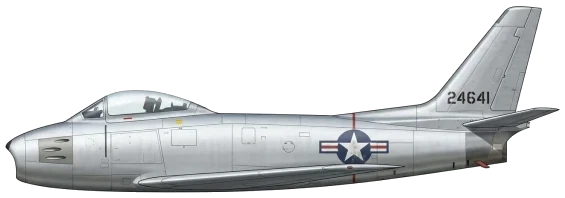
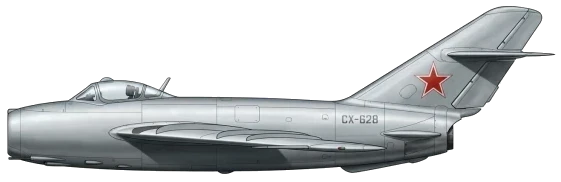
| F-86 Sabre | MiG-17 Fresco | |
|---|---|---|
| Origin country | 🇺🇸 United States | 🇷🇺 Ex-USSR |
| Category | Combat Aircraft | Combat Aircraft |
| Manufacturer | North American | Mikoyan-Gurevich |
| First flight | 1 October 1947 | 14 January 1950 |
| Year introduced | 1949 | 1952 |
| Number produced | 9860 units | 10649 units |
| Average unit price | $1.2 million | $600K |
| Wing area | 28.1 m² | 22.6 m² |
| Wingspan | 11.3 m | 9.6 m |
| Height | 4.4 m | 3.8 m |
| Length | 11.4 m | 11.3 m |
| Maximum speed | 1127 km/h | 1145 km/h |
| Operational range | 2,454 km | 2,020 km |
| Service ceiling | 15,850 m | 16,600 m |
| Max. takeoff weight | 9,621 kg | 6,069 kg |
| Empty weight | 5,443 kg | 3,919 kg |
| Total thrust | 1 x 3,402 kgf | 1 x 3,447 kgf |
Detailed Comparison
The North American F-86 Sabre and Mikoyan-Gurevich MiG-17 Fresco are defined by their lineage as transonic jet fighters that bridged the gap between post-WWII designs and the supersonic era. While the F-86 was the primary US air superiority fighter of the Korean War, the MiG-17 was an evolutionary step over the MiG-15, designed specifically to rectify high-speed instability and challenge Western air dominance in subsequent conflicts like Vietnam.
Development and Design
The F-86 utilized seized German aerodynamic data to incorporate a 35° swept-wing and automatic slats, transitioning from earlier straight-wing proposals to a design capable of delaying compressibility effects. It prioritized pilot effectiveness through advanced systems, including the AN/APG-30 radar-ranging gunsight and, in later models like the F-86E, a hydraulic "all-flying tail" to maintain control authority at Mach 1. Conversely, the MiG-17 was a direct evolution of the MiG-15, developed to cure that airframe's control reversals. It featured a more streamlined fuselage and a thinner, highly swept wing. The Soviet design philosophy emphasized structural robustness and simplicity over the complex avionics found in the Sabre, resulting in a lighter airframe capable of withstanding significant battle damage and operating from unimproved airfields.
Specifications and Performances
The MiG-17 holds a kinematic advantage in pure speed, reaching approximately 1193 km/h compared to the F-86’s 1127 km/h, driven by the powerful Klimov VK-1 engine and a significantly lower empty weight (3705 kg vs 5443 kg). This weight differential grants the Fresco superior vertical maneuverability and climb rates. However, the F-86 offers superior stability in high-speed dives and sustained turns due to its advanced flight control systems. Armament doctrines diverge sharply: the F-86 relies on volume of fire from six .50 caliber machine guns (1,200 rpm), creating a dense pattern for air-to-air engagement. The MiG-17 utilizes heavy, slower-firing 37mm and 23mm cannons optimized for destroying bombers; while destructive, this loadout proved difficult to aim against agile fighters due to low muzzle velocity and limited ammunition.
Deployment and usage
The F-86 served as the USAF's primary air superiority asset during the Korean War, engaging MiG-15s in the first large-scale jet-versus-jet combat. Post-Korea, variants like the F-86H transitioned to nuclear-capable fighter-bomber roles, and the platform was widely exported to NATO allies, Pakistan, and Taiwan. The MiG-17, entering service too late for Korea, proved effective in the Vietnam War, where North Vietnamese pilots utilized its low-speed agility to ambush faster, heavier US aircraft like the F-4 Phantom. While the F-86 was phased out by major powers in the late 1950s, the MiG-17 remained in frontline service longer, seeing extensive use in the Middle East and African conflicts, often repurposed for ground attack despite lacking specialized targeting avionics.
Conclusion
The F-86 Sabre represented a triumph of aerodynamic refinement and pilot-centric systems, offering a stable gun platform that set the standard for Western fighter design. The MiG-17, while lacking sophisticated avionics, leveraged a superior thrust-to-weight ratio and heavy weaponry to remain a lethal threat well into the missile era. The Sabre defined the tactical doctrine of the 1950s, whereas the Fresco demonstrated the enduring value of simple, high-performance airframes in asymmetric warfare environments.