J-29 Tunnan vs MiG-15 Fagot
J-29 Tunnan vs MiG-15 Fagot at a glance — top speed 1,060 vs 1,075 km/h, range 1,100 vs 2,520 km, max takeoff weight 8,375 vs 6,105 kg, built 661 vs 17,310 units.
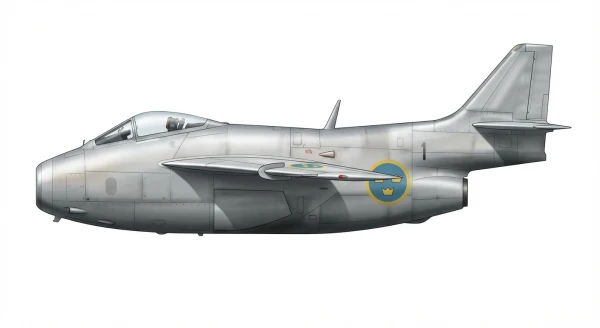
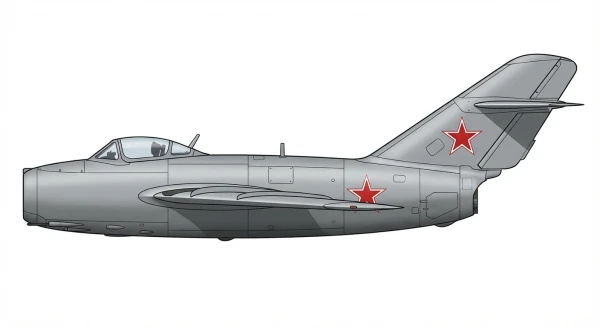
| J-29 Tunnan | MiG-15 Fagot | |
|---|---|---|
| Origin country | 🇸🇪 Sweden | 🇷🇺 Ex-USSR |
| Category | Combat Aircraft | Combat Aircraft |
| Manufacturer | Saab | Mikoyan-Gurevich |
| First flight | 1 September 1948 | 19 December 1947 |
| Year introduced | 1952 | 1949 |
| Number produced | 661 units | 17310 units |
| Average unit price | $1 million | $200K |
| Wing area | 24.2 m² | 20.6 m² |
| Wingspan | 10.2 m | 10.1 m |
| Height | 3.8 m | 3.7 m |
| Length | 11.0 m | 10.1 m |
| Maximum speed | 1060 km/h | 1075 km/h |
| Operational range | 1,100 km | 2,520 km |
| Service ceiling | 15,500 m | 15,500 m |
| Max. takeoff weight | 8,375 kg | 6,105 kg |
| Empty weight | 4,845 kg | 3,580 kg |
| Total thrust | 1 x 2,753 kgf | 1 x 2,700 kgf |
Detailed Comparison
The Saab J-29 Tunnan and Mikoyan-Gurevich MiG-15 Fagot were both first-generation swept-wing jet fighters developed in the immediate post-war period, heavily influenced by German aerodynamic research. The MiG-15, however, was produced on a vastly larger scale (over 17,000 units) as a primary interceptor for the Soviet Union and its allies, while the Tunnan (661 units) was a multi-role aircraft developed to meet Sweden's specific national defense requirements. Both aircraft were designed around powerful, but bulky, centrifugal-flow turbojets—a licensed de Havilland Ghost for the Tunnan and a reverse-engineered Rolls-Royce Nene (Klimov VK-1) for the MiG-15—which resulted in their characteristic stout, barrel-like fuselages.
Development and Design
The J-29 Tunnan's design was a domestic Swedish effort initiated in 1945. Its defining features were the mid-mounted, 25-degree swept wing and a fuselage optimized for the Ghost engine. Saab incorporated advanced features for the era, including a Saab-developed ejection seat and, on the final J 29F variant, a Swedish-designed afterburner and the ability to carry AIM-9B Sidewinder missiles. This evolution reflects a design philosophy focused on incremental, qualitative improvements for a long service life. The MiG-15 was developed with a more singular purpose: to be a high-altitude interceptor capable of countering Western strategic bombers. Its 35-degree swept wing and lighter airframe were optimized for climb rate and high-altitude performance. Its design prioritized manufacturability, enabling its mass production across the Eastern Bloc.
Specifications and Performances
While their maximum speeds and service ceilings are nearly identical (approx. 1070 km/h and 15,500 m), the MiG-15's performance was superior in its intended role. Its climb rate of 50 m/s was significantly higher than the Tunnan's 32.1 m/s, a critical advantage for an interceptor. This was largely due to the MiG's substantially lower empty weight (3,580 kg vs. 4,845 kg), which allowed it to better exploit the comparable thrust from its Klimov VK-1 engine. In terms of armament, the MiG-15's heavy cannon suite (one 37mm and two 23mm) offered devastating firepower against large targets but was hampered by low muzzle velocity and a slow rate of fire in dynamic air-to-air combat. The Tunnan's four 20mm cannons provided a more practical armament for fighter-versus-fighter engagements. The later integration of the AIM-9 Sidewinder gave the J-29F a technological edge in lethality that the gun-only MiG-15 lacked.
Deployment and usage
The MiG-15's operational history is defined by its extensive combat use in the Korean War. In the skies of "MiG Alley," it proved a formidable opponent to UN aircraft, effectively challenging initial air superiority. Its performance at high altitude forced the United States to deploy its own advanced swept-wing fighter, the F-86 Sabre. The Tunnan's combat record is limited to its deployment as part of a UN peacekeeping mission in the Congo, where J 29Bs performed ground-attack sorties. Although effective in this role, it was never tested in large-scale jet-versus-jet combat. The Tunnan served Sweden as a versatile platform in fighter, attack, and reconnaissance (S 29C) roles, and was exported only to Austria.
Conclusion
The MiG-15 was a highly successful, specialized interceptor whose design was optimized for climb rate and mass production. Its combat performance in Korea solidified its place as one of the most significant early jet fighters. The J-29 Tunnan was a more versatile and technologically evolving multi-role aircraft, representing a highly competent national defense program. While the MiG-15's impact was global due to its numbers and combat record, the Tunnan demonstrated Sweden's ability to independently develop a first-rate fighter that, in its final variants, incorporated more advanced armament than its Soviet contemporary.