J-29 Tunnan vs MiG-17 Fresco
J-29 Tunnan vs MiG-17 Fresco at a glance — top speed 1,060 vs 1,145 km/h, range 1,100 vs 2,020 km, max takeoff weight 8,375 vs 6,069 kg, built 661 vs 10,649 units.
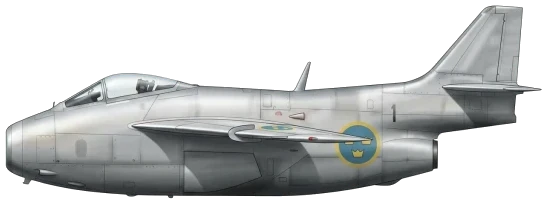
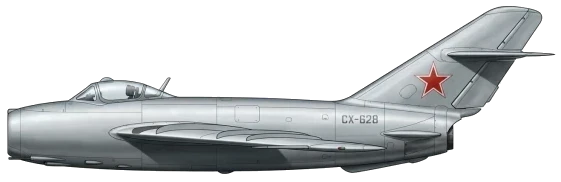
| J-29 Tunnan | MiG-17 Fresco | |
|---|---|---|
| Origin country | 🇸🇪 Sweden | 🇷🇺 Ex-USSR |
| Category | Combat Aircraft | Combat Aircraft |
| Manufacturer | Saab | Mikoyan-Gurevich |
| First flight | 1 September 1948 | 14 January 1950 |
| Year introduced | 1952 | 1952 |
| Number produced | 661 units | 10649 units |
| Average unit price | $1 million | $600K |
| Wing area | 24.2 m² | 22.6 m² |
| Wingspan | 10.2 m | 9.6 m |
| Height | 3.8 m | 3.8 m |
| Length | 11.0 m | 11.3 m |
| Maximum speed | 1060 km/h | 1145 km/h |
| Operational range | 1,100 km | 2,020 km |
| Service ceiling | 15,500 m | 16,600 m |
| Max. takeoff weight | 8,375 kg | 6,069 kg |
| Empty weight | 4,845 kg | 3,919 kg |
| Total thrust | 1 x 2,753 kgf | 1 x 3,447 kgf |
Detailed Comparison
The Saab J-29 Tunnan and the Mikoyan-Gurevich MiG-17 Fresco emerged as defining second-generation jet fighters, both entering service in 1952. While the Tunnan represented a distinct indigenous capability for Sweden, optimizing British engine technology in a unique fuselage, the MiG-17 was an evolutionary refinement of the ubiquitous MiG-15, focusing on high-speed stability and mass production. Both aircraft heavily utilized swept-wing aerodynamics derived from German wartime research, marking a convergence of Western and Eastern design philosophies during the early Cold War.
Development and Design
Development of the J-29 Tunnan began in 1945, utilizing a barrel-like fuselage to house the de Havilland Ghost turbojet. Its key innovation was the 25-degree swept wing, a direct application of German data, which allowed the aircraft to exceed initial performance estimates. Saab prioritized maintainability—the engine could be removed via a special trolley—and pilot safety, integrating a proprietary ejection seat. Conversely, the MiG-17 was designed specifically to rectify the high-speed control limitations of the MiG-15. It featured a more streamlined fuselage, improved wing sweep, and a stiffer wing structure. While the J-29 was a clean-sheet design for the jet age, the MiG-17 was an optimization of an existing platform, lacking advanced avionics in early iterations but boasting a robust airframe capable of absorbing significant battle damage.
Specifications and Performances
The MiG-17 holds a distinct advantage in raw kinematic performance, with a maximum speed of 1193 km/h compared to the Tunnan's 1060 km/h. The Soviet aircraft also offers nearly double the operational range at 2020 km versus the Swedish jet's 1100 km. However, the armament reflects different tactical doctrines. The Tunnan provides high rates of fire through four 20 mm Hispano cannons, suitable for dogfighting and ground strafing. The MiG-17 utilizes a heavy-hitting mix of one 37 mm and two 23 mm cannons, designed to destroy heavy bombers but limited by low ammunition capacities (40 and 80 rounds respectively). Late-model J-29Fs incorporated afterburners and a dog-tooth wing leading edge to improve critical Mach numbers, keeping pace with the afterburning MiG-17F variants.
Deployment and Usage
Operational history underscores the global disparity between the two airframes. The J-29 saw limited export to Austria but proved its combat efficacy during UN operations in the Congo, where J-29Bs conducted effective ground attacks under fire. The MiG-17, produced in vast numbers (over 10,000 units), became a staple of asymmetric warfare. In Vietnam, its agility allowed North Vietnamese pilots to effectively engage superior American aircraft like the F-4 Phantom II. While the Tunnan was a versatile regional asset capable of carrying napalm and rockets for Close Air Support (CAS), the MiG-17 served as a global workhorse, often outclassed in conventional conflicts like the Six-Day War but favored for its ruggedness and ease of maintenance in developing nations.
Conclusion
The J-29 Tunnan stands as a testament to Sweden's ability to produce a world-class fighter independent of major power blocs, matching the performance of contemporary superpowers with superior pilot integration and sustained fire capabilities. The MiG-17, however, achieved strategic dominance through sheer availability and a rugged design that prioritized high-speed interception and simple logistics. While the Tunnan was a sophisticated engineering achievement, the MiG-17 was a more influential geopolitical asset, defining air combat in the proxy wars of the mid-Cold War.


