NH90 / Caiman vs SH-3 Sea King
NH90 / Caiman vs SH-3 Sea King at a glance — top speed 300 vs 267 km/h, range 880 vs 1,005 km, max takeoff weight 10,600 vs 10,002 kg, built 471 vs 1,300 units.
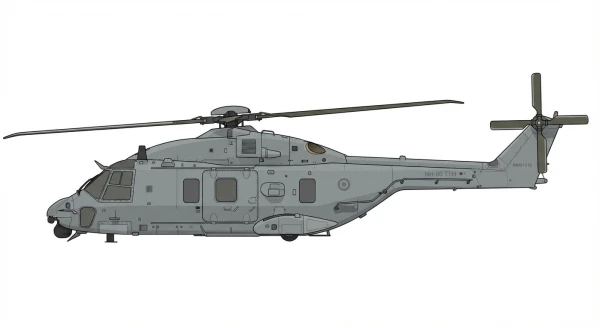
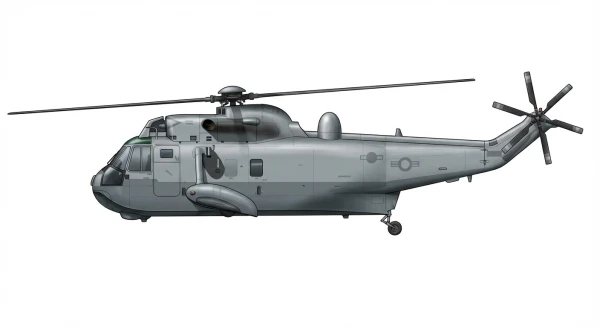
| NH90 / Caiman | SH-3 Sea King | |
|---|---|---|
| Origin country | 🇩🇪 Germany🇫🇷 France🇮🇹 Italy🇳🇱 Netherlands | 🇺🇸 United States |
| Category | Military Helicopters | Military Helicopters |
| Manufacturer | NHIndustries | Sikorsky |
| First flight | 18 December 1995 | 11 March 1959 |
| Year introduced | 2004 | 1961 |
| Number produced | 471 units | 1300 units |
| Average unit price | $42 million | $25 million |
| Wingspan | 16.3 m | 19.0 m |
| Height | 5.3 m | 5.1 m |
| Length | 19.6 m | 16.7 m |
| Maximum speed | 300 km/h | 267 km/h |
| Operational range | 880 km | 1,005 km |
| Service ceiling | 6,000 m | 4,481 m |
| Max. takeoff weight | 10,600 kg | 10,002 kg |
| Empty weight | 6,400 kg | 5,382 kg |
| Total thrust | 2 x 1,693 kW | 2 x 1,044 kW |
Detailed Comparison
The NH90 represents a modern, multinational approach to a multi-role helicopter, while the SH-3 Sea King is a legacy American design from the Cold War. The NH90, with its 1995 first flight, incorporates late 20th-century innovations like a composite airframe and full fly-by-wire controls, contrasting sharply with the Sea King's conventional 1959-era design. Despite a 36-year gap in their origins, both were developed with a primary focus on naval anti-submarine warfare (ASW) and utility transport.
Development and Design
The NH90 was born from a NATO requirement for a common battlefield and naval helicopter, developed by the NHIndustries consortium. Its design philosophy emphasizes technological advancement to reduce crew workload and enhance survivability. Key innovations include being the world's first production helicopter with full fly-by-wire (FBW) flight controls and a four-axis autopilot. The extensive use of composites in its diamond-shaped fuselage is intended to produce the lowest radar signature in its class. In contrast, the SH-3 Sea King's development by Sikorsky was driven by a US Navy need for an advanced ASW platform. Its design was revolutionary for its time, featuring a boat-like hull for amphibious operations and a twin-engine configuration that greatly improved over-water safety. Its conventional airframe and controls prioritize ruggedness and simplicity, which contributed to its remarkable longevity and adaptability.
Specifications and Performances
The technological gap is evident in performance metrics. The NH90's more powerful Rolls-Royce RTM322 engines (1,693 kW each) enable a higher maximum speed (300 km/h vs. the Sea King's 267 km/h) and support a greater maximum takeoff weight (10,600 kg vs. 10,002 kg). This allows the NH90 to carry heavier payloads despite being heavier empty. The NH90 also operates at a significantly higher altitude (up to 20,000 ft) compared to the Sea King's 4,481 m service ceiling, providing a distinct advantage in "hot and high" environments. The Sea King, however, has a slightly longer stated range of 965 km versus the NH90's 880 km, a testament to its efficient, albeit older, design for long-duration patrol missions.
Deployment and usage
The SH-3 Sea King has a long and distinguished service history, entering service in 1961. It was a cornerstone of US Navy ASW operations for decades and proved its versatility in roles from search and rescue and troop transport to mine countermeasures and VIP transport (as Marine One). Its reputation is built on reliability and ruggedness. The NH90, entering service in 2007, has had a more complex operational history. It has been deployed by numerous nations in its TTH (Tactical Transport Helicopter) and NFH (NATO Frigate Helicopter) variants. However, its service life has been marked by significant challenges, including low availability rates, high maintenance demands, software issues, and corrosion, leading several operators to plan or execute early retirements. While technologically capable, its operational readiness has often fallen short of expectations.
Conclusion
This comparison highlights a classic trade-off between advanced, complex technology and proven, robust design. The NH90 offers superior performance, integrated digital systems, and low observability, representing the theoretical peak of its generation. However, this complexity has resulted in significant serviceability and cost issues that have hampered its effectiveness. The SH-3 Sea King, while technologically obsolete in many respects, stands as a testament to a successful design philosophy centered on reliability and adaptability. Its long, multi-faceted service career illustrates the value of a rugged and dependable platform, a lesson that remains highly relevant for modern military procurement.