MQ-4 Triton vs RQ-4 Global Hawk
MQ-4 Triton vs RQ-4 Global Hawk at a glance — top speed 610 vs 629 km/h, range 15,200 vs 22,800 km, max takeoff weight 14,628 vs 14,628 kg, built 30 vs 40 units.
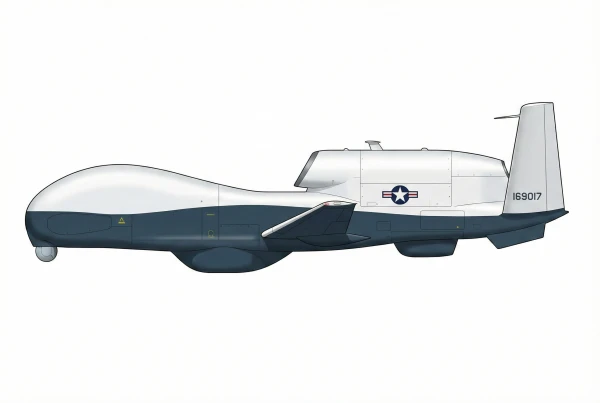
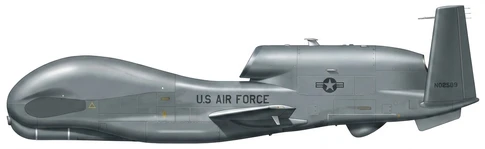
| MQ-4 Triton | RQ-4 Global Hawk | |
|---|---|---|
| Origin country | 🇺🇸 United States | 🇺🇸 United States |
| Category | Military Drones | Military Drones |
| Manufacturer | Northrop Grumman | Northrop Grumman |
| First flight | 22 May 2013 | 28 February 1998 |
| Year introduced | 2018 | 2001 |
| Number produced | 30 units | 40 units |
| Average unit price | $180 million | $131 million |
| Wingspan | 39.9 m | 39.9 m |
| Length | 14.5 m | 14.5 m |
| Maximum speed | 610 km/h | 629 km/h |
| Operational range | 15,200 km | 22,800 km |
| Service ceiling | 16,800 m | 18,000 m |
| Max. takeoff weight | 14,628 kg | 14,628 kg |
| Empty weight | 6,781 kg | 8,620 kg |
Detailed Comparison
While both the RQ-4 Global Hawk and MQ-4C Triton originate from the same Northrop Grumman high-altitude, long-endurance (HALE) airframe, they are tailored for distinct operational domains. The Global Hawk serves the U.S. Air Force as a strategic land-surveillance and reconnaissance platform, while the Triton is a U.S. Navy asset specifically adapted for persistent maritime intelligence. This divergence in mission dictates their differing design features, sensor suites, and performance envelopes.
Development and Design
The RQ-4 Global Hawk was developed in the 1990s as a high-altitude reconnaissance platform to complement and potentially replace manned aircraft like the U-2. Its design evolution through various blocks (10, 20, 30, 40) reflects a progressive enhancement of payload capacity and sensor integration for multi-intelligence (Multi-INT) missions, primarily over land. Its airframe is optimized for maximum altitude and endurance.
The MQ-4C Triton, developed from the Navy's Broad Area Maritime Surveillance (BAMS) program, is a derivative of the Global Hawk but incorporates critical modifications for its naval role. The airframe and wings are structurally reinforced, and it is equipped with de-icing and lightning protection systems. These features allow the Triton to safely descend through harsh maritime weather and cloud layers for closer inspection of surface targets, a key operational requirement the Global Hawk was not designed for. The Triton's sensor suite is headlined by the AN/ZPY-3 Multi-Function Active Sensor (MFAS), an X-band AESA radar optimized for 360-degree surveillance of vast sea areas.
Specifications and Performances
Though sharing an identical airframe length (14.5 m), wingspan (39.9 m), and max takeoff weight (14,628 kg), their performance metrics diverge based on mission optimization. The Global Hawk boasts a superior range of 22,780 km and an endurance of 32 hours, reflecting its design for strategic, long-range missions from established bases. In contrast, the Triton has a shorter range of 8,200 km and an endurance of 24 hours. This reduction is a direct trade-off for the added weight of its maritime-specific systems, such as airframe reinforcements and de-icing equipment. The Triton’s capability is not measured in raw range but in its ability to persistently patrol a designated maritime area for a full day.
Deployment and usage
The Global Hawk has a long operational history, with deployments beginning in 2001 in Afghanistan and Iraq. Its primary function has been providing wide-area imagery (IMINT) and signals intelligence (SIGINT) to support ground forces and strategic objectives, as seen in operations like Inherent Resolve. It operates almost exclusively at high altitudes to remain clear of most air defenses.
The Triton's deployment is more recent, with initial operational capability declared in 2018. It is specifically tasked with the BAMS mission, providing real-time surveillance of sea lanes, littorals, and open-ocean environments. Deployed from locations like Guam, its role is to identify and track surface vessels using its specialized radar and EO/IR sensors, acting as a force multiplier for naval fleets and P-8A Poseidon patrol aircraft. The 2019 shootdown of a BAMS-D prototype by Iran underscored its use in contested maritime regions.
Conclusion
The RQ-4 Global Hawk and MQ-4C Triton are not interchangeable assets but rather highly specialized platforms derived from a common design. The Global Hawk is a mature, strategic overland ISR system optimized for extreme altitude and range. The Triton is a purpose-built maritime derivative, hardened for its environment and equipped with sensors and flight characteristics essential for naval surveillance. Its key design distinction—the ability to safely operate in and below cloud cover over the ocean—makes it a unique and critical component of modern naval operations, a task for which the Global Hawk is ill-suited.