SA315 Alouette II vs SA340 Gazelle
SA315 Alouette II vs SA340 Gazelle at a glance — top speed 192 vs 310 km/h, range 565 vs 361 km, max takeoff weight 1,600 vs 2,100 kg, built 1,300 vs 1,775 units.
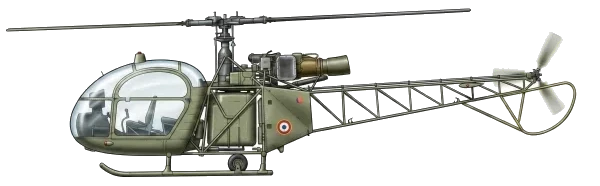
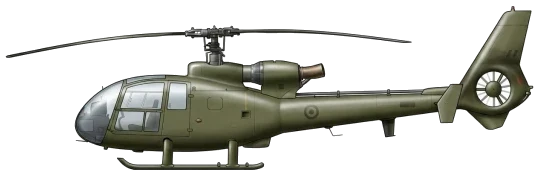
| SA315 Alouette II | SA340 Gazelle | |
|---|---|---|
| Origin country | 🇫🇷 France | 🇫🇷 France |
| Category | Military Helicopters | Military Helicopters |
| Manufacturer | Sud Aviation | Aérospatiale |
| First flight | 12 March 1955 | 7 April 1967 |
| Year introduced | 1957 | 1971 |
| Number produced | 1300 units | 1775 units |
| Average unit price | -- | $1.7 million |
| Wingspan | 10.2 m | 10.5 m |
| Height | 2.8 m | 3.2 m |
| Length | 9.7 m | 11.9 m |
| Maximum speed | 192 km/h | 310 km/h |
| Operational range | 565 km | 361 km |
| Service ceiling | 2,300 m | 4,450 m |
| Max. takeoff weight | 1,600 kg | 2,100 kg |
| Empty weight | 895 kg | 1,009 kg |
| Total thrust | 1 x 343 kW | 1 x 650 kW |
Detailed Comparison
The Aérospatiale SA315 Alouette II and SA340 Gazelle illustrate the rapid evolution of French rotary-wing technology from the mid-1950s to the 1970s. While the Alouette II pioneered the use of turbine engines in production helicopters, the Gazelle introduced aerodynamic refinements and composite materials that defined the next generation of light utility and reconnaissance platforms. Both aircraft served as foundational assets for French and export military markets, specifically in the light observation and anti-tank roles.
Development and Design
The Alouette II was developed by SNCASE (later Sud Aviation) to meet an urgent government requirement for a production helicopter. Its defining innovation was the integration of the Turbomeca Artouste single-shaft turbine, making it the world's first production turbine-powered helicopter. The design emphasized mechanical simplicity, utilizing a governor to manage rotor speed without a throttle-collective link and featuring an exposed open-truss tail structure.
Conversely, the SA340 Gazelle represented a shift toward high-speed performance and acoustic stealth. It introduced the fenestron (shrouded tail rotor), which significantly improved safety during low-level operations and reduced the aircraft's noise signature. The Gazelle also utilized composite materials and a semi-rigid main rotor system, departing from the Alouette's utilitarian aesthetic in favor of a streamlined, aerodynamic monocoque fuselage designed for speed and agility.
Specifications and Performances
Performance metrics highlight the generational gap in propulsion and aerodynamics between the two platforms. The Gazelle's Turbomeca Astazou XIVH delivers 650 kW, nearly double the 343 kW output of the Alouette II's Artouste IIC6. This power surplus translates to superior kinematics; the Gazelle achieves a maximum speed of 310 km/h, significantly outperforming the Alouette II, which lacks a specified maximum speed in the data but generally operates much slower due to drag.
The Gazelle also offers a climb rate of 7.7 m/s, compared to the Alouette’s 4.2 m/s, and possesses a much higher service ceiling of 4,450 m versus 2,300 m. While the Alouette II maintained a lighter empty weight (895 kg), the Gazelle's 2,100 kg maximum takeoff weight allows for a heavier mission payload, accommodating advanced sensor suites and weapon systems that the Alouette II's 1,600 kg limit could not support.
Deployment and Usage
The Alouette II pioneered the armed helicopter concept, notably becoming the first rotorcraft equipped with anti-tank munitions, specifically the SS.11 wire-guided missile. It saw extensive combat in the Algerian War and with Rhodesian forces, where it was integral to "Fireforce" vertical envelopment tactics despite performance limitations in hot-and-high conditions.
The Gazelle built upon this anti-armor legacy, serving as a primary platform for the Euromissile HOT system. Its operational history includes the Falklands War, the Gulf War, and operations in the Balkans. Unlike the general utility focus of the Alouette, the Gazelle became a specialized reconnaissance and light attack asset, leveraging its speed and advanced optics for scout missions in high-threat environments.
Conclusion
Ultimately, the SA315 Alouette II successfully proved the viability of the turbine helicopter, establishing a rugged baseline for air mobility and basic close air support. The SA340 Gazelle evolved this concept into a sophisticated tactical platform, prioritizing agility and survivability through aerodynamic innovation. While the Alouette II is remembered for its mechanical robustness and pioneering role in heliborne warfare, the Gazelle remains a benchmark for light scout and anti-tank helicopter design, influencing modern reconnaissance doctrines.


