SA315 Alouette II vs UH-1 Iroquois "Huey"
SA315 Alouette II vs UH-1 Iroquois "Huey" at a glance — top speed 192 vs 222 km/h, range 565 vs 510 km, max takeoff weight 1,600 vs 4,309 kg, built 1,300 vs 16,000 units.
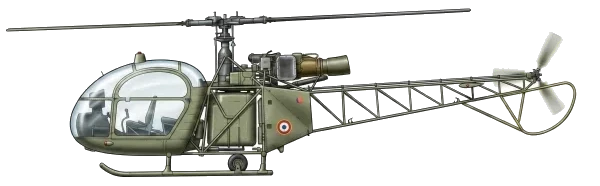
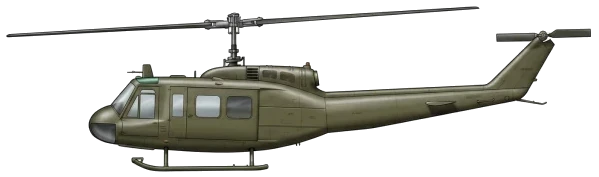
| SA315 Alouette II | UH-1 Iroquois "Huey" | |
|---|---|---|
| Origin country | 🇫🇷 France | 🇺🇸 United States |
| Category | Military Helicopters | Military Helicopters |
| Manufacturer | Sud Aviation | Bell |
| First flight | 12 March 1955 | 22 October 1956 |
| Year introduced | 1957 | 1959 |
| Number produced | 1300 units | 16000 units |
| Average unit price | -- | $1.3 million |
| Wingspan | 10.2 m | 14.6 m |
| Height | 2.8 m | 4.5 m |
| Length | 9.7 m | 12.7 m |
| Maximum speed | 192 km/h | 222 km/h |
| Operational range | 565 km | 510 km |
| Service ceiling | 2,300 m | 5,910 m |
| Max. takeoff weight | 1,600 kg | 4,309 kg |
| Empty weight | 895 kg | 2,087 kg |
| Total thrust | 1 x 343 kW | 1 x 820 kW |
Detailed Comparison
The Aérospatiale SA315 Alouette II and the Bell UH-1 Iroquois emerged in the mid-1950s as pivotal platforms transitioning military rotorcraft from piston to turbine engine technology. While the French Alouette II focused on light observation and specific tactical applications using the Artouste engine, the American UH-1 defined the medium-utility role, pioneering air mobility doctrine with its robust airframe and heavy lift capabilities. Both platforms set lasting standards for rotary-wing durability and versatility in their respective weight classes.
Development and Design
The Alouette II was developed as a rapid response to a French government ultimatum to produce a viable helicopter or cease rotary-wing activities. It became the world's first production turbine-powered helicopter, utilizing a Turbomeca Artouste single-shaft turbine. Its design prioritized simplicity, featuring an un-clutched transmission and an automated governor system that eliminated the need for a throttle twist-grip. The open-frame structure and dome-shaped windscreen maximized visibility and minimized weight.
Conversely, the UH-1 was developed to fulfill a specific US Army requirement for medical evacuation and utility. Bell designed a spacious, modular cabin around the Lycoming T53 engine, prioritizing structural robustness and ease of reconfiguration over the Alouette's lightweight architecture. The Huey introduced the characteristic twin-blade main rotor system that became a Bell trademark, utilizing a semi-monocoque metal construction capable of withstanding significant combat stress.
Specifications and Performance
The physical disparities between the aircraft dictate their operational envelopes. The UH-1 is a significantly heavier platform with a Maximum Takeoff Weight (MTOW) of 4,309 kg, nearly triple the Alouette II's 1,600 kg. This mass is supported by the T53 engine producing 820 kW, compared to the Artouste’s 343 kW. Consequently, the UH-1 offers superior kinematic performance, boasting a climb rate of 8.9 m/s versus the Alouette's 4.2 m/s and a higher service ceiling (5,910 m against 2,300 m). While the Alouette II is agile and compact (9.66 m length), the Huey's larger footprint (12.74 m) facilitates the payload capacity necessary for squad transport, whereas the Alouette is limited to smaller teams or external loads up to 500 kg.
Deployment and Usage
The UH-1 is synonymous with the Vietnam War, executing the concept of air mobility through massive troop insertion, medevac (over 7,000 deployed), and gunship support using machine guns and rockets. Its modularity allowed it to transition seamlessly between logistics and close air support, becoming the ubiquitous "slick" or "gunship."
The Alouette II found its niche in asymmetric warfare and specialized tasks. It was a pioneer in anti-tank warfare, being the first helicopter equipped with SS.11 wire-guided missiles. It saw extensive service in the Algerian War and with Rhodesian forces, where its resistance to battle damage and effectiveness in "Fireforce" envelopment tactics proved vital despite "high and hot" limitations. While the Huey moved armies, the Alouette II excelled in armed reconnaissance and precision strikes.
Conclusion
The Alouette II and UH-1 serve complementary rather than competing functions within military aviation history. The Alouette II demonstrated the viability of the light turbine helicopter, excelling in reconnaissance and the integration of guided anti-tank munitions. The UH-1, however, established the doctrine of vertical envelopment, offering the raw power and volume required for mass tactical transport. While the Huey’s production numbers (16,000+) dwarf the Alouette’s, both airframes demonstrated exceptional longevity, influencing rotorcraft design through the successful integration of turbine power and modular weapon systems.


-
 Turkey
172
Turkey
172
-
 Greece
112
Greece
112
-
 Japan
93
Japan
93
- All 39 operators →