Kobben vs Sang-O
Kobben vs Sang-O at a glance — displacement 435 vs 275 tons, length 47 vs 34 m, speed 10 vs 7.5 knots, crew 24 vs 15.
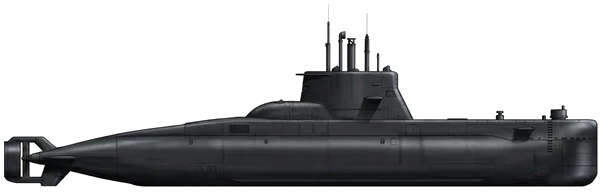
| Kobben | Sang-O | |
|---|---|---|
| Origin | 🇳🇴 Norway | 🇰🇵 North Korea |
| Category | Submarine | Submarine |
| Type | Coastal submarine | Coastal submarine |
| Manufacturer | Nordseewerke GmbH | Bong Dao Bo Shipyard, Sinpo |
| Year introduced | 1964 | 1991 |
| Number built | 15 units | 41 units |
| Estimated unit price | NA | NA |
| Displacement | 435 tons | 275 tons |
| Maximum speed | 10.0 knots | 7.5 knots |
| Range | 4,200 nm at 8 knots | 1,500 nm |
| Length | 47.2 m | 34.0 m |
| Beam | 4.7 m | 3.8 m |
| Crew | 24 | 15 |
| Max depth | 180 m | 150 m |
| Kobben | Sang-O | |
|---|---|---|
| Armament |
|
|
| Propulsion | 2 MTU 1,100 hp (820 kW) diesel engines, 1 1,700 hp (1,300 kW) electric motor | Diesel-electric, 1 diesel engine, 1 electric motor, 1 shaft |
Detailed Comparison
The Kobben-class (Type 207) and Sang-O-class submarines are diesel-electric coastal boats designed for constrained littoral environments. The Kobben, a 1960s German export design built for Norway and later operated by Denmark and Poland, was engineered to contest the North Atlantic and Baltic coasts against Soviet incursions. The Sang-O, entering service in 1991, forms the numerical core of North Korea's submarine force, built specifically for infiltration and area denial on the Korean peninsula.
Development and Design
The Kobben is a modified German Type 205, constructed by Rheinstahl Nordseewerke. Displacing 485 tons submerged with a 47.2-meter hull, the design was tailored for the Norwegian Fleet Plan of 1960 to navigate shallow fjords. Six units underwent a structural lengthening and modernization program between 1985 and 1993 to extend their service life. North Korea’s Sang-O, produced at the Sinpo shipyards, displaces 370 tons submerged at 34 meters. It is produced in two distinct configurations: a standard attack submarine and a dedicated infiltration variant that trades its torpedo tubes for an airlock and capacity for ten special operations personnel. A later Sang-O II variant adds approximately five meters to increase payload and range.
Weapons and Sensors
The Kobben carries double the organic firepower of the Sang-O.
- Kobben: Eight 533 mm bow torpedo tubes firing wire-guided TP-612/613 and Mk-37 torpedoes.
- Sang-O: Four 533 mm tubes utilizing wake-homing Russian 53-65KE torpedoes, plus capacity for 16 naval mines.
The Kobben's sensor suite received a modernization in the late 1980s with updated passive sonars, whereas the Sang-O relies on older, indigenous analogs of Soviet acoustic arrays.
Propulsion and Performance
Both are diesel-electric, but the Kobben's hydrodynamic profile yields higher performance. Its twin MTU diesels and electric motor generate a submerged speed of 17 knots and a surface range of 4,200 nautical miles at 8 knots. It operates down to 180 meters. The Sang-O's single-shaft system is restricted to 9 knots submerged and 7.5 knots surfaced. Its range is capped at 1,500 nautical miles, limiting it strictly to the Korean littoral zones. Its test depth is shallower, at 150 meters.
Deployment and Combat Record
The Kobben fleet conducted Cold War intelligence patrols, including a 14-day 1972 operation in the Sognefjord hunting a suspected Soviet Whiskey-class submarine. Danish units deployed to the Persian Gulf, with HDMS Sælen participating in the 2003 invasion of Iraq. The Sang-O operates aggressively in the Sea of Japan and Yellow Sea. In September 1996, a Sang-O conducting an infiltration mission ran aground off Gangneung, resulting in the crew abandoning the boat and triggering a 49-day ground engagement with South Korean forces.
Conclusion
The Kobben class holds the absolute advantage in conventional naval warfare. Its 17-knot submerged speed, 4,200-nautical-mile range, and eight torpedo tubes make it a viable sea-denial asset, evidenced by its extended service in NATO navies through 2021. The Sang-O is severely outclassed in a symmetric engagement due to its 9-knot speed limitation and smaller weapon payload. However, for asymmetric infiltration, the Sang-O possesses the edge. By sacrificing torpedo capacity for commando deployment space, it provides Pyongyang with a dedicated special operations platform that the purely conventional Kobben cannot replicate.