Los Angeles vs Virginia
Los Angeles vs Virginia at a glance — displacement 6,082 vs 6,930 tons, length 110 vs 115 m, speed 15 vs 15 knots, crew 129 vs 135.
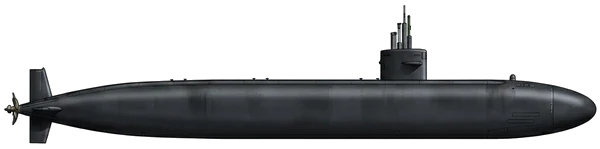
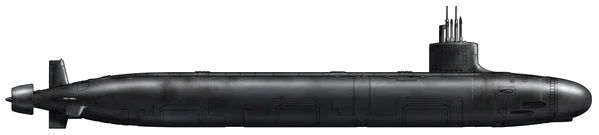
| Los Angeles | Virginia | |
|---|---|---|
| Origin | 🇺🇸 United States | 🇺🇸 United States |
| Category | Submarine | Submarine |
| Type | Nuclear-powered attack submarine | Nuclear-powered attack submarine |
| Manufacturer | Newport News Shipbuilding | General Dynamics Electric Boat |
| Year introduced | 1976 | 2004 |
| Number built | 62 units | 26 units |
| Estimated unit price | $900 million | $2,800 million |
| Displacement | 6,082 tons | 6,930 tons |
| Maximum speed | 15.0 knots | 15.0 knots |
| Range | Unlimited | Unlimited |
| Length | 110.0 m | 115.0 m |
| Beam | 10.0 m | 10.0 m |
| Crew | 129 | 135 |
| Max depth | 450 m | 240 m |
| Los Angeles | Virginia | |
|---|---|---|
| Armament |
|
|
| Propulsion | 1 × S6G nuclear reactor (150–165 MW), 2 × steam turbines (30,000–33,500) shp, 1 × shaft, 1 × secondary propulsion motor 325 hp (242 kW) | 1 × S9G nuclear reactor 280,000 hp (210 MW); 2 × steam turbines 40,000 shp (30 MW); 1 × single shaft pump-jet propulsor; 1 × secondary propulsion motor |
Detailed Comparison
The transition from the Los Angeles-class to the Virginia-class nuclear attack submarines marks a US Navy doctrine shift from deep-water Soviet deterrence to littoral multi-mission operations. With 62 Los Angeles boats built between 1972 and 1996, and 26 Virginia-class boats completed since 2004, these classes constitute the entirety of the active US attack submarine fleet, excluding the three Seawolf-class vessels.
Development and Design
The Los Angeles (688) class was designed in the late 1960s to outpace Soviet carrier groups, resulting in a single-hull design prioritizing speed. It evolved through three flights, culminating in the 688i, which moved diving planes to the bow to enable under-ice operations. The Virginia class, conceived under the 1991 Centurion Study, was developed as a $2.8 billion alternative to the cancelled Seawolf program. It utilizes commercial off-the-shelf (COTS) electronics and modular construction. It replaces the traditional hull-penetrating optical periscope with a photonic mast, allowing the control room to be moved down a deck into a wider, more protected section of the pressure hull.
Weapons and Sensors
Both classes utilize four 21-inch torpedo tubes launching Mk 48 torpedoes, but their land-attack capacities diverge. Flight II and 688i Los Angeles boats integrate 12 dedicated Vertical Launch System (VLS) tubes for Tomahawk missiles. The Virginia class initially mirrored this 12-tube VLS but shifted in Block III to two large-diameter Virginia Payload Tubes (VPT), each holding six Tomahawks. The Block V variant introduces the Virginia Payload Module (VPM), adding 28 Tomahawks to offset the impending retirement of the Ohio-class guided-missile submarines (SSGN). Sensor-wise, both utilize the open-architecture AN/BQQ-10 sonar suite, but the Virginia adds conformable arrays and high-frequency sonars designed for shallow-water mine detection.
Propulsion and Performance
The Los Angeles uses the 165 MW S6G pressurized water reactor and a traditional propeller, achieving 32 knots submerged. The Virginia utilizes the 210 MW S9G reactor and a pump-jet propulsor. The pump-jet delays cavitation at higher speeds, making the Virginia acoustically stealthier across a broader speed envelope and allowing a higher submerged speed of 34 knots. However, the Virginia operates with a shallower maximum test depth constraint of 240 meters compared to the Los Angeles' 450 meters.
Deployment and Combat Record
The Los Angeles class established its combat record during Operation Desert Storm in 1991, firing Tomahawk missiles at Iraqi targets, a role repeated during Operation Iraqi Freedom in 2003. The Virginia class has absorbed these strike and escort roles while expanding into seabed warfare. Driven by its acoustic profile and payload flexibility, the Virginia class forms the basis of the 2023 AUKUS pact, under which the Royal Australian Navy will purchase three units in the 2030s.
Conclusion
The Virginia class has the edge in littoral environments, intelligence gathering, and land-attack strike volume. Its pump-jet propulsor, digital architecture, and payload expansion make it structurally suited for the anti-access/area denial (A2/AD) environment of the Indo-Pacific.
The late-flight 688i Los Angeles boats retain structural advantages in specific Cold War-era profiles:
- Greater maximum operating depth (450 meters versus 240 meters)
- Lower historical procurement cost ($900 million versus $2.8 billion)
- Equivalent baseline anti-submarine torpedo capacity
For deep-water anti-submarine warfare, the 688i matches the core kinematic performance of its successor. However, for multi-domain strike and contested-water acoustic stealth, the Virginia's sensor integration and pump-jet propulsion render the Los Angeles obsolete.