Seawolf vs Yasen
Seawolf vs Yasen at a glance — displacement 8,600 vs 8,600 tons, length 108 vs 139 m, speed 18 vs 20 knots, crew 140 vs 85.
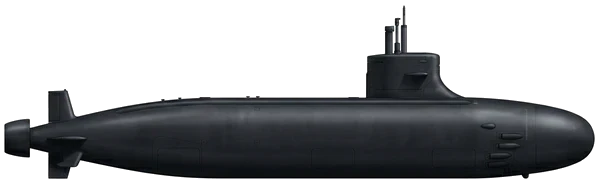

| Seawolf | Yasen | |
|---|---|---|
| Origin | 🇺🇸 United States | 🇷🇺 Russia |
| Category | Submarine | Submarine |
| Type | Nuclear-powered attack submarine | Nuclear-powered attack submarine |
| Manufacturer | General Dynamics Electric Boat | Sevmash |
| Year introduced | 1997 | 2014 |
| Number built | 3 units | 6 units |
| Estimated unit price | $3,000 million | $1,600 million |
| Displacement | 8,600 tons | 8,600 tons |
| Maximum speed | 18.0 knots | 20.0 knots |
| Range | Unlimited | Unlimited |
| Length | 108.0 m | 139.2 m |
| Beam | 12.0 m | 13.0 m |
| Crew | 140 | 85 |
| Max depth | 490 m | 658 m |
| Seawolf | Yasen | |
|---|---|---|
| Armament |
|
|
| Propulsion | 1 S6W PWR 220 MW (300,000 hp), 1 secondary propulsion submerged motor, 2 steam turbines 57,000 shp (43 MW), 1 shaft, 1 pump-jet propeller | OK-650KPM pressurized water reactor, 200 MWt turbines of 43,000 shp |
Detailed Comparison
The Seawolf class (United States) and Yasen class (Russia) differ fundamentally in operational concept, with the former designed as a dedicated hunter-killer and the latter as a multipurpose cruise missile platform. While the Seawolf entered service in 1997 as a Cold War interceptor, the Yasen class, commissioned in 2013, integrates modern standoff strike capabilities. The Seawolf production run was limited to three units due to post-Cold War budget cuts, whereas the Yasen class continues production with six units completed.
Development and Design
The Seawolf class utilizes an HY-100 steel hull designed for deep-ocean operations, measuring 108 meters in length with a submerged displacement of 9,138 tons. It requires a crew of 140. The third vessel, USS Jimmy Carter, includes a hull extension for deploying special operations forces and tapping undersea cables.
The Yasen class employs a low-magnetic steel hull and measures 139.2 meters, displacing 13,800 tons submerged—4,662 tons more than the Seawolf. Despite the larger volume, extensive automation reduces the crew requirement to 85. The Yasen design incorporates a single-hull structure for the majority of its length, differing from previous Soviet double-hull standards.
Weapons and Sensors
Armament architecture distinguishes the two platforms. The Seawolf lacks a Vertical Launch System (VLS), relying entirely on eight 26.5-inch (660mm) torpedo tubes. These discharge Mk 48 guided torpedoes, Tomahawk land-attack missiles, and Harpoon anti-ship missiles. Its sensor suite centers on the ARCI Modified AN/BSY-2 system with a spherical bow array.
The Yasen class prioritizes heavy missile payloads. It features a VLS compatible with Kalibr, Oniks, and Zircon hypersonic cruise missiles, alongside torpedoes and mines. Due to the spherical bow sonar occupying the nose—a first for Russian designs—the ten 533mm torpedo tubes are slanted and located aft of the bow. The Yasen carries 30 Futlyar heavyweight torpedoes and integrates surface-to-air defense via Igla-M systems.
Propulsion and Performance
Both classes achieve a maximum submerged speed of 35 knots. The Seawolf is powered by one S6W nuclear reactor delivering 57,000 shaft horsepower through a pump-jet propulsor, optimized for acoustic stealth. Its maximum reported depth is 490 meters.
The Yasen utilizes an OK-650KPM reactor with natural circulation capabilities to minimize pump noise, driving turbines rated at 43,000 shp. The design specifications list a maximum depth of 658 meters, 168 meters deeper than the Seawolf.
Deployment and Combat Record
Seawolf class submarines operate with the Atlantic and Pacific fleets. USS Jimmy Carter fulfills a specialized niche for covert underwater surveillance and payload delivery.
Yasen class vessels are assigned to Russia's Northern and Pacific Fleets. Operational activities include deployments to the Atlantic and live-fire testing of the Zircon hypersonic missile from both surfaced and submerged positions.
Conclusion
The Seawolf class represents a specialized anti-submarine platform with superior tube-launched weapon capacity and acoustic optimization, acquired at a unit cost of $3 billion. The Yasen class, at $1.6 billion per unit, functions as a heavy SSGN/SSN hybrid, trading some tube capacity for long-range hypersonic strike potential and deeper operational limits.