Seawolf vs Virginia
Seawolf vs Virginia at a glance — displacement 8,600 vs 6,930 tons, length 108 vs 115 m, speed 18 vs 15 knots, crew 140 vs 135.
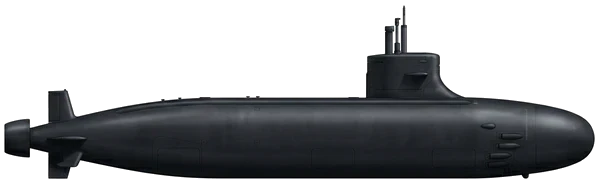
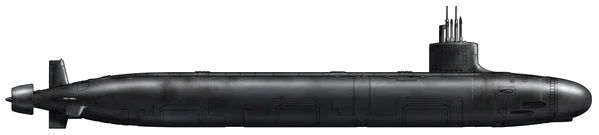
| Seawolf | Virginia | |
|---|---|---|
| Origin | 🇺🇸 United States | 🇺🇸 United States |
| Category | Submarine | Submarine |
| Type | Nuclear-powered attack submarine | Nuclear-powered attack submarine |
| Manufacturer | General Dynamics Electric Boat | General Dynamics Electric Boat |
| Year introduced | 1997 | 2004 |
| Number built | 3 units | 26 units |
| Estimated unit price | $3,000 million | $2,800 million |
| Displacement | 8,600 tons | 6,930 tons |
| Maximum speed | 18.0 knots | 15.0 knots |
| Range | Unlimited | Unlimited |
| Length | 108.0 m | 115.0 m |
| Beam | 12.0 m | 10.0 m |
| Crew | 140 | 135 |
| Max depth | 490 m | 240 m |
| Seawolf | Virginia | |
|---|---|---|
| Armament |
|
|
| Propulsion | 1 S6W PWR 220 MW (300,000 hp), 1 secondary propulsion submerged motor, 2 steam turbines 57,000 shp (43 MW), 1 shaft, 1 pump-jet propeller | 1 × S9G nuclear reactor 280,000 hp (210 MW); 2 × steam turbines 40,000 shp (30 MW); 1 × single shaft pump-jet propulsor; 1 × secondary propulsion motor |
Detailed Comparison
The US Navy's transition from the Seawolf to the Virginia class maps the shift from deep-ocean Soviet containment to littoral warfare and mass production. Procured as dedicated anti-submarine warfare platforms, the Seawolf program collapsed under post-Cold War budget constraints, yielding just three hulls. The Virginia class emerged as the high-volume, modular successor, designed to recapitalize the attack submarine fleet through continuous block upgrades while expanding payload volume for land-attack operations.
Development and Design
General Dynamics Electric Boat designed the Seawolf class in 1983 to counter Soviet Typhoon and Akula submarines. The pressure hull utilizes HY-100 steel, allowing a 490-meter maximum depth. Following the cancellation of the planned 29-boat run, unit costs settled at $3 billion. The third hull, USS Jimmy Carter, received a Multi-Mission Platform extension to deploy remotely operated vehicles and tap undersea fiber optic cables.
Initiated via the 1991 Centurion Study, the Virginia class substituted HY-100 with cheaper steel alloys and utilized commercial off-the-shelf data components. Construction is split between Electric Boat and Newport News Shipbuilding to maintain the industrial base. The design replaces optical periscopes with photonic masts, moving the control room down one deck.
Weapons and Sensors
The Seawolf class prioritizes tactical torpedo engagements. Its internal layout incorporates:
- 8 x 26.5-inch torpedo tubes
- A 50-weapon magazine holding Mk 48 torpedoes and Harpoon missiles
- The ARCI Modified AN/BSY-2 combat system
The Virginia class shifts the armament focus to land attack. Restricted to four 21-inch torpedo tubes, the class expands its vertical launch capacity across production blocks. Block III replaced 12 individual vertical launch tubes with two large-diameter Virginia Payload Tubes. Block V adds the Virginia Payload Module, increasing total Tomahawk capacity from 12 to 40 missiles.
Propulsion and Performance
An S6W pressurized water reactor (220 MW) drives the Seawolf's pump-jet propulsor. Displacing 9,138 tons submerged, the class achieves 35 knots and operates silently at high tactical speeds.
The Virginia class utilizes an S9G reactor (210 MW) and a fly-by-wire ship control system. It displaces 7,900 tons submerged and reaches 34 knots. It trades the Seawolf's extreme crush depth—maxing out at 240 meters—for better low-speed maneuverability in shallow coastal waters.
Deployment and Combat Record
Seawolf-class submarines deploy primarily to the Arctic and contested zones. In 2021, USS Connecticut struck an uncharted seamount in the South China Sea, forcing a multi-year repair cycle. USS Jimmy Carter conducts classified intelligence operations.
With 26 units in service, the Virginia class executes the bulk of US submarine deployments globally, escorting carrier strike groups and conducting surveillance. The class forms the basis of the 2023 AUKUS agreement, under which the Royal Australian Navy will procure three units in the 2030s.
Conclusion
The Virginia class is the better warship for modern naval doctrine. While the Seawolf holds a tactical advantage in a deep-ocean anti-submarine engagement—due to its 490-meter depth rating and eight 26.5-inch tubes—it was an unsustainable platform for a global fleet. The Virginia class provides the required production scale. By prioritizing vertical launch volume and open-architecture electronics, it provides the land-attack capacity and adaptability necessary to execute US naval strategy through 2070.