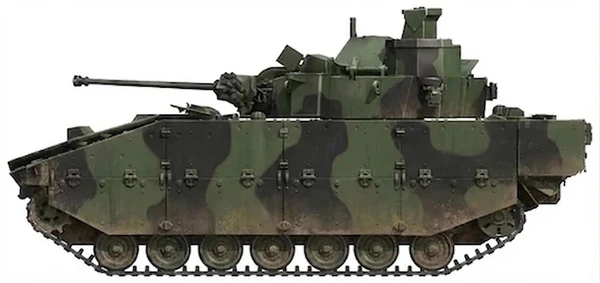
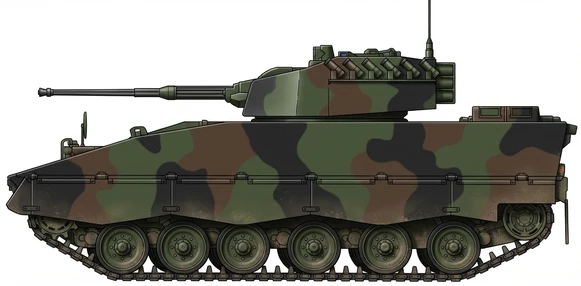
The British Ajax armored reconnaissance vehicle is a heavily modified, 38-ton derivative of the 28-ton Austrian-Spanish ASCOD infantry fighting vehicle. While the ASCOD operates as a mechanized infantry platform carrying an eight-man dismount section, the Ajax trades troop capacity for a 20 Gbit/s Ethernet sensor architecture and a larger caliber turret.
Development and Design
ASCOD development began in 1982 to meet a joint Austrian-Spanish requirement, resulting in a conventional front-engine layout with rear troop access. Production yielded 373 units entering service in 2002. The British Ministry of Defence selected the ASCOD 2 chassis in 2010 for the Future Rapid Effect System (FRES) to replace the 1971-era CVR(T) series. General Dynamics UK heavily modified the hull, but the resulting Ajax program suffered continuous engineering failures. Systemic vibration and noise issues caused crew hearing and joint damage, forcing the suspension of trials in 2020 and 2021.
Protection and Firepower
The baseline ASCOD utilizes steel armor supplemented by MEXAS composite (Austrian Ulan variant) or SABBLIR explosive reactive armor (Spanish Pizarro variant). It mounts a 30 mm Mauser MK 30/2 autocannon. The 38-ton Ajax carries thicker base armor, reflecting post-Iraq mass increases for survivability, and mounts a Lockheed Martin turret armed with a 40mm Cased Telescoped (CT) cannon. Firing at 200 rounds per minute with an 80-degree elevation, the 40CT provides localized anti-UAV capabilities—a strict requirement validated by drone proliferation in Ukraine. However, integration failures on the Ajax chassis previously prevented the stabilization of this gun while on the move.
Mobility and Logistics
Both vehicles achieve maximum speeds of 70-72 km/h on paved surfaces:
The ASCOD uses a 720 hp diesel engine on a 28-ton chassis, producing 25.7 hp/ton.
The Ajax utilizes an 800 hp MTU V8 diesel, but its 38-ton mass restricts it to 21.0 hp/ton.
The 10-ton weight penalty of the Ajax strains its suspension and drivetrain, the root cause of the noise and vibration failures. The lighter ASCOD conforms to standard European rail and trailer transport load limits, lowering logistical friction during deployment.
Deployment and Combat Record
Neither platform has combat experience. Spain explicitly withheld the Pizarro from the ISAF mission in Afghanistan due to the lack of a V-hull mine-protection kit, a known vulnerability against buried IEDs. Austria restricts the Ulan to territorial defense and NATO exercises. The Ajax remains non-operational. The British Army withdrew its Initial Operating Capability (IOC) status in January 2026 after renewed reports of crew illness during field training.
Conclusion
The ASCOD is the superior platform. A 38-ton reconnaissance vehicle that physically injures its crew and struggles to stabilize its main armament holds zero tactical value, rendering the Ajax's on-paper advantages in sensor architecture and 40mm lethality entirely irrelevant. The ASCOD provides a functional, mechanically reliable platform that, despite lacking modern mine-resistant geometry, actually executes its doctrinal requirements for its operators.