General Dynamics Ajax vs CV-90
General Dynamics Ajax vs CV-90 at a glance — weight 38,000 vs 26,000 kg, top speed 70 vs 70 km/h, range 500 vs 560 km, crew — vs 3.
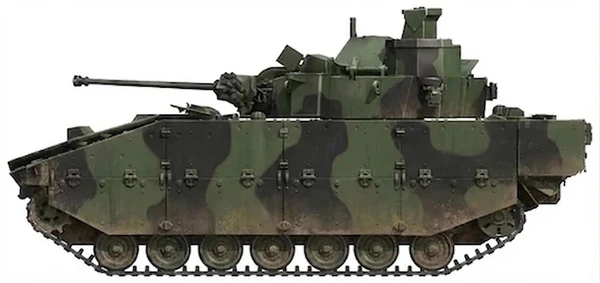
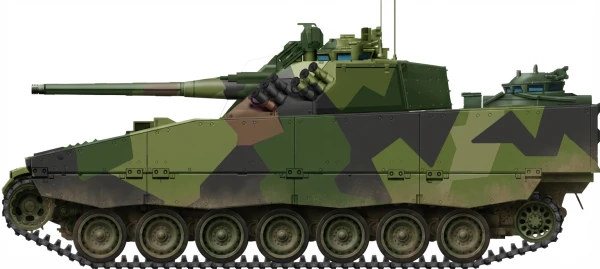
| General Dynamics Ajax | CV-90 | |
|---|---|---|
| Origin country | 🇬🇧 United Kingdom | 🇸🇪 Sweden |
| Category | Light Armoured Vehicle | Infantry Fighting Vehicle |
| Type | Armoured Reconnaissance Vehicle | Infantry Fighting Vehicle |
| Manufacturer | General Dynamics UK | Bofors |
| Number produced | 100 units | 1,400 units |
| Estimated unit price | $13 million | $10 million |
| Combat weight | 38.0 tons | 26.0 tons |
| Maximum speed | 70 km/h | 70 km/h |
| Operational range | 500 km | 560 km |
| Length | 7.62 m | 6.47 m |
| Width | 3.35 m | 3.19 m |
| Height | 3.00 m | 2.50 m |
| Crew | 3 (commander, gunner, driver) | 3 |
| General Dynamics Ajax | CV-90 | |
|---|---|---|
| Main armament | 40mm CT cannon | 1 Bofors 30mm (400 shells) gun |
| Secondary weapon | 7.62mm machine gun | 1 Bofors 7.5mm machine gun (2100 rounds) |
| Engine | MTU V8 diesel, 800 hp | Scania DSI 14 Diesel Engine with 550 hp |
Detailed Comparison
The British Ajax program attempts to field a digitized, 38-ton armored reconnaissance platform based on the ASCOD 2 chassis, while the Swedish Combat Vehicle 90 (CV90) series relies on an iterative design that evolved from a 26-ton Nordic infantry fighting vehicle into a heavily exported multi-role platform.
Development and Design
General Dynamics UK derived the Ajax from the ASCOD 2 common base platform to replace the 1970s-era CVR(T) family. The architecture centers on a 20 Gbit/s Ethernet network designed to process sensor data across six modular variants. Hägglunds and Bofors developed the CV90 in the 1980s specifically for Nordic subarctic conditions. Instead of a single generational leap, BAE Systems iterated the CV90 from the Mk 0 to the Mk IV, integrating technologies like active damping and the iFighting augmented reality system while maintaining the core chassis layout.
Protection and Firepower
Weight dictates the baseline protection. The Ajax operates at 38.0 tons, absorbing mass for integrated modular armor, though the composite composition remains classified. The baseline CV90 weighs 26.0 tons, protecting the frontal arc against 30mm APFSDS and 14.5mm all-around. Later iterations add ceramic appliqué and Iron Fist active protection systems (APS), pushing gross weight past 35 tons.
The Ajax turret houses the 40CT 40mm cannon using cased telescoped ammunition. Its linkless carousel feeds 200 rounds per minute and elevates to 80° for counter-UAV engagements. The CV90 alters its armament based on the variant:
- Swedish Strf 9040 mounts a 40mm Bofors L/70 autocannon
- Export Mk I–IV variants use 30mm or 35mm Bushmaster chain guns
- Heavy configurations integrate 120mm twin mortars or 105mm/120mm direct-fire guns
Mobility and Logistics
Both vehicles top out at 70.0 km/h. The 38-ton Ajax relies on an 800 hp MTU V8 diesel, yielding a power-to-weight ratio of 21.0 hp/ton. The baseline CV90 uses a 550 hp Scania DSI 14, though Mk IV variants utilize up to 1000 hp Scania engines to offset added armor weight. The Ajax suffers from fundamental integration failures; severe noise and vibration issues suspended trials multiple times between 2020 and 2026 due to crew injuries, indicating unresolved chassis dynamics. The CV90 utilizes established torsion bar or active damping setups, requiring standard tracked-vehicle maintenance cycles without the acoustic defects plaguing the British platform.
Deployment and Combat Record
The Ajax lacks a combat record. The British Army declared and subsequently withdrew initial operating capability (IOC) in early 2026 following reports of crew illness during training exercises. The CV90 deployed to Liberia, Afghanistan, and Ukraine. In Afghanistan, Norwegian and Danish CV90s engaged Taliban forces. In Ukraine, transferred CV9040C units engaged Russian forces near Bakhmut and Vovchansk in 2023 and 2024. Ukrainian combat data confirmed survivability against artillery fragmentation, though several units succumbed to Lancet loitering munitions and direct tank fire.
Conclusion
The CV90 holds a definitive edge in every practical metric. Its continuous, iterative development yielded an adaptable platform validated by direct combat data in Ukraine and Afghanistan. The Ajax represents a stalled procurement effort. While its 40mm cased telescoped armament and high-bandwidth sensor architecture appear advanced on paper, its failure to resolve basic vibration dynamics renders it operationally unviable. Militaries requiring functional mechanized infantry or reconnaissance capability must select the CV90; the Ajax remains an experimental liability.