AML-90 / Eland vs ERC-90 Sagaie
AML-90 / Eland vs ERC-90 Sagaie at a glance — weight 5,500 vs 8,300 kg, top speed 100 vs 100 km/h, range 600 vs 730 km, crew — vs 3.
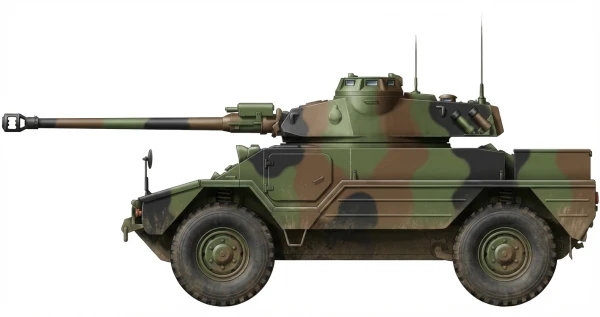
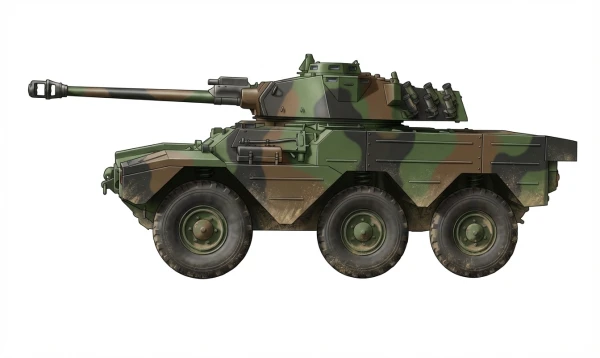
| AML-90 / Eland | ERC-90 Sagaie | |
|---|---|---|
| Origin country | 🇫🇷 France | 🇫🇷 France |
| Category | Light Armoured Vehicle | Light Armoured Vehicle |
| Type | Light Armored Vehicle | Reconnaissance armoured car |
| Manufacturer | Panhard | Panhard |
| Number produced | 4,812 units | 300 units |
| Estimated unit price | $-- million | $-- million |
| Combat weight | 5.5 tons | 8.3 tons |
| Maximum speed | 100 km/h | 100 km/h |
| Operational range | 600 km | 730 km |
| Length | 5.11 m | 7.69 m |
| Width | 1.97 m | 2.49 m |
| Height | 2.07 m | 2.25 m |
| Crew | 3 (commander, driver, gunner) | 3 |
| AML-90 / Eland | ERC-90 Sagaie | |
|---|---|---|
| Main armament | 90 mm D921/GIAT F1 (20 rounds) | 1 D921 F-1 90mm rifled barrel (20 shells) gun |
| Secondary weapon | 60mm Brandt mortar (53 rounds) | 1 NF-1 7.62mm machine gun (2000 rounds) |
| Engine | Panhard 1.99 L Model 4 HD flat 4-cylinder air-cooled petrol | V-6 Peugeot Petro Diesel Engine with 155 hp |
Detailed Comparison
The Panhard AML-90 and the ERC-90 Sagaie represent two generations of French wheeled armored fighting vehicles designed for reconnaissance and fire support. While the 4x4 AML-90 was engineered for counter-insurgency and rapid air deployment in the 1960s, the 6x6 ERC-90 Sagaie was developed in the late 1970s to provide heavier anti-tank capabilities and improved mobility for the French Fast Deployment Force. Both vehicles prioritize firepower and strategic mobility over heavy armor protection.
Development and Design
The AML-90 originated from a 1956 requirement for a light armored car, entering service in 1961. Its design features a 13-part welded hull on a 4x4 chassis with nitrogen run-flat tires. The vehicle is extremely compact, with a combat weight of only 5.5 tons. In contrast, Panhard developed the ERC-90 as a private venture, with the French Army adopting the Sagaie variant in 1980. The ERC utilizes a 6x6 configuration where the center wheels can be raised for road efficiency or lowered for off-road traction. Designed for Transall C-160 and C-130 transport, the ERC is fully amphibious, propelled by hydrojets, whereas the AML requires bridge or ferry support for water crossings.
Protection and Firepower
Both vehicles operate with a three-person crew (commander, gunner, driver). The AML-90 mounts a DEFA D921 90mm low-pressure rifled cannon. This weapon relies on chemical energy rounds, specifically fin-stabilized HEAT projectiles capable of penetrating 320mm of armor, to engage targets. The ERC-90 Sagaie offers superior ballistic performance through its CN90 F4 90mm smoothbore cannon mounted in a GIAT TS 90 turret. Unlike the AML's low-pressure system, the F4 fires high-velocity APFSDS (Armor-Piercing Fin-Stabilized Discarding Sabot) rounds, allowing it to engage main battle tanks more effectively. Both carry secondary 7.62mm machine guns, but the ERC's fire control and engagement range exceed that of the older AML.
Mobility and Logistics
The AML-90 is powered by a 1.99 L air-cooled flat-4 petrol engine, achieving speeds of 100 km/h with a range of 600 km. Its manual steering requires the vehicle to be in motion for effective maneuvering. The 8.3-ton ERC-90 retains the 100 km/h top speed but extends the operational range to 730 km. Initially equipped with a Peugeot V-6 petrol engine, French units were later upgraded to MTU diesel engines and Renk automatic gearboxes. The ERC's 6x6 suspension provides superior cross-country performance and load-bearing capacity compared to the AML's 4x4 layout.
Deployment and Combat Record
The AML-90 was exported to over fifty countries. Israeli forces utilized it effectively against T-54 and M48 tanks during the Six-Day War, and Argentine forces deployed it in the Falklands. It saw extensive use in the Lebanese Civil War and by the Irish Army in UNIFIL operations. The ERC-90 saw service in the Gulf War, Bosnia, and extensively in the Sahel (Chad, Mali) and Ivory Coast. While the AML-90 was phased out of French service, the ERC-90 remained active until 2022, serving as a primary reconnaissance asset for French expeditionary operations in Africa.
Conclusion
The AML-90 remains a cost-effective solution for asymmetric warfare and territorial defense in infrastructure-poor regions, leveraging its low weight and maintenance simplicity. The ERC-90 Sagaie serves as a more capable kinetic platform for conventional conflicts, offering the amphibious mobility and high-velocity anti-tank firepower required to threaten modern armored units.